| Osan-myeon Seongdeok-san Gwaneum-sa |
| Ancient, Ruined and Relatively Obscure Temple in Gokseong-gun County, South Jeolla Province one of the "Great 108" Korean temples |
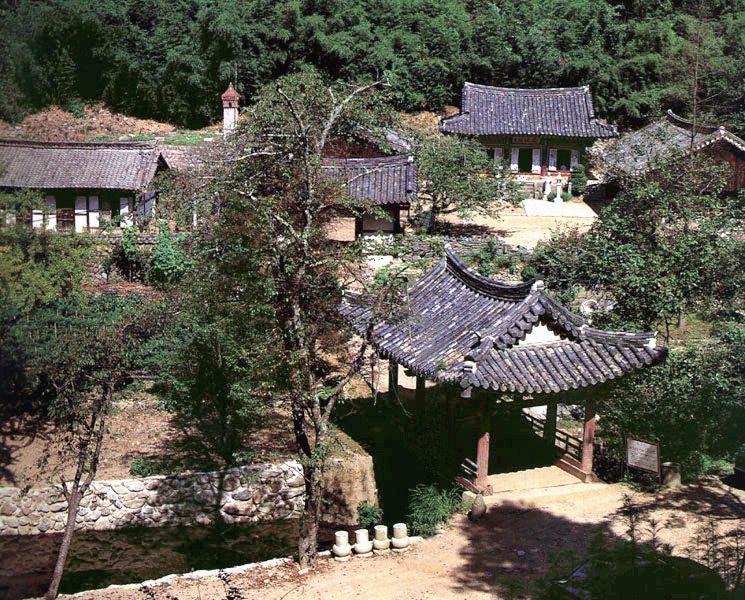
Seongdeok-san Gwaneum-sa [Saint-Virtue Mountain Bodhisattva of Compassion
Temple] is located in Seonsei-ri Village, Osan-myeon District, Gokseong-gun County of
Jeolla-namdo Province. It is purported to have founded around 300 CE during the reign of
the Baekje Kingdom's King Bunseo. If this is true, then it's one of Korea's oldest Buddhist
temples; but it cannot be verified -- Baekje is known to have adopted Buddhism in 384 CE.
It is said that a missionary-monk from China named Seongdeok (in Korean; this could be a
generic name "virtuous saint") brought a golden of Gwanse-eum-bosal the Bodhisattva of
Compassion [Geumdong Guanyin Bosal Sang] from "Naganan-po" (a port) to this place
(presumably after presenting it to the king), enshrined it here in a round-shaped hall called
the Wontong-jeon [圓通 殿, Circular Pass-through Hall, a shrine for circumambulating a
holy icon], and started a temple named Gwaneum-sa; later the mountain became named
after him.
We have no records of this monastery from the Three Kingdoms, Unified Shilla and Early
Goryeo eras (5th~13th centuries). King Gongmin, the last important ruler of the Goryeo
Dynasty, ordered and financed major renovations and expansion of it in 1374, according
to dynastic records. Experts say that the historic Wontong-jeon displayed characteristics
of late-Goryeo hanok architecture. It was badly damaged by Japanese invaders during
the 1592-98 Imjin War in the middle of the Joseon Dynasty, and then reconstructed
starting in 1604.
In modern times, Master Yeongdam repaired this temple in 1912 after it had suffered a
fire, but it was all burned down again during the 1950-53 Korean War -- and at that time,
the historic Wontong-jeon and its precious Geumdong Guanyin Bosal Sang were lost.
The 13 buildings that are now there are newly constructed since the 1970s, and it was
designated as Jeollanam-do's 24th Cultural Heritage Site in 1984; it is not designated
as a national site due to its lack of remaining physical history, but is still regarded as
significant enough to be on the list of Korea's Great-108 Temples.
Temple] is located in Seonsei-ri Village, Osan-myeon District, Gokseong-gun County of
Jeolla-namdo Province. It is purported to have founded around 300 CE during the reign of
the Baekje Kingdom's King Bunseo. If this is true, then it's one of Korea's oldest Buddhist
temples; but it cannot be verified -- Baekje is known to have adopted Buddhism in 384 CE.
It is said that a missionary-monk from China named Seongdeok (in Korean; this could be a
generic name "virtuous saint") brought a golden of Gwanse-eum-bosal the Bodhisattva of
Compassion [Geumdong Guanyin Bosal Sang] from "Naganan-po" (a port) to this place
(presumably after presenting it to the king), enshrined it here in a round-shaped hall called
the Wontong-jeon [圓通 殿, Circular Pass-through Hall, a shrine for circumambulating a
holy icon], and started a temple named Gwaneum-sa; later the mountain became named
after him.
We have no records of this monastery from the Three Kingdoms, Unified Shilla and Early
Goryeo eras (5th~13th centuries). King Gongmin, the last important ruler of the Goryeo
Dynasty, ordered and financed major renovations and expansion of it in 1374, according
to dynastic records. Experts say that the historic Wontong-jeon displayed characteristics
of late-Goryeo hanok architecture. It was badly damaged by Japanese invaders during
the 1592-98 Imjin War in the middle of the Joseon Dynasty, and then reconstructed
starting in 1604.
In modern times, Master Yeongdam repaired this temple in 1912 after it had suffered a
fire, but it was all burned down again during the 1950-53 Korean War -- and at that time,
the historic Wontong-jeon and its precious Geumdong Guanyin Bosal Sang were lost.
The 13 buildings that are now there are newly constructed since the 1970s, and it was
designated as Jeollanam-do's 24th Cultural Heritage Site in 1984; it is not designated
as a national site due to its lack of remaining physical history, but is still regarded as
significant enough to be on the list of Korea's Great-108 Temples.