| Gyeongju's Toham-san Bulguk-sa's Dabo-tap & Seokga-tap Yin-Yang Pair Pagodas of the Buddha-Kingdom Temple |
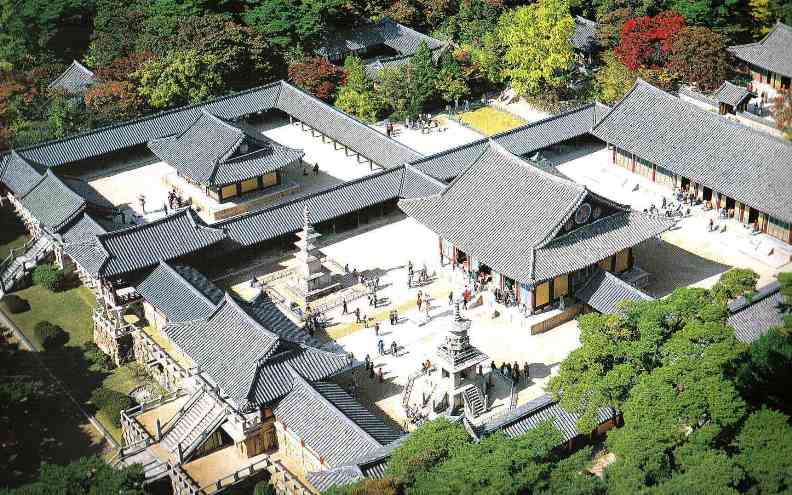

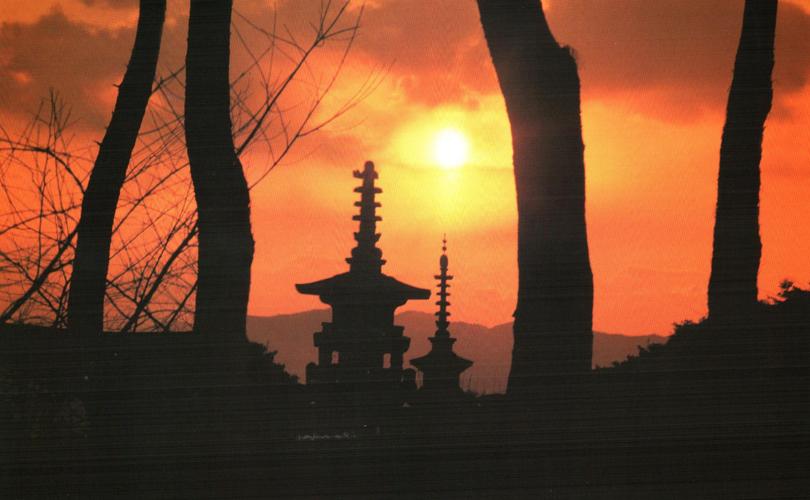
| Sunset over Bulguk-sa |
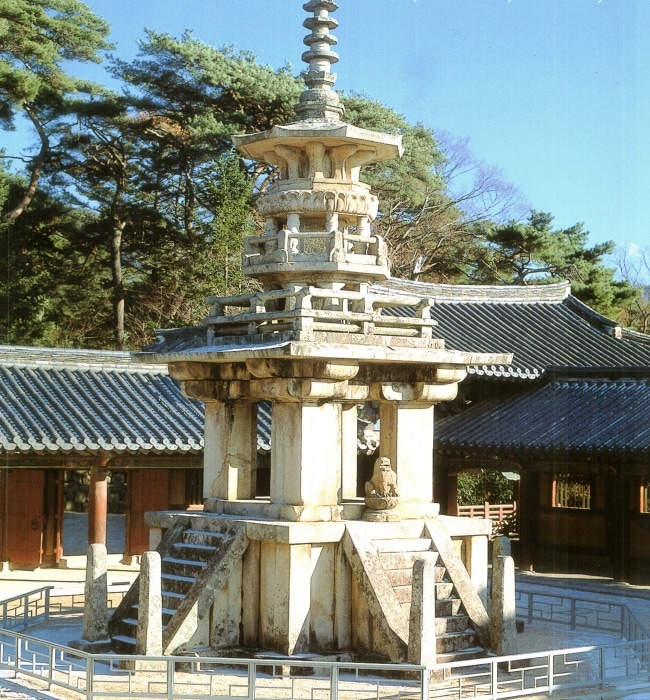
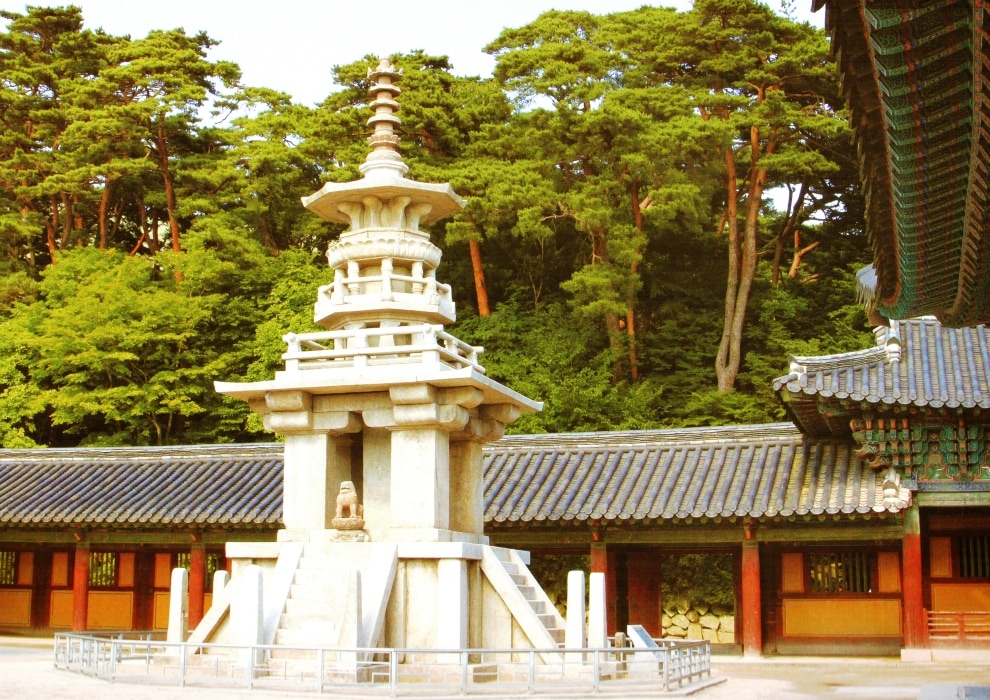
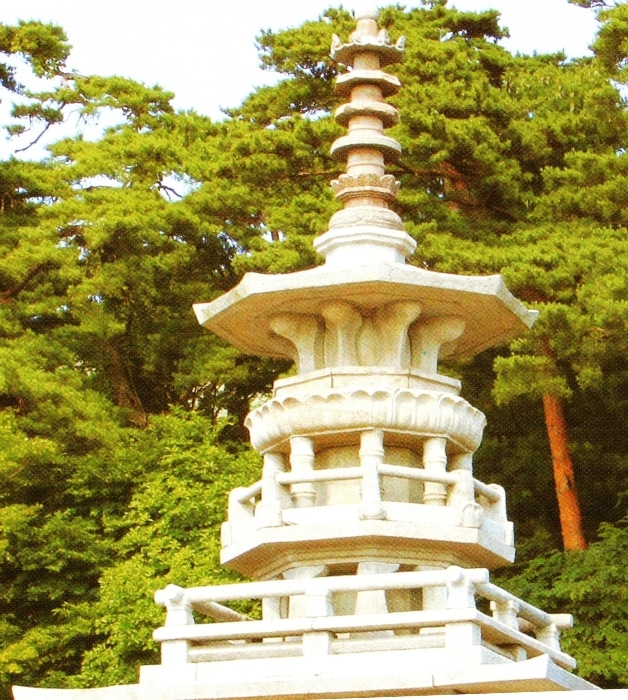
| Dabo-tap [Pagoda of Myriad Treasures] |
Bulguk-sa is probably the most heavily-visited Buddhist monastery in Korea, a favorite of tourists and
aficionados of ancient religious art. The Seokga-tap & Tabo-tap Pagodas are especially well-designed,
famous and magnificent -- each a supreme official National Treasure of Korea. They are a good part
of why Bulguk-sa is one of the Top-7 Temples of Korea.
aficionados of ancient religious art. The Seokga-tap & Tabo-tap Pagodas are especially well-designed,
famous and magnificent -- each a supreme official National Treasure of Korea. They are a good part
of why Bulguk-sa is one of the Top-7 Temples of Korea.
| Back to Bulguk-sa Page Next: Seokgul-am Grotto Toham-san index Page Gyeongju Sacred Mountains Page San-shin Site Contents Page |
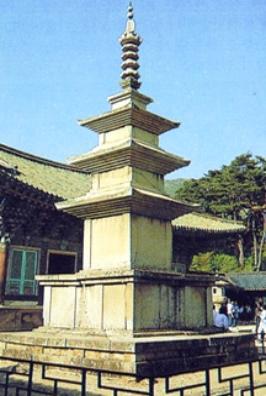
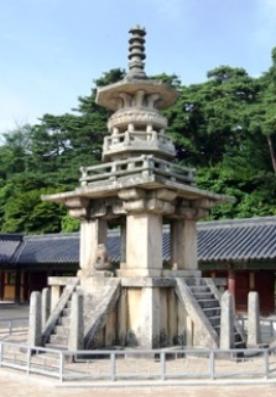
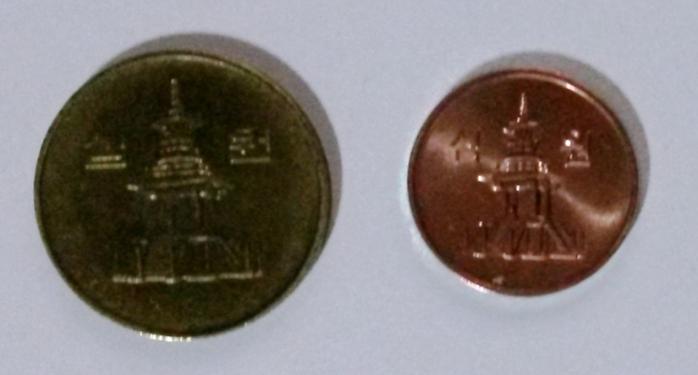
| Dabo-tap on the old and new 10-Won coins |
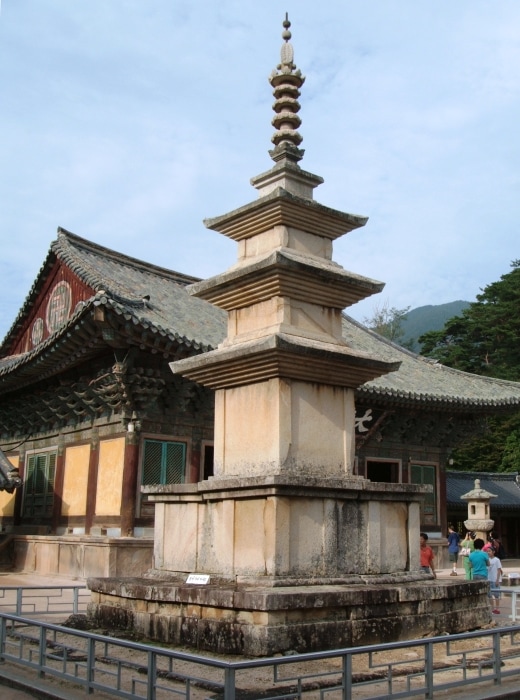
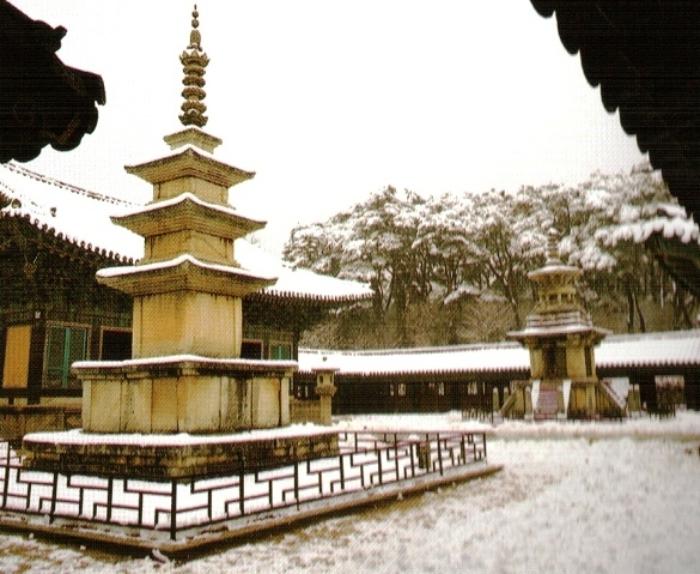
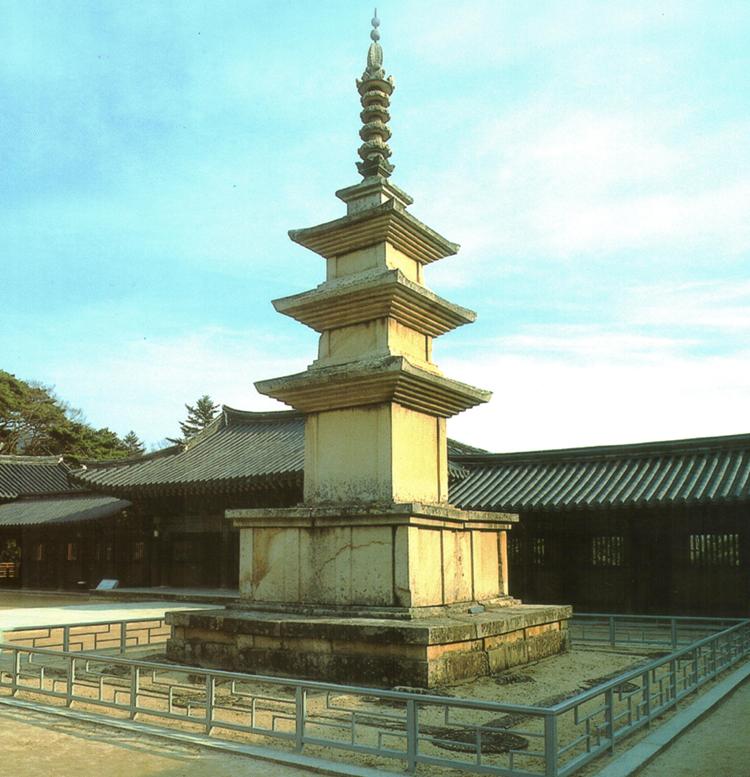
This 3-story seoktap (石塔, stone Buddhist pagoda) named the Seokga-tap [석가탑 釋迦塔,
Sakyamuni Buddha Pagoda] is widely regarded as the finest example of all early Korean seoktap.
It was built between 751 and 774 during the Unified Shilla Dynasty as part of Bulguk-sa Temple
under the inspiration and direction of Prime Minister Kim Dae-seong 金大城. It is famously paired
with the Dabo-tap as a eum-yang (yin 陰 and yang 陽) set in front of the beopdang [法堂, Main
Dharma Hall] in the main courtyard.
It is also called the Muyeong-tap (無影塔, Pagoda with No Reflection), denoting the sad legend of
a master stonemason named Asadal from the former Baekje Kingdom lands, who built the pagoda.
The Samguk Yusa (三國遺事, Legends and History of the Three Kingdoms, c. 1280) says that his
loyal wife Asanyeo waited by a pond near the south end of Gyeongju Nam-san for him to finish,
because it was taboo for him to see her before that, and she kept looking at the reflection of the
distant temple in the pond for the filial of this pagoda to be seen above the wall; when it failed to
appear by the scheduled time, she jumped into the pond and drowned.
The Seokga-tap is 8.2 meters tall and admired for its monumental but graceful style. Its three stories
are thought to symbolize both the Sambo (三寶, Three Treasures of Buddha, Dharma and Sangha)
and the fundamental Oriental-philosophy trinity of Cheon-Ji-In (天地人, Heaven, Earth & Humanity).
It represents Seokgamoni-bul (釋迦牟尼佛, Sakyamuni the historical Buddha) himself, hence its
name; and its undecorated austerity represents ascent of the human spirit towards the heavens
through simplicity, while in contrast the sophisticated Dabo-tap symbolizes the complexity of this
world. Many other interpretations of this pair have been made, including that Dabo-tap represents
objective truth while Seokga-tap represents subjective wisdom to realize it, and that the former is
eum (陰; dark, cold, soft, feminine, etc) and the latter is yang (陽; light, hot, hard, masculine, etc).
The scripture-based reason for building these two pagodas side-by-side in front of the Beopdang
follows the content of one section of the Beophwa-gyeong 法華經 or Lotus Sutra that the 'former
Buddha' Dabo-bul 多寶佛 or Prabhutaratna Buddha) is standing beside the 'present Buddha'
Sakyamuni during this lecture to verify and demonstrate that his sermon is correct. Therefore the
Dabo-tap stands parallel to Seokga-tap in front of Sakyamuni’s Hall, depicting that scene frozen in
permanent time, and all visitors to this temple can stand there in the courtyard between these grand
pagodas and be in-effect actually in attendance at the preaching of the Lotus Sutra. This set of
masterpieces expresses a profound section of Buddhist philosophy from a classical scripture in
highly refined granite symbolism, and also offers pilgrims direct experience of it; this demonstrates
the high level of artistic sophistication at the creators of the later Shilla era had attained, as well
as their amazing skill of execution of the architectural concepts.
The Seokga-tap was dismantled for repair in 1977 and a collection of precious treasures was
found inside, including a set of reliquary for sari (舍利, sarira, crystal post-cremation relics) and
a paper scroll of the True Words of Pure and Clean Light Scripture (無垢淨光大陀羅尼經), now
accepted as the oldest extant xylographic print in the world, printed between 706 and 751.
Seokga-tap was designated as National Treasure #21 as the Bulguk-sa Samcheung Seoktap,
beside its partner the Dabo-tap (National Treasure #20) and the rest of that temple’s ancient
stoneworks and bronze statues. Their superlative architecture is collectively regarded as one of
Korea’s finest and most representative creations, and were key reasons that Bulguk-sa became
the first place in Korea to be designated by UNESCO as a World Heritage Site in 1995.
Sakyamuni Buddha Pagoda] is widely regarded as the finest example of all early Korean seoktap.
It was built between 751 and 774 during the Unified Shilla Dynasty as part of Bulguk-sa Temple
under the inspiration and direction of Prime Minister Kim Dae-seong 金大城. It is famously paired
with the Dabo-tap as a eum-yang (yin 陰 and yang 陽) set in front of the beopdang [法堂, Main
Dharma Hall] in the main courtyard.
It is also called the Muyeong-tap (無影塔, Pagoda with No Reflection), denoting the sad legend of
a master stonemason named Asadal from the former Baekje Kingdom lands, who built the pagoda.
The Samguk Yusa (三國遺事, Legends and History of the Three Kingdoms, c. 1280) says that his
loyal wife Asanyeo waited by a pond near the south end of Gyeongju Nam-san for him to finish,
because it was taboo for him to see her before that, and she kept looking at the reflection of the
distant temple in the pond for the filial of this pagoda to be seen above the wall; when it failed to
appear by the scheduled time, she jumped into the pond and drowned.
The Seokga-tap is 8.2 meters tall and admired for its monumental but graceful style. Its three stories
are thought to symbolize both the Sambo (三寶, Three Treasures of Buddha, Dharma and Sangha)
and the fundamental Oriental-philosophy trinity of Cheon-Ji-In (天地人, Heaven, Earth & Humanity).
It represents Seokgamoni-bul (釋迦牟尼佛, Sakyamuni the historical Buddha) himself, hence its
name; and its undecorated austerity represents ascent of the human spirit towards the heavens
through simplicity, while in contrast the sophisticated Dabo-tap symbolizes the complexity of this
world. Many other interpretations of this pair have been made, including that Dabo-tap represents
objective truth while Seokga-tap represents subjective wisdom to realize it, and that the former is
eum (陰; dark, cold, soft, feminine, etc) and the latter is yang (陽; light, hot, hard, masculine, etc).
The scripture-based reason for building these two pagodas side-by-side in front of the Beopdang
follows the content of one section of the Beophwa-gyeong 法華經 or Lotus Sutra that the 'former
Buddha' Dabo-bul 多寶佛 or Prabhutaratna Buddha) is standing beside the 'present Buddha'
Sakyamuni during this lecture to verify and demonstrate that his sermon is correct. Therefore the
Dabo-tap stands parallel to Seokga-tap in front of Sakyamuni’s Hall, depicting that scene frozen in
permanent time, and all visitors to this temple can stand there in the courtyard between these grand
pagodas and be in-effect actually in attendance at the preaching of the Lotus Sutra. This set of
masterpieces expresses a profound section of Buddhist philosophy from a classical scripture in
highly refined granite symbolism, and also offers pilgrims direct experience of it; this demonstrates
the high level of artistic sophistication at the creators of the later Shilla era had attained, as well
as their amazing skill of execution of the architectural concepts.
The Seokga-tap was dismantled for repair in 1977 and a collection of precious treasures was
found inside, including a set of reliquary for sari (舍利, sarira, crystal post-cremation relics) and
a paper scroll of the True Words of Pure and Clean Light Scripture (無垢淨光大陀羅尼經), now
accepted as the oldest extant xylographic print in the world, printed between 706 and 751.
Seokga-tap was designated as National Treasure #21 as the Bulguk-sa Samcheung Seoktap,
beside its partner the Dabo-tap (National Treasure #20) and the rest of that temple’s ancient
stoneworks and bronze statues. Their superlative architecture is collectively regarded as one of
Korea’s finest and most representative creations, and were key reasons that Bulguk-sa became
the first place in Korea to be designated by UNESCO as a World Heritage Site in 1995.
The Dabo-tap 다보탑, 多寶塔 or Myriad Treasures Pagoda is the single most-famous pagoda in
Korea, a supreme national treasure considered one of the most excellent and interesting ancient
structures in East Asia, if not the world. It is depicted on the 10-won coin since the 1970s, the only
obviously Buddhist symbol appearing on the currency of the Republic of Korea. This is the eastern
of a contrasting but complimentary pair of large granite pagodas that stand in the main courtyard of
Bulguk-sa. It was constructed along with its eum-yang (陰陽, yin-yang, complimentary-balancing)
partner the Seokga-tap and the rest of that temple’s ancient stoneworks and bronze statues under
the inspiration and direction of high-ranking Minister Kim Dae-seong between 751 and 774 CE, and
their monumental architecture is collectively regarded as one of Korea’s finest and most representative
creations. Designated as National Treasure #20, Dabo-tap is a key reason that Bulguk-sa became
the first place in Korea to be designated by UNESCO as a World Heritage Site in 1995.
Dabo-tap stands 10.4 meters tall, and its fame results from its extremely complex and delicate
structure, its overall design that is unique in the global history of religious art. Experts have differing
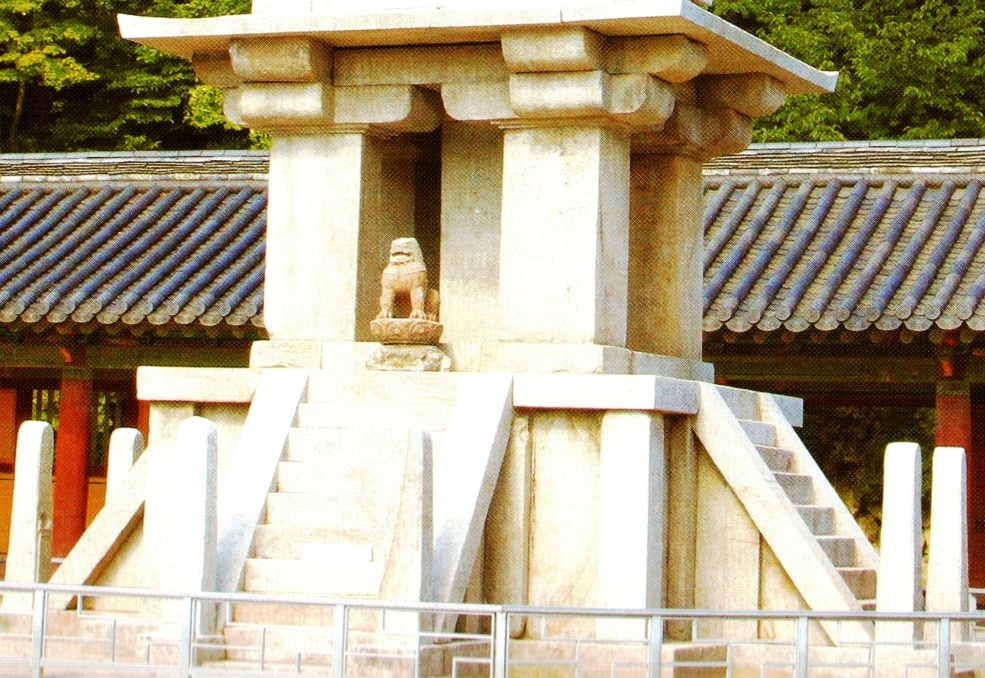
opinions about its interpretation; even on how many stories it has (3 or 4). At the square base are
four sets of steps, originally with railings (although now only the lower posts remain), each with ten
steps signifying the ten Bara-mil (波羅蜜, Perfections or Paramitas); there are four to represent
access to the Dharma from all of the four directions, meaning universally (this is a theme from early
Buddhist and imperial monument-designs in India). These stairs led up to four sitting stone lions on
the main platform, symbolizing guardians of wisdom in Buddhism (although now only one of those
remains; the others disappeared during the 1925-27 Japanese colonial restoration project). Standing
on the square platform-base (four sides representing the Four Noble Truths) above the lions are
several octagonal pagoda-body sections featuring eight bamboo joint-shaped stone pillars
(representing the Eightfold Noble Path) supporting a round lotus-flower platform (like those that
Buddha statues sit upon), surrounded by square guard-rails, topped by a curved octagonal roof
and elaborate round lotus-flowers finial decorations (in original complete condition, which is rare
for a Silla Kingdom Pagoda).
The progression downwards from the round summit through octagonal structures to the basic square
shape is thought to symbolize the fundamental Oriental-philosophy trinity of Cheon-Ji-In [天地人,
Heaven, Earth & Humanity], respectively, in a way that reflects Buddhist ideology, as the myriad bo
[寶, jewels or treasures) of Buddha-Dharma flow down from Heaven through humanity to the earth.
The austere Seokga-tap in contrast represents ascent of the human spirit towards the heavens
through simplicity, while the sophisticated Dabo-tap symbolizes the complexity of this world. Many
other interpretations of this pair have been made, including that Dabo-tap represents objective truth
while Seokga-tap represents subjective wisdom to realize it, and that the Dabo-tap is eum (陰, dark;
cold; soft; feminine; etc) and the Seokga-tap is yang (陽, light; hot; hard; masculine; etc).
Korea, a supreme national treasure considered one of the most excellent and interesting ancient
structures in East Asia, if not the world. It is depicted on the 10-won coin since the 1970s, the only
obviously Buddhist symbol appearing on the currency of the Republic of Korea. This is the eastern
of a contrasting but complimentary pair of large granite pagodas that stand in the main courtyard of
Bulguk-sa. It was constructed along with its eum-yang (陰陽, yin-yang, complimentary-balancing)
partner the Seokga-tap and the rest of that temple’s ancient stoneworks and bronze statues under
the inspiration and direction of high-ranking Minister Kim Dae-seong between 751 and 774 CE, and
their monumental architecture is collectively regarded as one of Korea’s finest and most representative
creations. Designated as National Treasure #20, Dabo-tap is a key reason that Bulguk-sa became
the first place in Korea to be designated by UNESCO as a World Heritage Site in 1995.
Dabo-tap stands 10.4 meters tall, and its fame results from its extremely complex and delicate
structure, its overall design that is unique in the global history of religious art. Experts have differing
opinions about its interpretation; even on how many stories it has (3 or 4). At the square base are
four sets of steps, originally with railings (although now only the lower posts remain), each with ten
steps signifying the ten Bara-mil (波羅蜜, Perfections or Paramitas); there are four to represent
access to the Dharma from all of the four directions, meaning universally (this is a theme from early
Buddhist and imperial monument-designs in India). These stairs led up to four sitting stone lions on
the main platform, symbolizing guardians of wisdom in Buddhism (although now only one of those
remains; the others disappeared during the 1925-27 Japanese colonial restoration project). Standing
on the square platform-base (four sides representing the Four Noble Truths) above the lions are
several octagonal pagoda-body sections featuring eight bamboo joint-shaped stone pillars
(representing the Eightfold Noble Path) supporting a round lotus-flower platform (like those that
Buddha statues sit upon), surrounded by square guard-rails, topped by a curved octagonal roof
and elaborate round lotus-flowers finial decorations (in original complete condition, which is rare
for a Silla Kingdom Pagoda).
The progression downwards from the round summit through octagonal structures to the basic square
shape is thought to symbolize the fundamental Oriental-philosophy trinity of Cheon-Ji-In [天地人,
Heaven, Earth & Humanity], respectively, in a way that reflects Buddhist ideology, as the myriad bo
[寶, jewels or treasures) of Buddha-Dharma flow down from Heaven through humanity to the earth.
The austere Seokga-tap in contrast represents ascent of the human spirit towards the heavens
through simplicity, while the sophisticated Dabo-tap symbolizes the complexity of this world. Many
other interpretations of this pair have been made, including that Dabo-tap represents objective truth
while Seokga-tap represents subjective wisdom to realize it, and that the Dabo-tap is eum (陰, dark;
cold; soft; feminine; etc) and the Seokga-tap is yang (陽, light; hot; hard; masculine; etc).