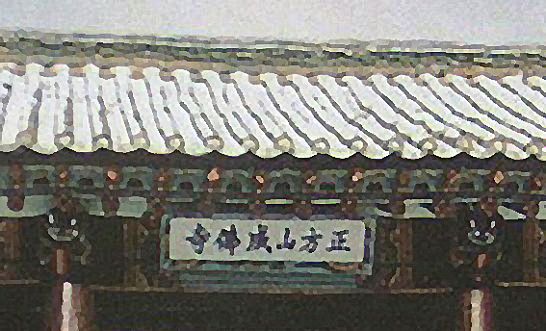
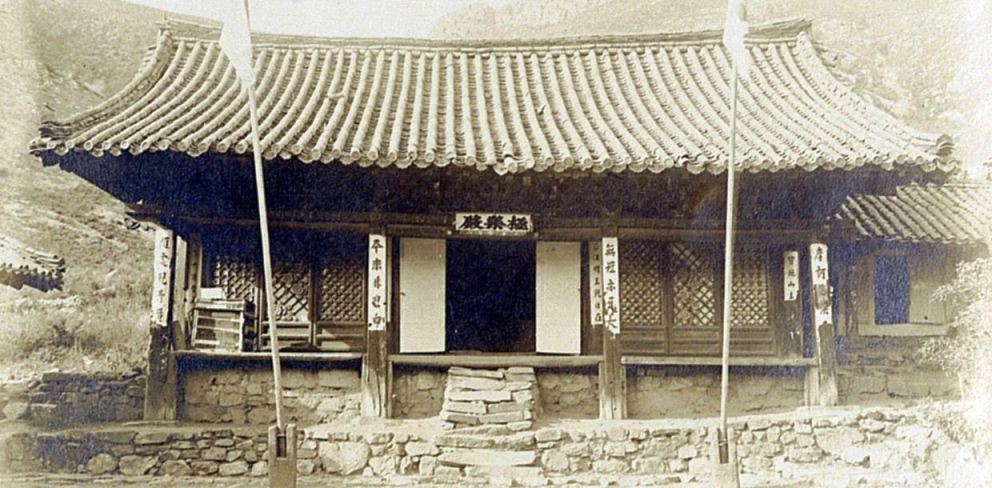
| Jeongbang-san Seongbul-sa 成佛寺 정방산 성불사 Buddhist Temple of Hwanghae-do, North Korea |
Seongbul-sa is an ancient Korean Buddhist temple within an old fortress on Mt. Jeongbang
-san, in Sariwŏn County of North Hwanghae Province of North Korea. It was founded in 898,
right near the end of the Unified Shilla Dynasty when all Korea was in violent chaos due to
rebellions and governmental-breakdown, approaching civil war. It became important in the
subsequent Goryeo Dynasty 935-1392.
-san, in Sariwŏn County of North Hwanghae Province of North Korea. It was founded in 898,
right near the end of the Unified Shilla Dynasty when all Korea was in violent chaos due to
rebellions and governmental-breakdown, approaching civil war. It became important in the
subsequent Goryeo Dynasty 935-1392.
From North Korea's KCNA propaganda-website in 2005: Songbul Temple in DPRK
Pyongyang, August 3 (KCNA) -- Songbul Temple built in 898 is located in the fort on Mt. Jongbang
in Sariwon city, North Hwanghae Province, the Democratic People's Republic of Korea. It consists
of 6 buildings--Ungjin, Kukrak, Myongbu and Unha halls and Chongphung and Sansin pavilions
with a five-storied pagoda in the centre.
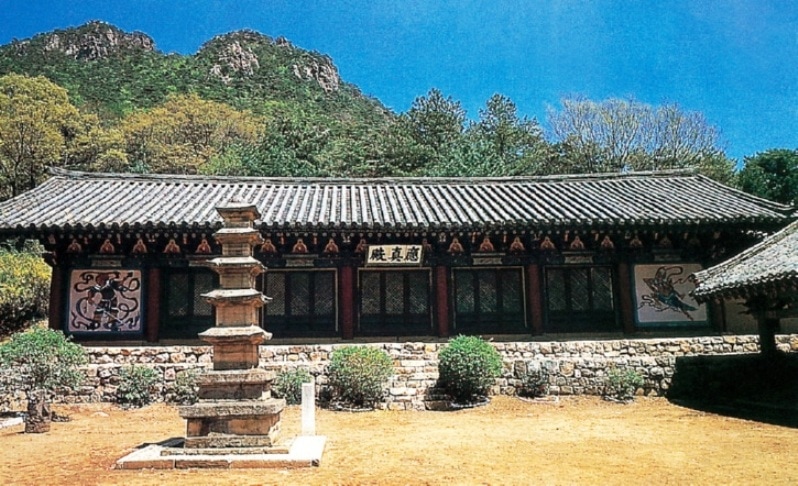
The Ungjin hall is one of the oldest remaining wooden buildings in the country. It, belonging to
the period of Koryo (918-1392), was rebuilt in 1327 Though nearly 700 years has passed since
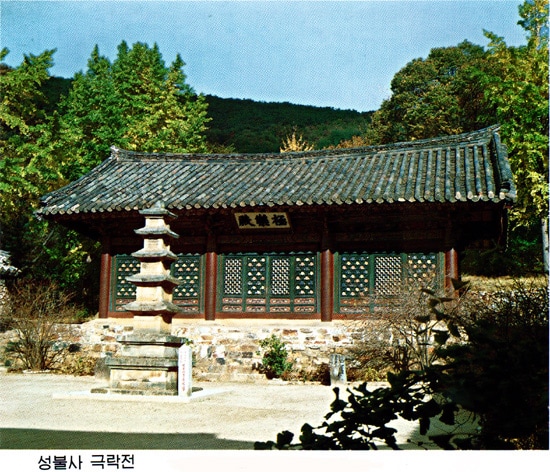
its reconstruction, its colorful painting remains unchanged. The Kukrak hall, which was built in
898 and rebuilt in 1376, was burnt out by the U.S. imperialist aggressors' bombing during the
Fatherland Liberation War. The present one was constructed as it was in Juche 45 (1956).
The Ungjin and Kukrak halls are worthy of studying the medieval architecture as they reflect
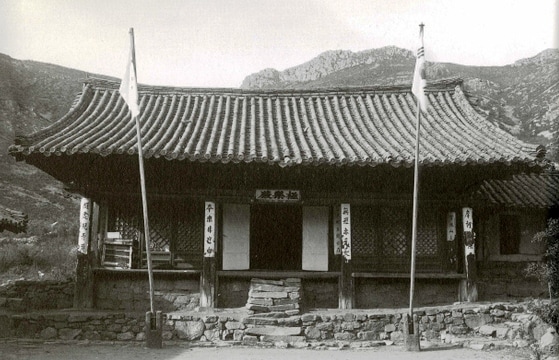
the variety of architecture of Koryo. The Myongbu hall was built in 1711. Its interior beams
painted during the Ri Dynasty still keep its original color.
There remain in Chongphung pavilion, the front gate of the Temple, a bell and woodcarvings
depicting fish which were used in Buddhist rite during the Ri Dynasty. The Unha hall and
Sansin pavilion are buildings where monks lived and studied.
Lots of people visit the temple, enjoying their holidays in Mt. Jongbang which has turned
into a pleasure ground under the wise leadership of President Kim Il Sung and Kim Jong Il.
Pyongyang, August 3 (KCNA) -- Songbul Temple built in 898 is located in the fort on Mt. Jongbang
in Sariwon city, North Hwanghae Province, the Democratic People's Republic of Korea. It consists
of 6 buildings--Ungjin, Kukrak, Myongbu and Unha halls and Chongphung and Sansin pavilions
with a five-storied pagoda in the centre.
The Ungjin hall is one of the oldest remaining wooden buildings in the country. It, belonging to
the period of Koryo (918-1392), was rebuilt in 1327 Though nearly 700 years has passed since
its reconstruction, its colorful painting remains unchanged. The Kukrak hall, which was built in
898 and rebuilt in 1376, was burnt out by the U.S. imperialist aggressors' bombing during the
Fatherland Liberation War. The present one was constructed as it was in Juche 45 (1956).
The Ungjin and Kukrak halls are worthy of studying the medieval architecture as they reflect
the variety of architecture of Koryo. The Myongbu hall was built in 1711. Its interior beams
painted during the Ri Dynasty still keep its original color.
There remain in Chongphung pavilion, the front gate of the Temple, a bell and woodcarvings
depicting fish which were used in Buddhist rite during the Ri Dynasty. The Unha hall and
Sansin pavilion are buildings where monks lived and studied.
Lots of people visit the temple, enjoying their holidays in Mt. Jongbang which has turned
into a pleasure ground under the wise leadership of President Kim Il Sung and Kim Jong Il.
| Photo by David Stanley, CC BY 3.0, https://commons.wikimedia.org/w/index.php?curid=53129575 |
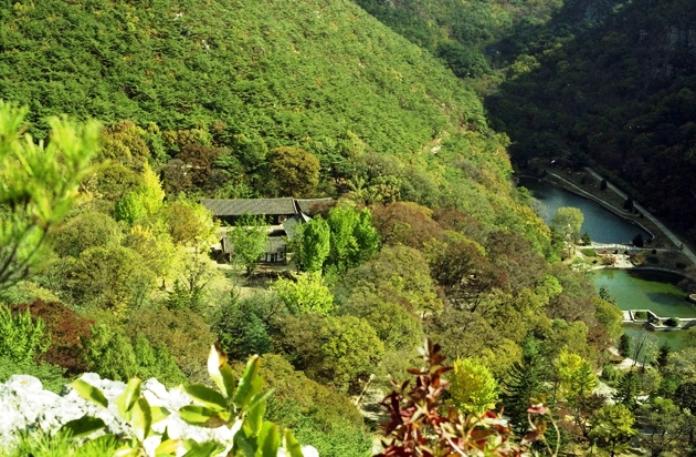
The complex was historically much larger, but now consists of six buildings, some of which
are claimed to be among the oldest wooden buildings in that nation. These include the
Geukrak Hall (극락전/極樂殿), which was last rebuilt in 1374, standing on a raised stone
platform and featuring excellent late-Goryeo paintings, cow-tongue eaves, and doors with
carved flower grilles. Also the Ungjin Hall (웅진전/雄津殿), said to have last been rebuilt in
1327 and therefore claimed to be the very oldest wooden building in North Korea, is a long,
spacious hall called "a paradigm of Goryeo architecture." The other surviving buildings are
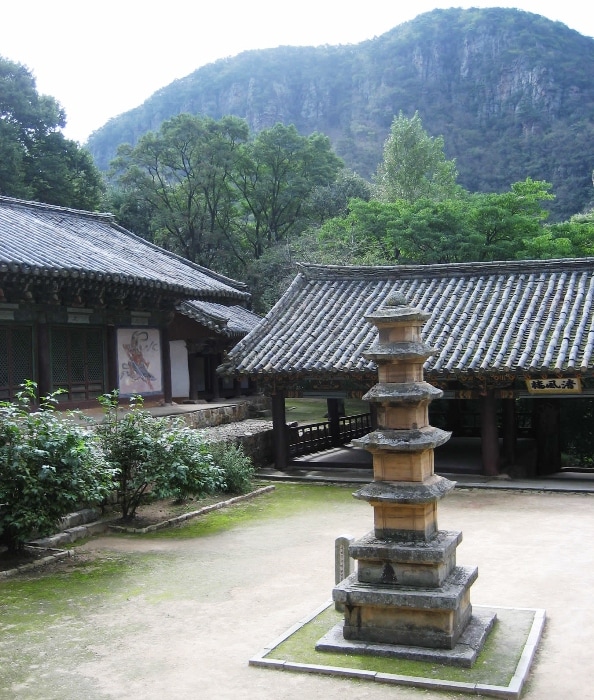
a Myeongbu-jeon [Funeral Hall, 명부전/冥府殿]; the Cheongpung Entrance-Pavilion
(청풍루/清風樓); the Unha Shrine (운하당/雲霞堂), and a Sanshin-gak [Mountain-spirit
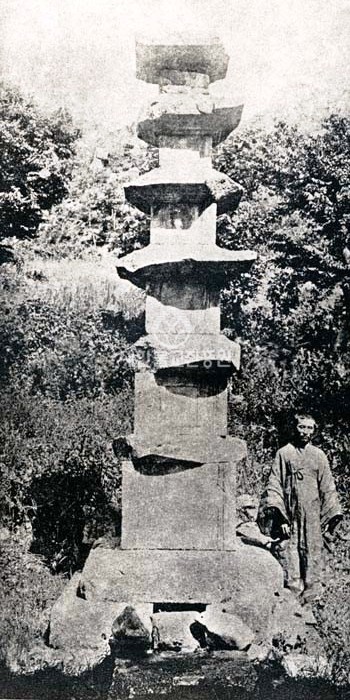
Shrine, 산신각/山神閣]. An early Goryeo period five-story stone pagoda stands in the
middle of the courtyard these buildings surround. It is listed as one of the 108 Greatest
Temples in all Korea by the Jogye Order.
are claimed to be among the oldest wooden buildings in that nation. These include the
Geukrak Hall (극락전/極樂殿), which was last rebuilt in 1374, standing on a raised stone
platform and featuring excellent late-Goryeo paintings, cow-tongue eaves, and doors with
carved flower grilles. Also the Ungjin Hall (웅진전/雄津殿), said to have last been rebuilt in
1327 and therefore claimed to be the very oldest wooden building in North Korea, is a long,
spacious hall called "a paradigm of Goryeo architecture." The other surviving buildings are
a Myeongbu-jeon [Funeral Hall, 명부전/冥府殿]; the Cheongpung Entrance-Pavilion
(청풍루/清風樓); the Unha Shrine (운하당/雲霞堂), and a Sanshin-gak [Mountain-spirit
Shrine, 산신각/山神閣]. An early Goryeo period five-story stone pagoda stands in the
middle of the courtyard these buildings surround. It is listed as one of the 108 Greatest
Temples in all Korea by the Jogye Order.