| Samseong-gung -- Three Sages Palace Korea's Daoist Utopia in the SW part of Cheonghak-dong [Azure-Crane Village] in the Far-South (Hadong-gun, below Samshin-bong) Sector of Jiri-san |
Next Page: Special Dances and Rituals
of the 1993 Cheonje Festival
Jiri-san Intro/Index Page
San-shin Site Contents
of the 1993 Cheonje Festival
Jiri-san Intro/Index Page
San-shin Site Contents
| the 1993 Cheonje Festival |
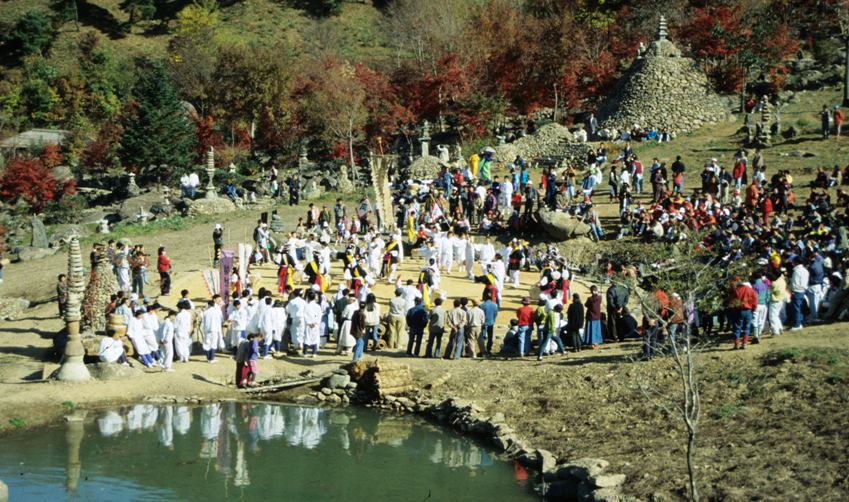
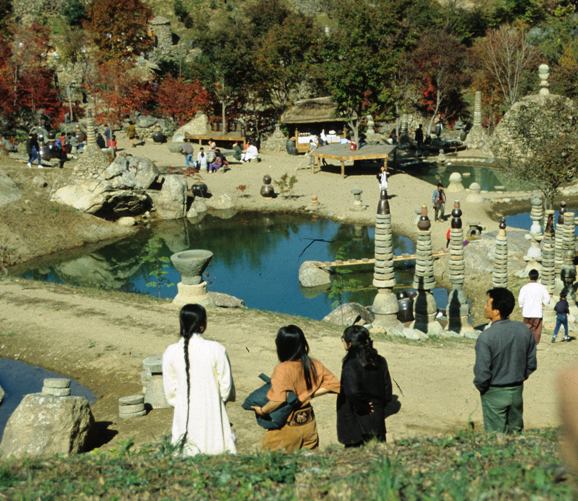
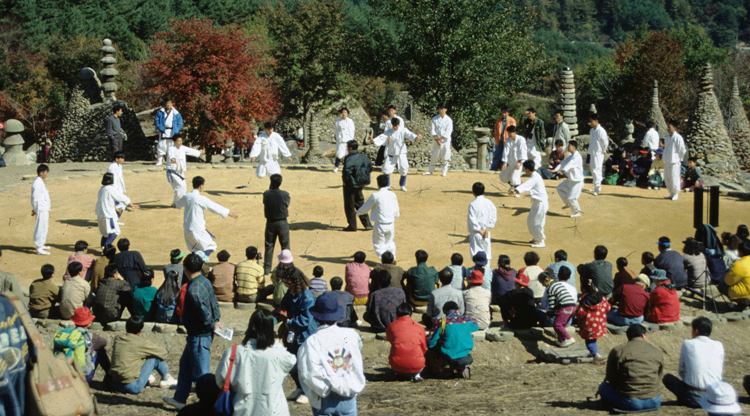
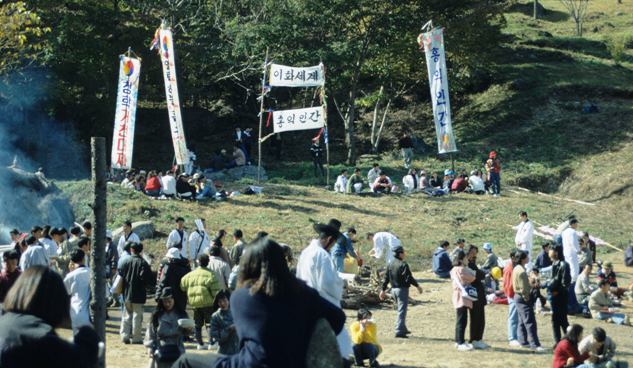
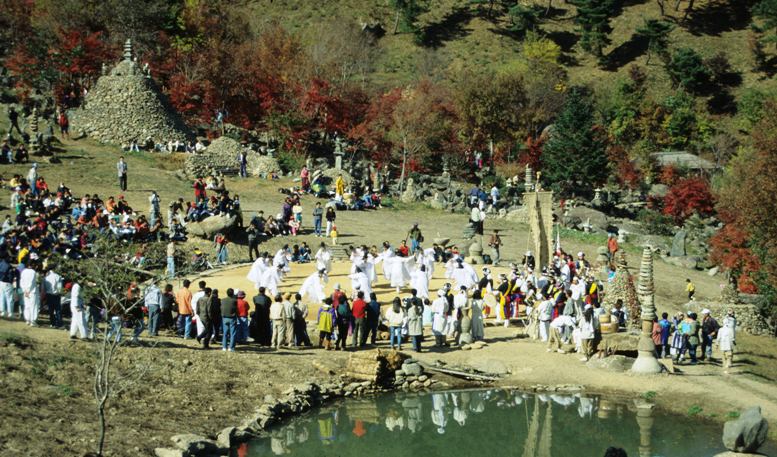
Cheonje means "Heavenly Ritual", or "Ceremony for Heaven". Cheonje have been held by Koreans
since the dawn of their history more than 2000 years ago -- their ancestors riding in from Siberian / Mongolian
origins were probably originally Sun-worshipers, a cult that developed into more general ritual-worship of the
entire range of Heavenly spirits now represented in Shamanism and Daoism (with some carryover to Korea's
Buddhist and Neo-Confucian arts as well). Cheonje were once presided over by the shaman-kings of early
proto-nations on this peninsula, and then by the kings of the royal dynasties or their representatives. After
being banned in the early decades of the 20th Century by the Japanese colonialists who sought to weaken
their Korean subject's national pride and native spirituality, they were revived in the post-Korean-War era and
transformed into public festivals of nationalistic traditional culture. The largest of these dramatic, unique and
fascinating events are now held at Taebaek-san, Mani-san and here at Jiri-san's Three Sages Palace.
since the dawn of their history more than 2000 years ago -- their ancestors riding in from Siberian / Mongolian
origins were probably originally Sun-worshipers, a cult that developed into more general ritual-worship of the
entire range of Heavenly spirits now represented in Shamanism and Daoism (with some carryover to Korea's
Buddhist and Neo-Confucian arts as well). Cheonje were once presided over by the shaman-kings of early
proto-nations on this peninsula, and then by the kings of the royal dynasties or their representatives. After
being banned in the early decades of the 20th Century by the Japanese colonialists who sought to weaken
their Korean subject's national pride and native spirituality, they were revived in the post-Korean-War era and
transformed into public festivals of nationalistic traditional culture. The largest of these dramatic, unique and
fascinating events are now held at Taebaek-san, Mani-san and here at Jiri-san's Three Sages Palace.
These Cheonje Festivals used to be only held on October 3rd, the government-designated Gaecheon-jeol
[Opening of Heaven Day], traditionally said to be the day upon which Hwaneung (son of Hwanin the Lord of
Heaven) descended onto the peak of mythical Taebaek-san [Grand White Mountain]. Due to its devotion to
restoring the authenticity of Korea's cultural traditions, the Samseong-gung began holding Cheonje on the
"real Gaecheon-jeol", the Third Day of the Tenth Moon by the Oriental Lunar Calendar. By now this practice
has spread to the two other holy mountains (see this page), and Samseong-gung's event has become one of
Jiri-san's biggest annual events. In the early 1990s I was usually the only foreigner ever present at them; by
now these festivals are announced on the Hadong County tourism website, and many international citizens
attend along with thousands of Koreans. The Daoists living here are glad to share their culture with visitors.
[Opening of Heaven Day], traditionally said to be the day upon which Hwaneung (son of Hwanin the Lord of
Heaven) descended onto the peak of mythical Taebaek-san [Grand White Mountain]. Due to its devotion to
restoring the authenticity of Korea's cultural traditions, the Samseong-gung began holding Cheonje on the
"real Gaecheon-jeol", the Third Day of the Tenth Moon by the Oriental Lunar Calendar. By now this practice
has spread to the two other holy mountains (see this page), and Samseong-gung's event has become one of
Jiri-san's biggest annual events. In the early 1990s I was usually the only foreigner ever present at them; by
now these festivals are announced on the Hadong County tourism website, and many international citizens
attend along with thousands of Koreans. The Daoists living here are glad to share their culture with visitors.
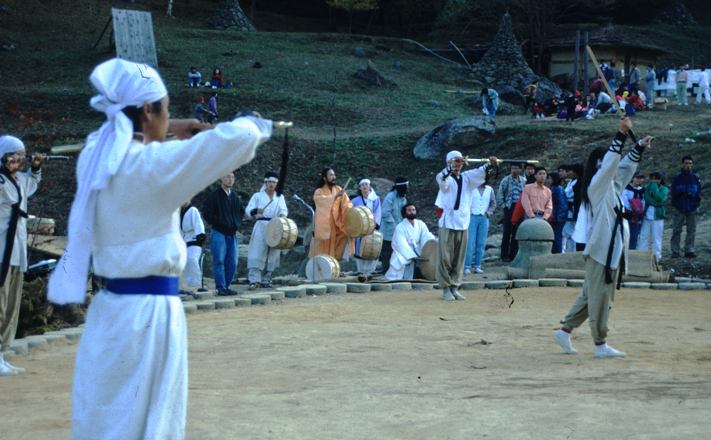
| Master Ham Pil, in natural-dyed ochre robes, leads the drumming for his student's Sword-Dance |
| a Taekwondo-type-martial-arts-based dance |
Several of the banners here read "Hong-ik in-gwan" [to Bring Benefit to Humanity],
the philosophy under which Hwaneung founded a "spiritual city" on Taebaek-san
and his son Dan-gun Wanggeom founded the first Korean kingdom (known as
Gojoseon) in the valleys below it, according to Korea's oldest mythologies of its
origins. This rather Confucian doctrine of the purpose of government is said to be
the root of all ancient Korean thought, and still the guiding principle of the nation.
the philosophy under which Hwaneung founded a "spiritual city" on Taebaek-san
and his son Dan-gun Wanggeom founded the first Korean kingdom (known as
Gojoseon) in the valleys below it, according to Korea's oldest mythologies of its
origins. This rather Confucian doctrine of the purpose of government is said to be
the root of all ancient Korean thought, and still the guiding principle of the nation.