"At this time, locals of Sicheon-myeon District of Mountain-Azure County [Sancheong-gun]
with all their hearts have produced this new statue of our Holy Mother here in Center-of-
Mountains Village [Jungsan-ri], bigger than the original one. They installed it in the present
location on August 6th, 2000, and established it as a monument of our wish for re-unification,
defense of the fatherland and national prosperity."
{translation by Lim Jeong-suk, with stylistic corrections by myself}.
with all their hearts have produced this new statue of our Holy Mother here in Center-of-
Mountains Village [Jungsan-ri], bigger than the original one. They installed it in the present
location on August 6th, 2000, and established it as a monument of our wish for re-unification,
defense of the fatherland and national prosperity."
{translation by Lim Jeong-suk, with stylistic corrections by myself}.
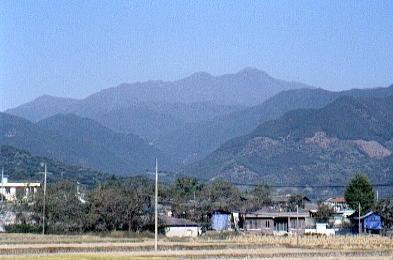
| The eastern side of Jiri-san, seen from Highway 20 in 1998 |
Jiri-san is frequently said to have eum [feminine]
type of earth-energy due to its gentle rounded
shape, as opposed to more yang [masculine]
sharp & craggy mountains such as Sorak-san.
However, the shape or appearance of a mountain
does not determine the gender of its San-shin in
any simple way -- witness Gyeryong-san (named
for its resemblance to a cockscomb atop a
winding dragon), which is as sharp and craggy
as any mountain anywhere, yet is also widely
believed to have a female San-shin. Everyone
that I have spoken to on several visits there
agrees that the Gyeryong-sanshin is female, but
many of the San-shin taeng-hwa I photographed
there depicted it as the usual old man. This is not
really surprising, and is not a contradiction for the
traditional Korean mind.
type of earth-energy due to its gentle rounded
shape, as opposed to more yang [masculine]
sharp & craggy mountains such as Sorak-san.
However, the shape or appearance of a mountain
does not determine the gender of its San-shin in
any simple way -- witness Gyeryong-san (named
for its resemblance to a cockscomb atop a
winding dragon), which is as sharp and craggy
as any mountain anywhere, yet is also widely
believed to have a female San-shin. Everyone
that I have spoken to on several visits there
agrees that the Gyeryong-sanshin is female, but
many of the San-shin taeng-hwa I photographed
there depicted it as the usual old man. This is not
really surprising, and is not a contradiction for the
traditional Korean mind.
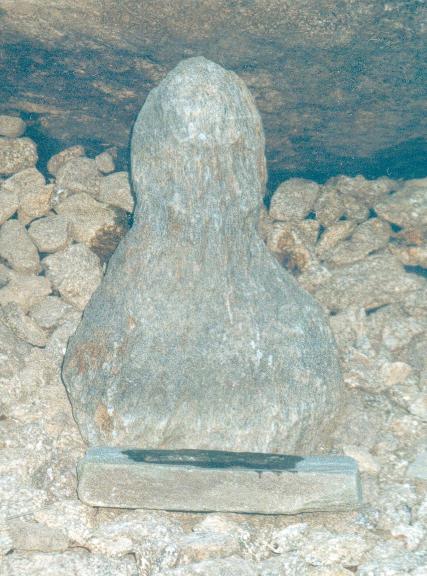
| Above: the uncarved granite statue found after a dream of Her by the Master of the Three Sages Palace, and enshrined as their San-shin icon. |
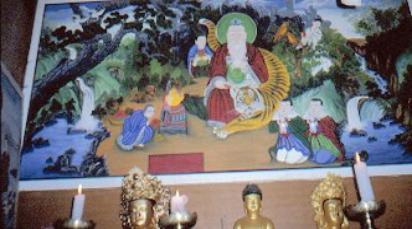
the San-shin painting at Yaksu-sa [Healing Waters
Temple] another small, strange place in the alpine
Beobgye-sa Ipgu area. Note the Buddha and two
Bodhisattva statues in front of it! It's fairly normal,
except for the *5* attendants -- 4 boys up front and a
white-robed girl in the bushes behind -- never seen
that before, and not sure who she is supposed to be.
Temple] another small, strange place in the alpine
Beobgye-sa Ipgu area. Note the Buddha and two
Bodhisattva statues in front of it! It's fairly normal,
except for the *5* attendants -- 4 boys up front and a
white-robed girl in the bushes behind -- never seen
that before, and not sure who she is supposed to be.
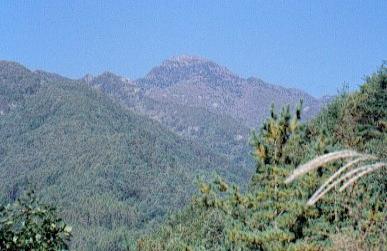
| Jiri-san's Cheon-hwang-bong, viewed from the Beobgye-sa Trailhead area to the southeast. At 1915 meters, this is the highest peak in mainland South Korea |
| More photos of icons of this important Mountain- Goddess have been posted on my pages about Ssanggye-sa, Guksa-am, Daewon-sa, the Naedaecheon Shrines and Jeonggak-sa. |