NEXT PAGE in this SECTION (Far-Northeast -- Sancheong County):
Eunseok-bong the Bear-Stone Mountain
[not yet put up]
NEXT SECTION: Byeoksong-sa and Seo-am --->
Jiri-san Intro/Index Page
San-shin Site Contents
.
Eunseok-bong the Bear-Stone Mountain
[not yet put up]
NEXT SECTION: Byeoksong-sa and Seo-am --->
Jiri-san Intro/Index Page
San-shin Site Contents
.
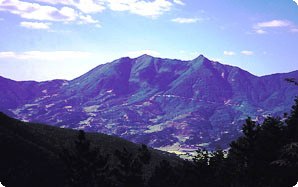
| Wang-san The pyramidal "King's Mountain" with Tomb of Gaya King Guhyeong, in Geumseo-myeon District of Sancheong County 923m summit, and including Pilbong-san 858m to its east in the Far-Northeast (Central Sancheong County) Sector of Jiri-san |
| Wangsan and Pilbongsan stand high in Geumseo-myeon, Sancheong-gun. The tomb of King Guhyeong of Garak Kingdom, who had to watch the fall of his kingdom is in Wangsan. Another important site in Wangsang is Sadae. Kim Yusin, who played a major role in the unification of three kingdoms, practiced archery there. Because of these stories, the mountain is called Wangsan. And Pilbongsan represents Sancheong as a home of scholars. Jirisan has more stories related to Garak Kingdom than many people expect. Gitdaebong that connects Wangsan and Jirisan, Wangdeungjae with the remains of old fortress, and Gukgol near Chilseon valley with a legend related to Garak Kingdom are all related to Garak Kingdom. It is said that a flag symbolizing Garak Kingdom was placed on Gitdaebong. And Wangdeungjae was named such because a king climbed it. The remains of old fortress still exist in the mountain. And Gukgol means a valley where a kingdom lived. Place names like 'Dujiteo‘ meaning the place of grain storage, and 'Eoleumteo' meaning the place of ice storage are still used. It is said that the name of Chuseong-ri at the entrance of Chilseon valley was taken from the name of Chuseong mountain fortress in Gukgol. Most of the history of Garak Kingdom has been lost, but some of it still remains in Jirisan as legends. |
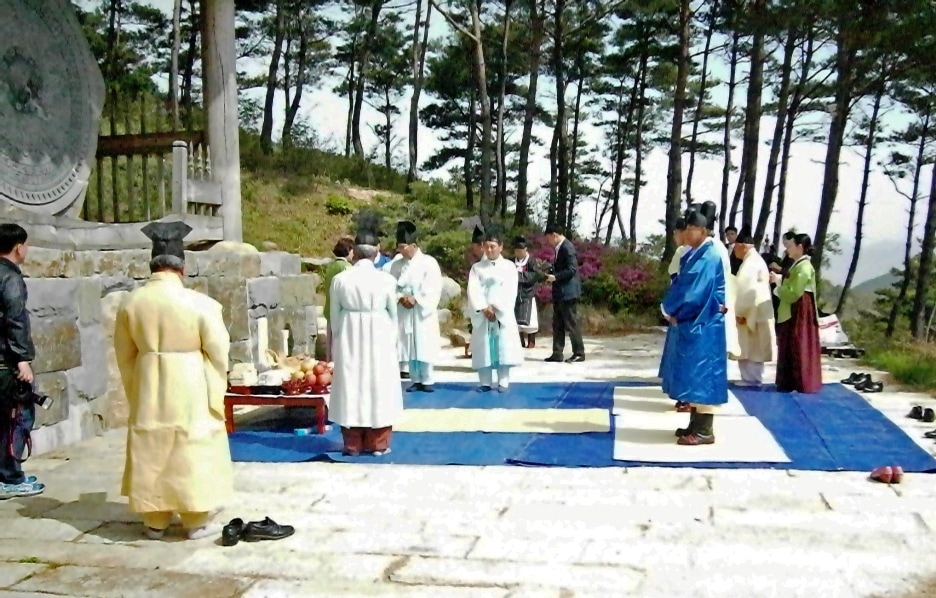
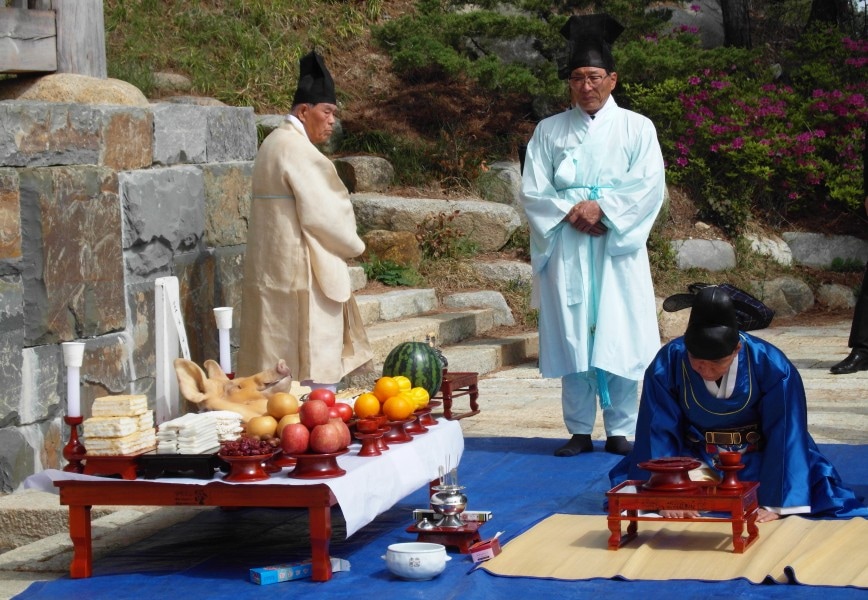
| Sanshin-je [ritual to venerate the Mountain-spirit] at Mt. Wang-san, in front of the carved "Mirror Boulder", in May 2011 -- part of the opening of the annual Sancheong Medicinal Herbs Festival. Photos provided to me by Mr. Philip Gowman, Honorary Ambassador of Sancheong County |
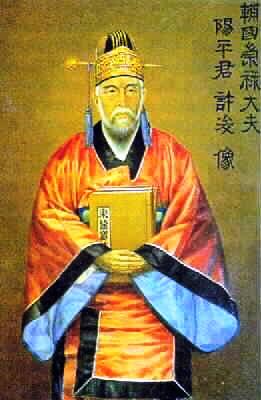
Famed Dr. Heo Jun, Korea's master
of Oriental Medicine and author of
its classic compendium. He often
gathered potent health-giving herbs
such as san-insam (wild mtn ginseng)
here in Sancheong County (Jiri-san,
Wang-san, Hanmae-san and etc), and
remains as one of its local heroes.
of Oriental Medicine and author of
its classic compendium. He often
gathered potent health-giving herbs
such as san-insam (wild mtn ginseng)
here in Sancheong County (Jiri-san,
Wang-san, Hanmae-san and etc), and
remains as one of its local heroes.