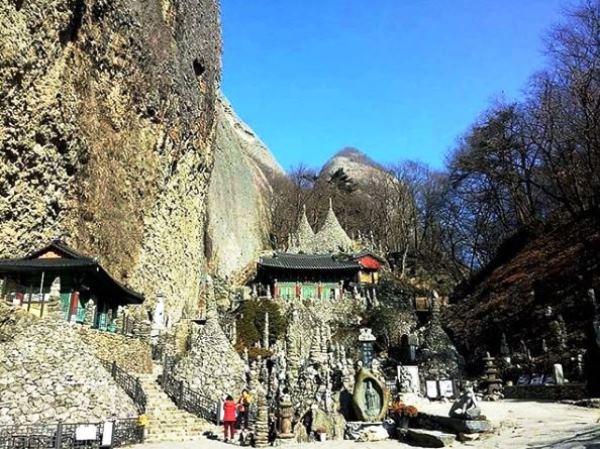
| Ma-i-san Tap-sa 마이산 탑사 spectacular temple of stone pagodas |
| Still Under Construction |
Ma-i-san Ok-su-sa
[Horse-Ears Mountain Jade-Water Temple]
North Jeolla Province, Spring 1999
(see also my book, pages 167-169)
The strangest looking
peaks in all Korea,
thrusting up like
mighty Earth-spirits,
out in a fairly flat
farming region. Seen
here from the south
(left) and the north
(right) in 1999.
Made of rough, pitted
volcanic stone. Long
a sacred place; now a
Provincial Park.
[Horse-Ears Mountain Jade-Water Temple]
North Jeolla Province, Spring 1999
(see also my book, pages 167-169)
The strangest looking
peaks in all Korea,
thrusting up like
mighty Earth-spirits,
out in a fairly flat
farming region. Seen
here from the south
(left) and the north
(right) in 1999.
Made of rough, pitted
volcanic stone. Long
a sacred place; now a
Provincial Park.
LEFT: a new shot of Tap-sa
[Pagoda Temple] at the
base of Ma-i-san
[Horse-Ears Mtn] in North
Jeolla Province, featured
on pages 167-169 of my
First Edition. The San-shin-
gak can barely be seen to
the right of the Main Hall.
ABOVE: Portrait of Korea's first
king Dan-gun; note the
leaf-mantles (two different
species!) on his shoulders and
waist. Refer to pages 132-139 in my book.
BELOW: a statue of a San-shin-dosa (see pages
28-29) in that same sextagonal shrine.
ABOVE: a painting of the Ma-i-san-shin giving a
magical sword to Yi Seong-gye, who used it to take
over Korea and become founder of the Joseon
Dynasty as Yi Taejo in 1392. Yi is said to have
prayed to this San-shin in a cave there for 100
days, before he appeared. A painting of Yi Taejo
as himself the San-shin of Ma-i-san is on page 34
of my book; after death he joined his "teacher" and
took over the status.. He is a common deity used in
Korean Shamanism, but this is the only mountain
which he is regarded as the San-shin of. That
great icon is now stashed away by the abbot, for
security.
One more time,
the amazing Tap-sa!
NEXT --->
Home
New Discoveries Index Page
(see also my book, pages 167-169)
RIGHT: Ok-su-sa
[Jade Water Temple] further up the trail, right
between the two bizzare peaks. The sextagonal
shrine up front is for icons of two Founder-Kings: Yi
Taejo & Dan-gun (photos below).
[Pagoda Temple] at the
base of Ma-i-san
[Horse-Ears Mtn] in North
Jeolla Province, featured
on pages 167-169 of my
First Edition. The San-shin-
gak can barely be seen to
the right of the Main Hall.
ABOVE: Portrait of Korea's first
king Dan-gun; note the
leaf-mantles (two different
species!) on his shoulders and
waist. Refer to pages 132-139 in my book.
BELOW: a statue of a San-shin-dosa (see pages
28-29) in that same sextagonal shrine.
ABOVE: a painting of the Ma-i-san-shin giving a
magical sword to Yi Seong-gye, who used it to take
over Korea and become founder of the Joseon
Dynasty as Yi Taejo in 1392. Yi is said to have
prayed to this San-shin in a cave there for 100
days, before he appeared. A painting of Yi Taejo
as himself the San-shin of Ma-i-san is on page 34
of my book; after death he joined his "teacher" and
took over the status.. He is a common deity used in
Korean Shamanism, but this is the only mountain
which he is regarded as the San-shin of. That
great icon is now stashed away by the abbot, for
security.
One more time,
the amazing Tap-sa!
NEXT --->
Home
New Discoveries Index Page
(see also my book, pages 167-169)
RIGHT: Ok-su-sa
[Jade Water Temple] further up the trail, right
between the two bizzare peaks. The sextagonal
shrine up front is for icons of two Founder-Kings: Yi
Taejo & Dan-gun (photos below).
ABOVE: Portrait of Korea's first
king Dan-gun; note the leaf-mantles (two
different species!) on his shoulders and
waist. Refer to pages 132-139 in my
book.
BELOW: a statue of a San-shin-dosa
(see pages 28-29) in that same
sextagonal shrine.
king Dan-gun; note the leaf-mantles (two
different species!) on his shoulders and
waist. Refer to pages 132-139 in my
book.
BELOW: a statue of a San-shin-dosa
(see pages 28-29) in that same
sextagonal shrine.