| Shinheung-sa 新興寺 신흥사 Ancient "Burgeoning" Meditation Temple amidst Splendid Scenery in Outer Seorak-san |
| Naewon-am Kejo-am and Ulsan-Bawi Seorak-san intro/index page San-shin Site Contents most-sacred mountains index |
Shinheung-sa [Burgeoning Temple] was
founded by Jajang-yulsa in 642 CE as a
remote temple devoted to Seon Buddhist
Meditation practice, leading to claims
that it is "the world's oldest Zen temple",
although it was never dedicated to the
Seon School until the Joseon Dynasty Era.
founded by Jajang-yulsa in 642 CE as a
remote temple devoted to Seon Buddhist
Meditation practice, leading to claims
that it is "the world's oldest Zen temple",
although it was never dedicated to the
Seon School until the Joseon Dynasty Era.
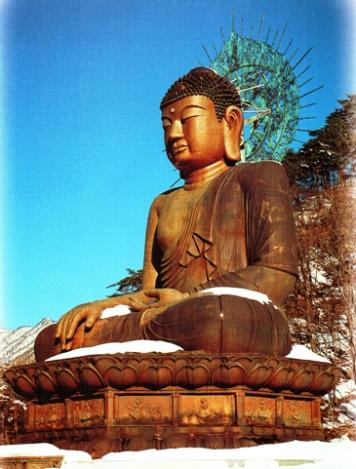
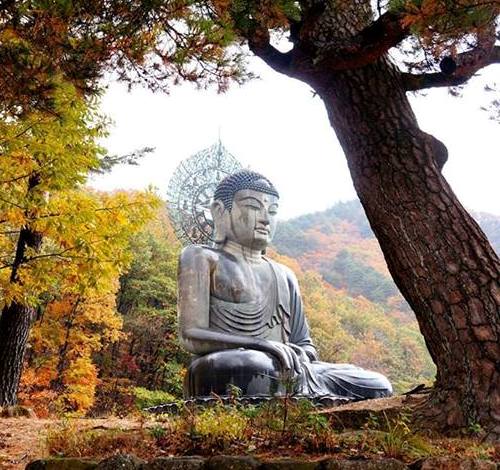
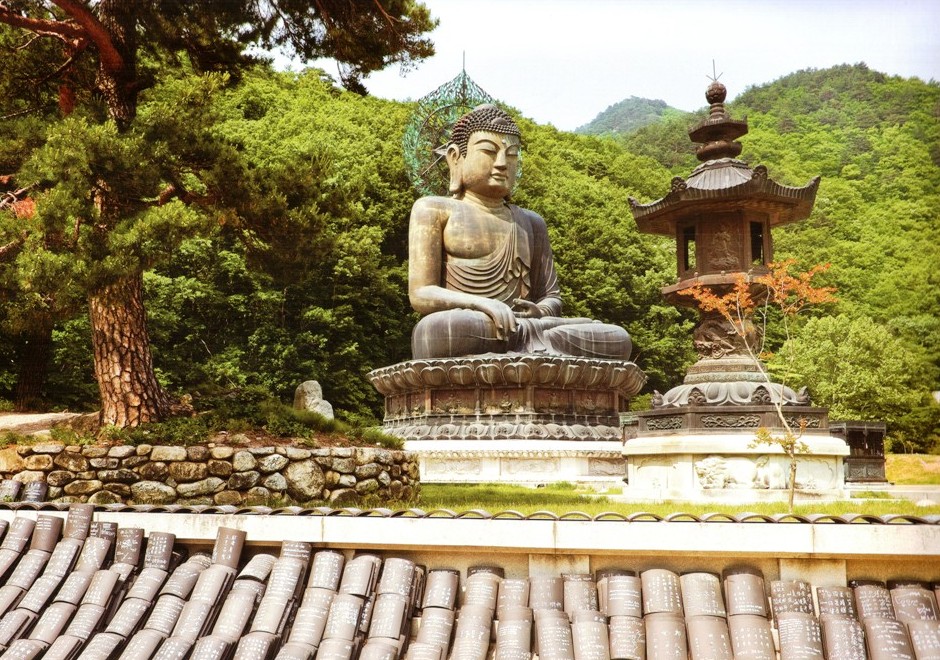
| The giant bronze the Tongil-Daebul 統一大佛 Buddha outside its entrance, dedicated to National Re-unification |
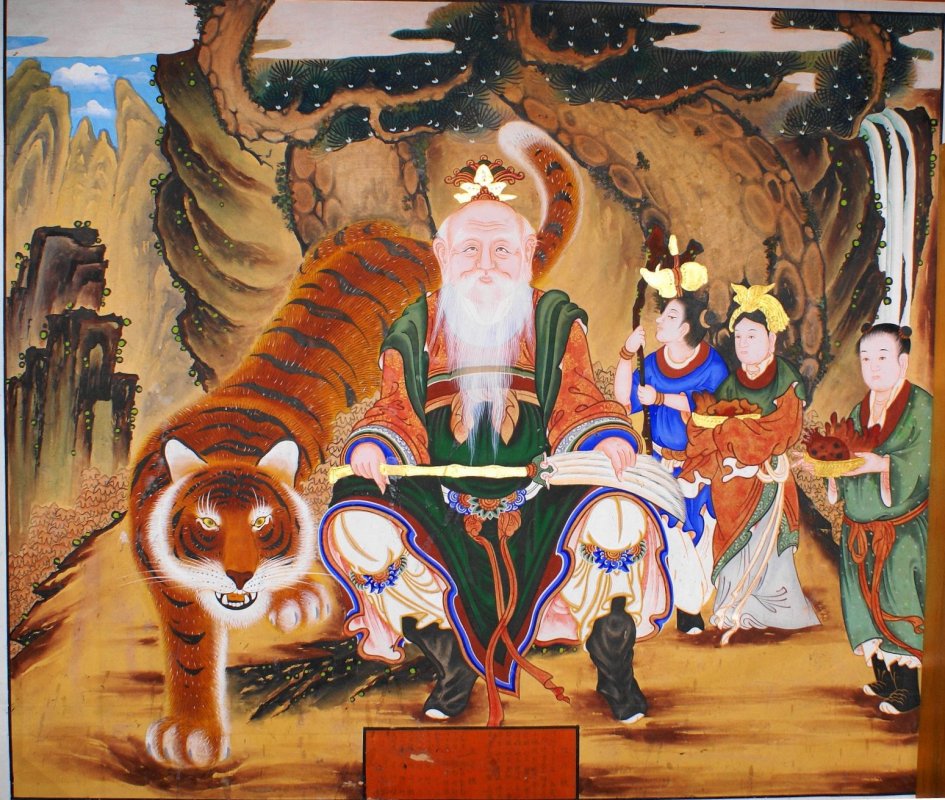
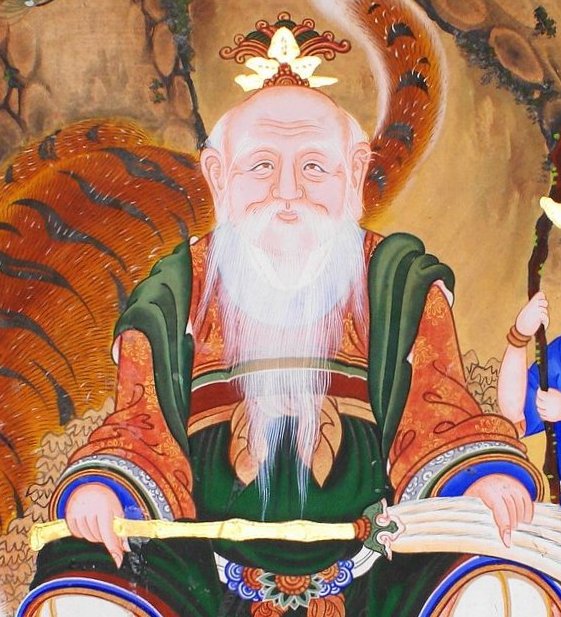
| the excellent modern Sanshin painting of Shinheung-sa, shot in 2012 by my reseach-partner-friend Roger Shepherd |
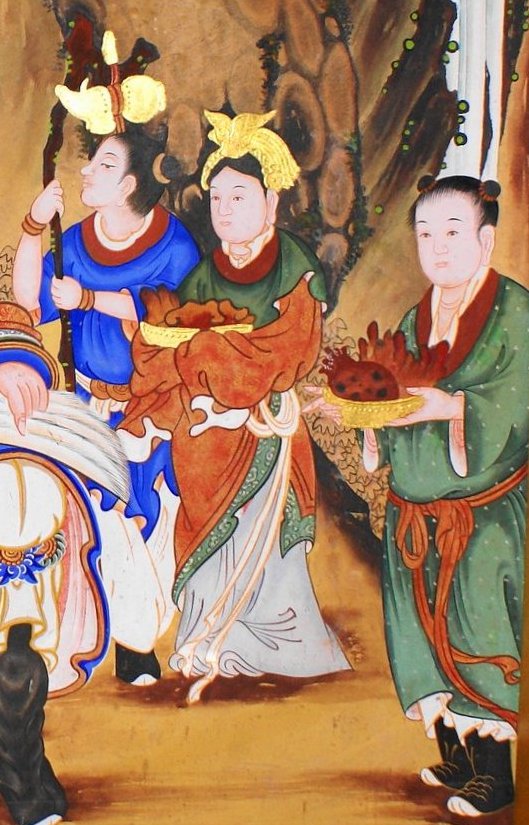
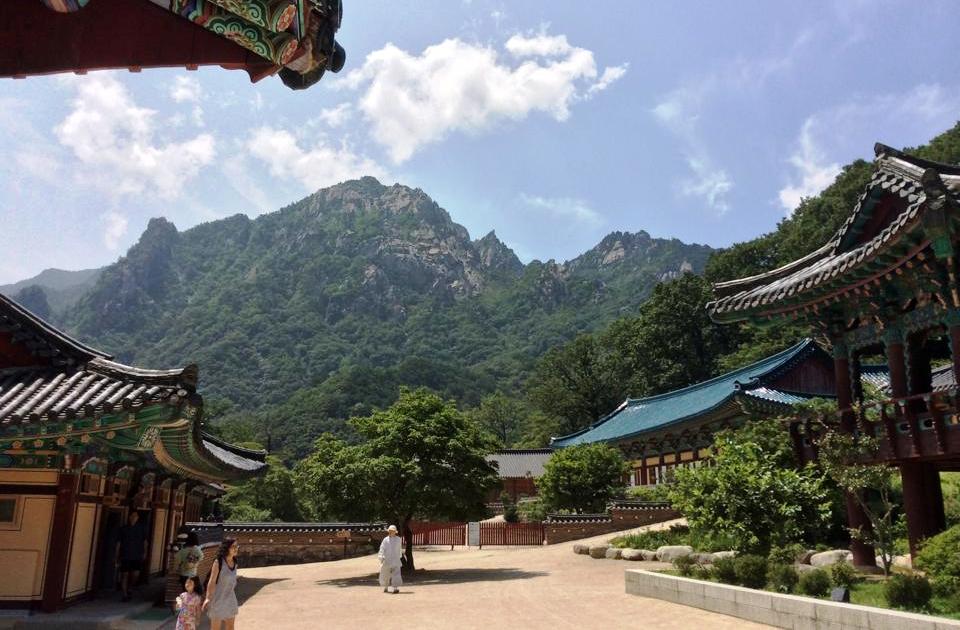
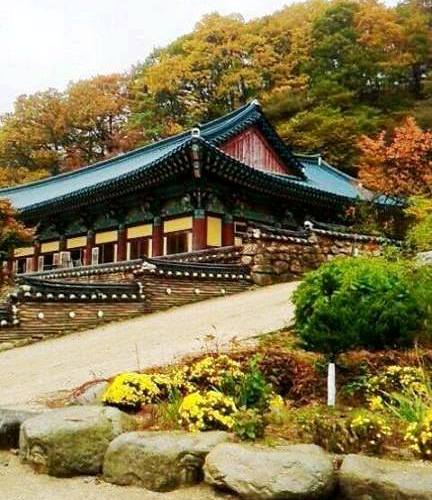
| July 2014 photo by Irene NaYoung Ye |
From my Encyclopedia of Korean Buddhism:
Shinheung-sa 新興寺 신흥사 is the main temple of the area known as "Oe-seorak" [外雪嶽,
Outer Area of Seorak-san] in the Seorak-san National Park. It was founded during the Shilla Kingdom
by Master Jajang (慈藏) a bit further down the valley (where the New Seorak and Kensington Hotels
stood 1960s~2000s) in 652 CE under the name Hyangseong-sa [香城寺, Fragrant Castle Temple] in
order to be a quiet refuge for meditators surrounded by natural beauty, which appears to mean that it
is Korea’s oldest temple dedicated to meditation practice -- some try to claim that it is "the oldest Zen
temple" but that is wrong because it was not devoted to the Seon School which had not yet entered
Korea. After it was accidentally burned down in 699 Master Uisang (義湘) rebuilt and expanded it,
moving it about 2 km up the valley towards Ulsan-bawi Peak and renaming it Seonjeong-sa [禪定寺,
Meditation Concentration Temple] in 701; that site is now Naewon-am [內院庵, Courtyard Hermitage].
Unlike many other temples it was not destroyed during the 13th-century Mongol Invasions or the 1592
-98 Imjin War, but then a catastrophic fire razed it in 1642; all the monks left the site except for three
faithful ones named Unseo (雲瑞), Hyewon (惠元) and Yeon-ok (連玉). While sleeping after they had
performed gido [祈禱, ritual supplication prayer] all day that the venerable temple might be rebuilt, all
three of them had the same dream of the local seorak Sanshin [山神, Mountain-spirit] advising them
to relocate the temple to the bottom of the gorge to avoid further physical misfortunes. They therefore
rebuilt the temple in its present location in 1647 with the name Shinheung-sa [新興寺, Newly-Arising
Temple, Divine-Inspiration Temple or Burgeoning Temple, the last referring to the budding of a Lotus
flower, symbol of enlightenment].
Shinheung-sa 新興寺 신흥사 is the main temple of the area known as "Oe-seorak" [外雪嶽,
Outer Area of Seorak-san] in the Seorak-san National Park. It was founded during the Shilla Kingdom
by Master Jajang (慈藏) a bit further down the valley (where the New Seorak and Kensington Hotels
stood 1960s~2000s) in 652 CE under the name Hyangseong-sa [香城寺, Fragrant Castle Temple] in
order to be a quiet refuge for meditators surrounded by natural beauty, which appears to mean that it
is Korea’s oldest temple dedicated to meditation practice -- some try to claim that it is "the oldest Zen
temple" but that is wrong because it was not devoted to the Seon School which had not yet entered
Korea. After it was accidentally burned down in 699 Master Uisang (義湘) rebuilt and expanded it,
moving it about 2 km up the valley towards Ulsan-bawi Peak and renaming it Seonjeong-sa [禪定寺,
Meditation Concentration Temple] in 701; that site is now Naewon-am [內院庵, Courtyard Hermitage].
Unlike many other temples it was not destroyed during the 13th-century Mongol Invasions or the 1592
-98 Imjin War, but then a catastrophic fire razed it in 1642; all the monks left the site except for three
faithful ones named Unseo (雲瑞), Hyewon (惠元) and Yeon-ok (連玉). While sleeping after they had
performed gido [祈禱, ritual supplication prayer] all day that the venerable temple might be rebuilt, all
three of them had the same dream of the local seorak Sanshin [山神, Mountain-spirit] advising them
to relocate the temple to the bottom of the gorge to avoid further physical misfortunes. They therefore
rebuilt the temple in its present location in 1647 with the name Shinheung-sa [新興寺, Newly-Arising
Temple, Divine-Inspiration Temple or Burgeoning Temple, the last referring to the budding of a Lotus
flower, symbol of enlightenment].
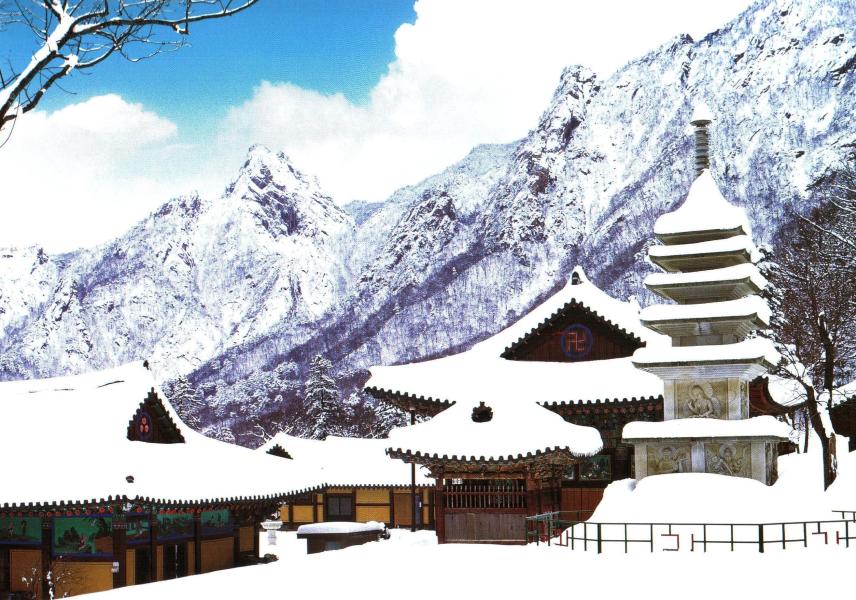
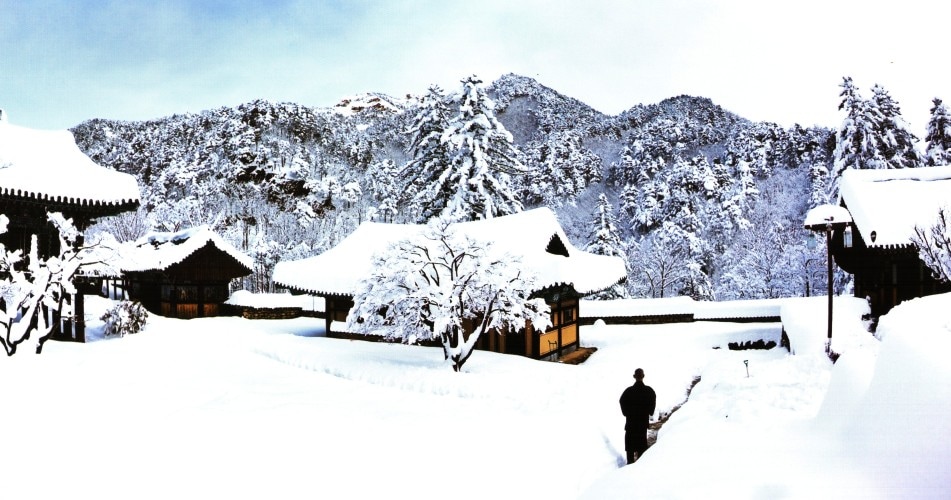
| Deep Winter |
Shinheung-sa was badly damaged in the 1950-53 Korean War and reconstructed in its present form
after that, as Seorak-san became one of Korea's earliest and most-popular national parks by 1970.
It now serves as a District Headquarters temple of the 3rd District of the Jogye Monastic Order of
Korean Buddhism, supervising all the temples located in the northeastern Gangwon-do Province area.
Its central hall, entitled a Geungnak-bojeon [極樂寶殿, Paradise Treasure-Hall], has some unusual
architectural features, and is designated Provincial Tangible Cultural Property #14.
It features a popular Samseong-gak (三聖閣) containing icons of Sanshin, Dokseong and Chilseong.
Its budo-won [浮屠園, stupa-garden] contains 20 monuments and is designated Provincial Tangible
Cultural Property #115. On the original site of Hyangseong-sa (in front of the hotels) stands a
Three-Story Stone Pagoda designated as Treasure #443, the northern-most extant Shilla Kingdom
Stone Pagoda. When it was repaired in modern times, workers found inside of it a silver case for
enshrining sarira of Buddha, but it was empty.
In the surrounding mountains there are a number of interesting hermitages, some of which also date
back to the time of Jajang, along with forests, waterfalls and towering cliffs famous for their beauty.
Due to its location just above the “Seorak-dong Plaza (雪嶽洞 프라자)” that serves as the main
entranceway for this very famous and popular National Park that serves between 3 and 4 million
visitors every year, it may be the most tourist-visited temple in all of Korea. It also offers a popular
TempleStay program.
Sinheung-sa dedicated the Tongil-Daebul [統一大佛, Unification Great Buddha Statue] just across
the stream in front of the temple in 1997, after eleven years of fundraising and construction. It is 17.5
meters high, making it one of the largest sitting bronze statues in the world, depicting Sakyamuni the
Historical Buddha (563-483 BCE) in the “teaching” su-in [手印, mudra] with the 16 principal Nahan
[羅漢, Arhats, primary disciples of Buddha] carved on the massive pedestal. This great monument is
dedicated to the wished-for ideal of peaceful national re-unification, and is very popular with pilgrims
bowing and performing gido [祈禱, ritual supplication prayer] to it for fulfillment of their desires.
after that, as Seorak-san became one of Korea's earliest and most-popular national parks by 1970.
It now serves as a District Headquarters temple of the 3rd District of the Jogye Monastic Order of
Korean Buddhism, supervising all the temples located in the northeastern Gangwon-do Province area.
Its central hall, entitled a Geungnak-bojeon [極樂寶殿, Paradise Treasure-Hall], has some unusual
architectural features, and is designated Provincial Tangible Cultural Property #14.
It features a popular Samseong-gak (三聖閣) containing icons of Sanshin, Dokseong and Chilseong.
Its budo-won [浮屠園, stupa-garden] contains 20 monuments and is designated Provincial Tangible
Cultural Property #115. On the original site of Hyangseong-sa (in front of the hotels) stands a
Three-Story Stone Pagoda designated as Treasure #443, the northern-most extant Shilla Kingdom
Stone Pagoda. When it was repaired in modern times, workers found inside of it a silver case for
enshrining sarira of Buddha, but it was empty.
In the surrounding mountains there are a number of interesting hermitages, some of which also date
back to the time of Jajang, along with forests, waterfalls and towering cliffs famous for their beauty.
Due to its location just above the “Seorak-dong Plaza (雪嶽洞 프라자)” that serves as the main
entranceway for this very famous and popular National Park that serves between 3 and 4 million
visitors every year, it may be the most tourist-visited temple in all of Korea. It also offers a popular
TempleStay program.
Sinheung-sa dedicated the Tongil-Daebul [統一大佛, Unification Great Buddha Statue] just across
the stream in front of the temple in 1997, after eleven years of fundraising and construction. It is 17.5
meters high, making it one of the largest sitting bronze statues in the world, depicting Sakyamuni the
Historical Buddha (563-483 BCE) in the “teaching” su-in [手印, mudra] with the 16 principal Nahan
[羅漢, Arhats, primary disciples of Buddha] carved on the massive pedestal. This great monument is
dedicated to the wished-for ideal of peaceful national re-unification, and is very popular with pilgrims
bowing and performing gido [祈禱, ritual supplication prayer] to it for fulfillment of their desires.
| Deep Winter |