| Wolchul-san Dogap-sa Temple of Doseon-guksa at the mighty mountain of South Jeolla |
| Still Under Construction San-shin Site Contents Page |
from http://yeongam.go.kr/english/culture/content04-1a.html
Dogapsa was built By Doseonguksa, a national monk, in the late Silla period and it was greatly prosperous
at the late Goryeo period. There was a site of temple named Munsusa where Doseonguksa spent his
childhood. After he visited China where he was raised, he built Dogapsa on the site of Munsusa. Later, two
monks named Sumi and Sinmi rebuilt this temple in 1473 and the current building was rebuilt after the old
building was burned down during the Korean War. The road leading to this temple is dotted with cherry
trees and fully bloomed cherry blossoms in Spring harmonize it with Mt. Wolchul, which creates a fantastic
scenery. Doseon-Sumibi, a monument, was erected in 1653 to commemorate Doseon and Sumi. Dogapsa
is famous as it is filled with clean air. It was popular as one of three Gap temples in the Goryeo and Joseon
periods, but most of the temple was destroyed by repetitive fires and it keeps just a serene appearance.
This temple is representative of quiet compounds to stroll.
Dogapsa Haetalmun ( rehabilitation gate : National Treasure No. 50 )
This gate is, the oldest in Dogapsa, situated at the mouth of the temple and Haetal means releasing from
all sufferings. It has three sections on the front, and two in the side. Geumgangyeoksasang stands to
protect the temple against evil on the right and left side. One section in the middle is used as a passage. A
hanging board " Wolchulsan Dogapsa " is displayed at the upper side of the building, indicating this is a
main gate. To the opposite side, is a hanging board of " Haetalmun ".
Dogapsa Haetalmun is rarely seen in our country and considered as important enough to be comparable to
Hwejounmun (a turnstile) ( Treasure No. 164 ) of Chonpyeongsa.
Seokjoyeoraejwasang ( seated stone Buddha image )
This Buddha image is enshrined in Mireukjeon of Dogapsa. The nimbus and the body of the statue are
made of one piece of stone and this buddha statue looks directly carved on a rock (Maebul).
The statue's hair looks like a turban shell and a protrusion is present over the head. Description is
presented as follows: oval face, embossed eyes, large nose, thick lips with a gentle smile, stout shoulders,
a flat chest, and a simplified body. It has a stiff appearance without animated mood. The robe flows down
over the left shoulder with the right one exposed and a few wrinkles are presented clumsily on the robe.
In the middle of a slim and oval nimbus, a lotus flower pattern is represented. Small buddha images are
displayed on the top and both sides of the head. The statue carved in the nimbus is simplified and clumsy.
Daejwa(pedestal) designed to enshrine the Buddha statue is just square and it is assumed that it was an
octagonal pedestal with lotus flower patterns.
The sculpturing is rather stiffly and formally represented, but the facial expression is warm and gentle. This
Buddha statue follows the style of Buddha sculptures of the Unified Silla period while showing the clumsy
and simplified style of Goryeo Buddha images. It is assumed that it was built in the middle of the Goryeo
period.
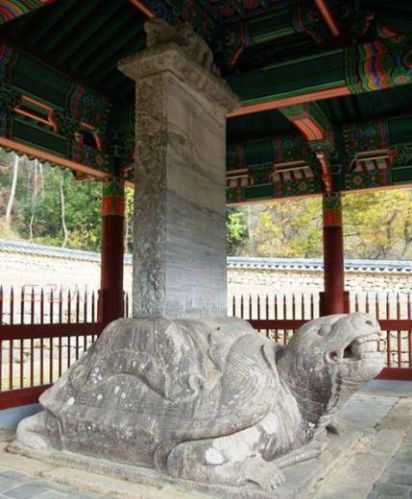
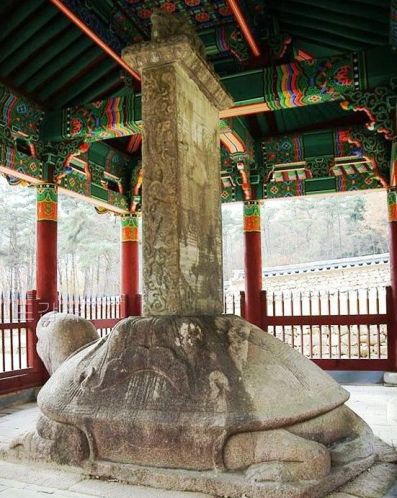
Doseonsumibi (monument to priests Dosen and Sumi)
This monument is situated on an alley leading in the direction of north-east from Daeungjeon(main
sanctuary) of Dogapsa and erected to honour two great Buddhists, Doseon and Sumi who established
Dogapsa.
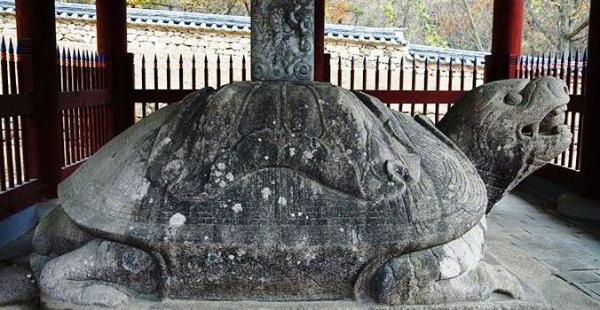
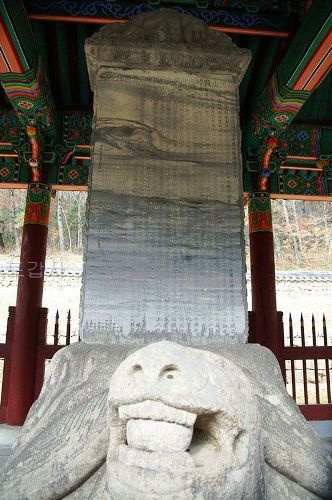
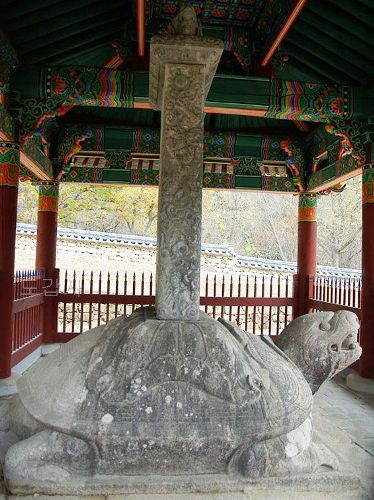
This stone stele has a turtle-shaped base, body and head stone as is typical of stone stele. The turtle base
looks southward with its neck lifted and a little inclination to the right. The stone turtle carries an Yeoeuijoo(
magic bead ) in its mouth with five front toes and three hind toes. Its tail is hidden by the left foot. There are
5-angled and 5 layered patterns on the back, which are unusual, considering patterns are usually
six-angled. Around the place where the body of the monument is inserted, lotus flowers and stalks flow
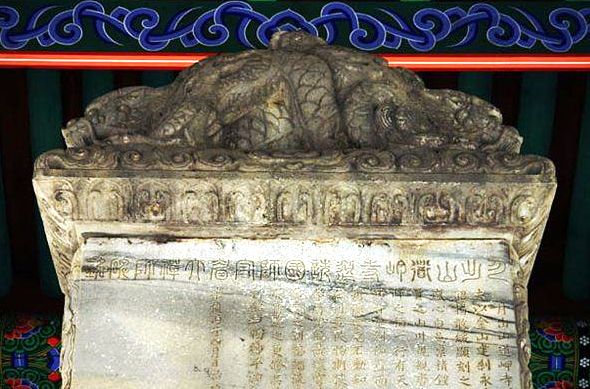
down and are rolled up at the end. The body of the monument is long rectangular and patterns of a turtle
and a dragon are inscribed on the sides. The head stone has patterns of lotus flowers and a dragon, over
which two dragons ars arranged back to back.
This elaborated stone stele was erected from 1636 through 1653 and carries an inscription of 1,500
Chinese ideographs on the face. The scale is relatively large and a large turtle-shaped base gives a stable
feeling. Sculpturing is considered superior.
Dogapsaseokjo (stone water trough)
This kind of stone trough was used to hold water or to wash grains in. This one looks like a boat when it is
viewed from the sides because the ends and bottom are rounded. There is a small drain at the bottom. As
there is a record on the face, it is known that it was made in 1682.
Sumiwangsabi ( stele to Sumiwangsa)
This stele was erected to record the life and activities of Sumiwangsa, who was born in Yongam. He
entered the priesthood when he was 13 and became a royal preceptor under the reign of King Sejo who
respected Buddhism.
It is representative of Korean stele. The body of the monument which is topped by a capstone is erected on
the tortoise-shaped pedestal. The head of the tortoise-shaped pedestal is that of dragon, but its neck is
short with five front and hind claws. The hexagons on the shell of the tortoise are very thickly carved. The
cloud patterns and intertwined dragons of the capstone are well sculpted. The monument fell down in 1581
and its re-erection started in 1629 and was completed in 1633. Its sculpturing technique and inscription are
elaborate. Though it was made in the early 17th century, it is of special note because it follows a style that
was prevalent during the Goryeo period.
Daeungbojeon(sanctuary)
This hall has three section on the front and three in the side. It is a Daposik single-storied building.
Doseonguksaseongbojeon
This is a museum to display relics relating to Doseonguksa who established Dogapsa and treasures of
Dogapsa. This museum was open in 2000, equipped with a seminar room where narratives relating to
Doseonguksa and his history are displayed in film.
Dogapsa was built By Doseonguksa, a national monk, in the late Silla period and it was greatly prosperous
at the late Goryeo period. There was a site of temple named Munsusa where Doseonguksa spent his
childhood. After he visited China where he was raised, he built Dogapsa on the site of Munsusa. Later, two
monks named Sumi and Sinmi rebuilt this temple in 1473 and the current building was rebuilt after the old
building was burned down during the Korean War. The road leading to this temple is dotted with cherry
trees and fully bloomed cherry blossoms in Spring harmonize it with Mt. Wolchul, which creates a fantastic
scenery. Doseon-Sumibi, a monument, was erected in 1653 to commemorate Doseon and Sumi. Dogapsa
is famous as it is filled with clean air. It was popular as one of three Gap temples in the Goryeo and Joseon
periods, but most of the temple was destroyed by repetitive fires and it keeps just a serene appearance.
This temple is representative of quiet compounds to stroll.
Dogapsa Haetalmun ( rehabilitation gate : National Treasure No. 50 )
This gate is, the oldest in Dogapsa, situated at the mouth of the temple and Haetal means releasing from
all sufferings. It has three sections on the front, and two in the side. Geumgangyeoksasang stands to
protect the temple against evil on the right and left side. One section in the middle is used as a passage. A
hanging board " Wolchulsan Dogapsa " is displayed at the upper side of the building, indicating this is a
main gate. To the opposite side, is a hanging board of " Haetalmun ".
Dogapsa Haetalmun is rarely seen in our country and considered as important enough to be comparable to
Hwejounmun (a turnstile) ( Treasure No. 164 ) of Chonpyeongsa.
Seokjoyeoraejwasang ( seated stone Buddha image )
This Buddha image is enshrined in Mireukjeon of Dogapsa. The nimbus and the body of the statue are
made of one piece of stone and this buddha statue looks directly carved on a rock (Maebul).
The statue's hair looks like a turban shell and a protrusion is present over the head. Description is
presented as follows: oval face, embossed eyes, large nose, thick lips with a gentle smile, stout shoulders,
a flat chest, and a simplified body. It has a stiff appearance without animated mood. The robe flows down
over the left shoulder with the right one exposed and a few wrinkles are presented clumsily on the robe.
In the middle of a slim and oval nimbus, a lotus flower pattern is represented. Small buddha images are
displayed on the top and both sides of the head. The statue carved in the nimbus is simplified and clumsy.
Daejwa(pedestal) designed to enshrine the Buddha statue is just square and it is assumed that it was an
octagonal pedestal with lotus flower patterns.
The sculpturing is rather stiffly and formally represented, but the facial expression is warm and gentle. This
Buddha statue follows the style of Buddha sculptures of the Unified Silla period while showing the clumsy
and simplified style of Goryeo Buddha images. It is assumed that it was built in the middle of the Goryeo
period.
Doseonsumibi (monument to priests Dosen and Sumi)
This monument is situated on an alley leading in the direction of north-east from Daeungjeon(main
sanctuary) of Dogapsa and erected to honour two great Buddhists, Doseon and Sumi who established
Dogapsa.
This stone stele has a turtle-shaped base, body and head stone as is typical of stone stele. The turtle base
looks southward with its neck lifted and a little inclination to the right. The stone turtle carries an Yeoeuijoo(
magic bead ) in its mouth with five front toes and three hind toes. Its tail is hidden by the left foot. There are
5-angled and 5 layered patterns on the back, which are unusual, considering patterns are usually
six-angled. Around the place where the body of the monument is inserted, lotus flowers and stalks flow
down and are rolled up at the end. The body of the monument is long rectangular and patterns of a turtle
and a dragon are inscribed on the sides. The head stone has patterns of lotus flowers and a dragon, over
which two dragons ars arranged back to back.
This elaborated stone stele was erected from 1636 through 1653 and carries an inscription of 1,500
Chinese ideographs on the face. The scale is relatively large and a large turtle-shaped base gives a stable
feeling. Sculpturing is considered superior.
Dogapsaseokjo (stone water trough)
This kind of stone trough was used to hold water or to wash grains in. This one looks like a boat when it is
viewed from the sides because the ends and bottom are rounded. There is a small drain at the bottom. As
there is a record on the face, it is known that it was made in 1682.
Sumiwangsabi ( stele to Sumiwangsa)
This stele was erected to record the life and activities of Sumiwangsa, who was born in Yongam. He
entered the priesthood when he was 13 and became a royal preceptor under the reign of King Sejo who
respected Buddhism.
It is representative of Korean stele. The body of the monument which is topped by a capstone is erected on
the tortoise-shaped pedestal. The head of the tortoise-shaped pedestal is that of dragon, but its neck is
short with five front and hind claws. The hexagons on the shell of the tortoise are very thickly carved. The
cloud patterns and intertwined dragons of the capstone are well sculpted. The monument fell down in 1581
and its re-erection started in 1629 and was completed in 1633. Its sculpturing technique and inscription are
elaborate. Though it was made in the early 17th century, it is of special note because it follows a style that
was prevalent during the Goryeo period.
Daeungbojeon(sanctuary)
This hall has three section on the front and three in the side. It is a Daposik single-storied building.
Doseonguksaseongbojeon
This is a museum to display relics relating to Doseonguksa who established Dogapsa and treasures of
Dogapsa. This museum was open in 2000, equipped with a seminar room where narratives relating to
Doseonguksa and his history are displayed in film.
Wolchul-san National Park of South Jeolla
Province, Korea, is a small but amazingly-beautiful
mountain to hike on, and features the two ancient
temples Dogap-sa and Muwi-sa.
Province, Korea, is a small but amazingly-beautiful
mountain to hike on, and features the two ancient
temples Dogap-sa and Muwi-sa.
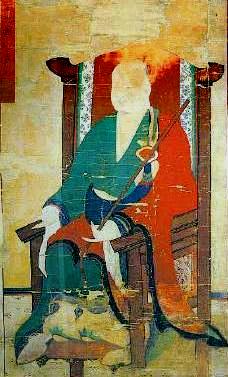
The portrait of Doseon painted in 1456,
kept at Wolchul-san's Dogap-sa which is
in
Yeongam-gun County of South Jeolla
Province.
kept at Wolchul-san's Dogap-sa which is
in
Yeongam-gun County of South Jeolla
Province.
Doseon's family name was Kim and he came from Gurim Village of Yeong-am-gun [Spirit-Rock County] of
Jeolla-namdo, near Wolchul-san. It was rumored that he had descended from a secondary son of
Shilla's Great King Taejong Muyeol (r.664-681). His mother had a conception-dream that she swallowed a
beautiful pearl (a symbol of pure wisdom), and for her first month of pregnancy chanted Buddhist scriptures
while abstaining from meat, onions and garlic. Her son was a Buddhist prodigy from infancy onwards,
learning to chant basic Sutras soon after he could talk. One local myth tells that he was accidentally
abandoned soon after birth, but was protected by birds at a gigantic boulder now called Guksa-am
[National Master Rock], found behind Wolchul-san's Gukam-sa Hermitage (where astronomer Choi Ji-mong is
enshrined).
Jeolla-namdo, near Wolchul-san. It was rumored that he had descended from a secondary son of
Shilla's Great King Taejong Muyeol (r.664-681). His mother had a conception-dream that she swallowed a
beautiful pearl (a symbol of pure wisdom), and for her first month of pregnancy chanted Buddhist scriptures
while abstaining from meat, onions and garlic. Her son was a Buddhist prodigy from infancy onwards,
learning to chant basic Sutras soon after he could talk. One local myth tells that he was accidentally
abandoned soon after birth, but was protected by birds at a gigantic boulder now called Guksa-am
[National Master Rock], found behind Wolchul-san's Gukam-sa Hermitage (where astronomer Choi Ji-mong is
enshrined).
Yeongam County claims that Doseon spent at least part of his childhood (circa 835?) at Munsu-sa
[Bodhisattva of Wisdom Temple] on the western slopes of what is now Wolchul-san National Park. They also
claim that there is a nearby site called Nakbal-jiji that long ago hosted Wolam-sa [Moon-Rock Temple],
which is where Doseon first had his hair cut off so as to officially become a novice-monk (the date of this is
not stated). They say that when Doseon returned from his early studies in China he reconstructed
Munsu-sa on the same site, renaming it Dogap-sa. Anyway, Dogap-sa is known to have been famous
and prosperous during the Goryeo Dynasty, and its official history claims Doseon as its Founder.
[Bodhisattva of Wisdom Temple] on the western slopes of what is now Wolchul-san National Park. They also
claim that there is a nearby site called Nakbal-jiji that long ago hosted Wolam-sa [Moon-Rock Temple],
which is where Doseon first had his hair cut off so as to officially become a novice-monk (the date of this is
not stated). They say that when Doseon returned from his early studies in China he reconstructed
Munsu-sa on the same site, renaming it Dogap-sa. Anyway, Dogap-sa is known to have been famous
and prosperous during the Goryeo Dynasty, and its official history claims Doseon as its Founder.
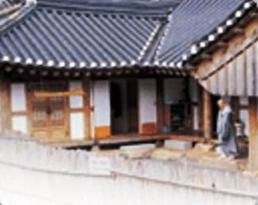
Yeongam County has in recent times become
proud of being Doseon's "hometown", and has
upgraded Dogap-sa as a kind of shrine to him. It
opened the Doseon-guksa-sungbojeon Museum
(upper-left) to preserve and display his relics (and
other temple treasures) in 2000. It contains a
seminar room where documentary films about
Doseon are continuously shown for visitors, and
the original manuscript of Doseon-guksa-silrok, a
detailed chronicle of his life from the Joseon era.
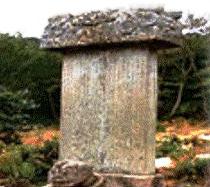
Dogap-sa also contains a Joseon monument of its
history (lower-left) that mentions Doseon, and a
copy of the inscription on the
Jeungdung-hyedeung-tap monument of
Okryong-sa (see below).
proud of being Doseon's "hometown", and has
upgraded Dogap-sa as a kind of shrine to him. It
opened the Doseon-guksa-sungbojeon Museum
(upper-left) to preserve and display his relics (and
other temple treasures) in 2000. It contains a
seminar room where documentary films about
Doseon are continuously shown for visitors, and
the original manuscript of Doseon-guksa-silrok, a
detailed chronicle of his life from the Joseon era.
Dogap-sa also contains a Joseon monument of its
history (lower-left) that mentions Doseon, and a
copy of the inscription on the
Jeungdung-hyedeung-tap monument of
Okryong-sa (see below).
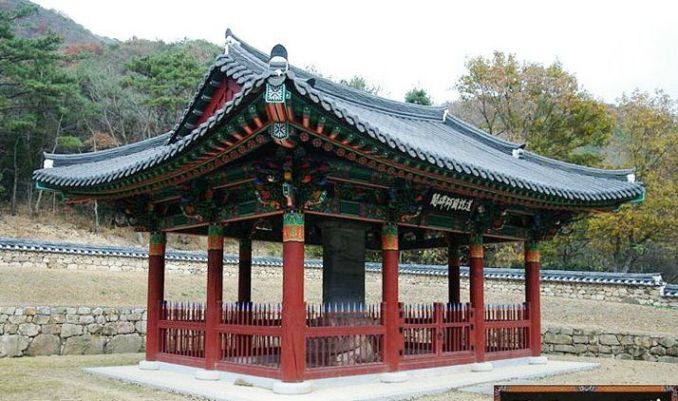
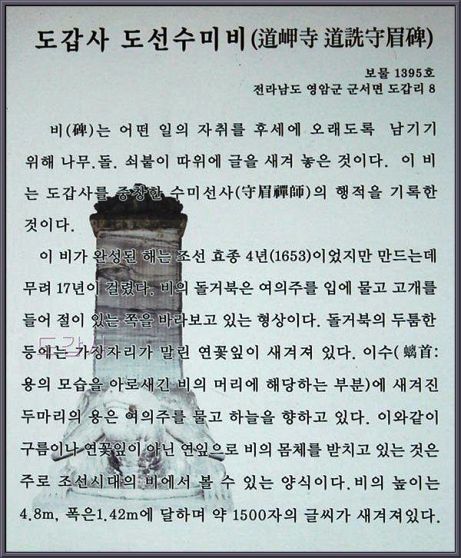
In 1473 (in the early Joseon Dynasty) Dogap-sa was reconstructed by a monk named Sumi, and then in
1653 a stone biseok monument named the Dogapsa-doseon-sumi-bi was erected to
commemorate Doseon and Sumi. It is 4.8m tall, and considered a masterpiece of the Joseon
period due to its exquisite carving and grand scale. An unusual feature is that on the back of the
tortoise-base, lotus leaves are carved instead of the typical lotus flowers.
1653 a stone biseok monument named the Dogapsa-doseon-sumi-bi was erected to
commemorate Doseon and Sumi. It is 4.8m tall, and considered a masterpiece of the Joseon
period due to its exquisite carving and grand scale. An unusual feature is that on the back of the
tortoise-base, lotus leaves are carved instead of the typical lotus flowers.