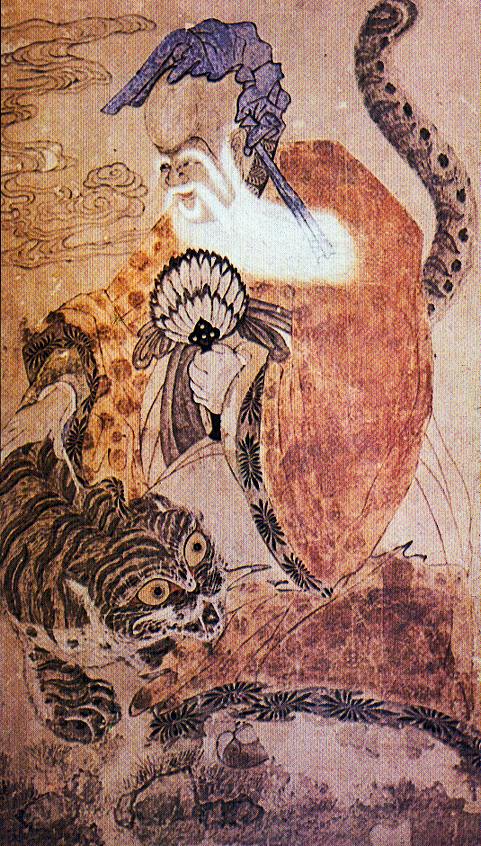
An excellent 19th-century Daoist-flavored San-shin
taeng-hwa from Dr. Zo's former collection. The
tiger is classic Korean folk-art, crazy-eyed and
looking both ferocious and cute. His tail rises
upwards in a gentle S-curve, decorated with
leopard-spots. San-shin's right hand pets the
beast, while his left holds the typical white-crane
feather-fan.
His head is covered with a crumpled cloth, in the
style of a Daoist hermit (rather than the usual royal
topknot-holder). The eyebrows are very long in the
fashion of a Buddhist Na-han or Daoist "Immortal"
(see page 73 in the first edition of my book); the
beard is very full and snow-white, another Daoist
touch.
But the most striking aspect of this unique painting
is how San-shin's skull is over-sized, bald and
buldging in front. This is a conflation with the
North-Star-Spirit in Korea's Chil-seong paintings,
derived from the Chinese Daoist God of Longevity
(see pages 107-109 for more on this).
taeng-hwa from Dr. Zo's former collection. The
tiger is classic Korean folk-art, crazy-eyed and
looking both ferocious and cute. His tail rises
upwards in a gentle S-curve, decorated with
leopard-spots. San-shin's right hand pets the
beast, while his left holds the typical white-crane
feather-fan.
His head is covered with a crumpled cloth, in the
style of a Daoist hermit (rather than the usual royal
topknot-holder). The eyebrows are very long in the
fashion of a Buddhist Na-han or Daoist "Immortal"
(see page 73 in the first edition of my book); the
beard is very full and snow-white, another Daoist
touch.
But the most striking aspect of this unique painting
is how San-shin's skull is over-sized, bald and
buldging in front. This is a conflation with the
North-Star-Spirit in Korea's Chil-seong paintings,
derived from the Chinese Daoist God of Longevity
(see pages 107-109 for more on this).
| GREAT ANTIQUE SAN-SHIN PAINTINGS From Zo Zayong's Emille Museum (museum now closed and collection dispersed) |
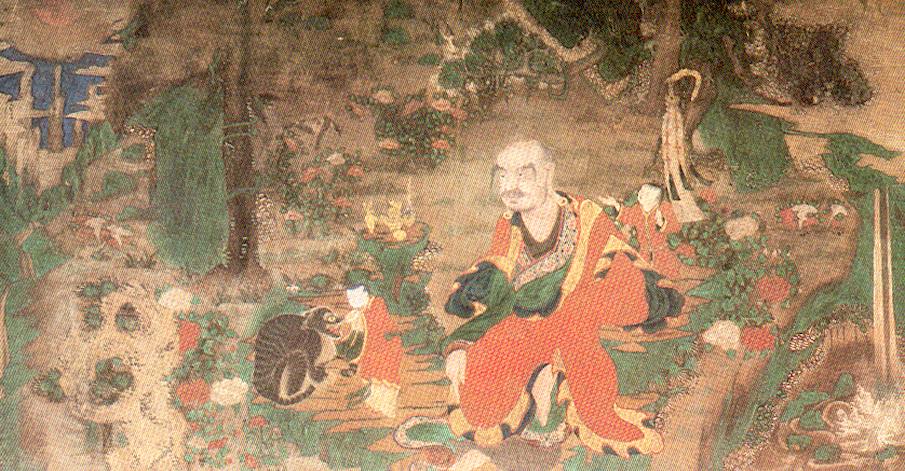
One of the very best, from the early 19th
Century. San-shin is bald and hat-less and
has long grey eyebrows, like a Buddhist
Nahan (enlightened adept); there is nothing
in his hands. The most unusual thing is the
two dongja boys shown in casual, amusing,
unique activities -- one is feeding the tiger
from a holy-water bottle as if it were a baby,
while the other (holding a fancy fly-wisk)
holds out his hand as if feeling rain-drops!
Beautiful flowers abound... an elaborate
golden incense-burner is near the center.
Century. San-shin is bald and hat-less and
has long grey eyebrows, like a Buddhist
Nahan (enlightened adept); there is nothing
in his hands. The most unusual thing is the
two dongja boys shown in casual, amusing,
unique activities -- one is feeding the tiger
from a holy-water bottle as if it were a baby,
while the other (holding a fancy fly-wisk)
holds out his hand as if feeling rain-drops!
Beautiful flowers abound... an elaborate
golden incense-burner is near the center.
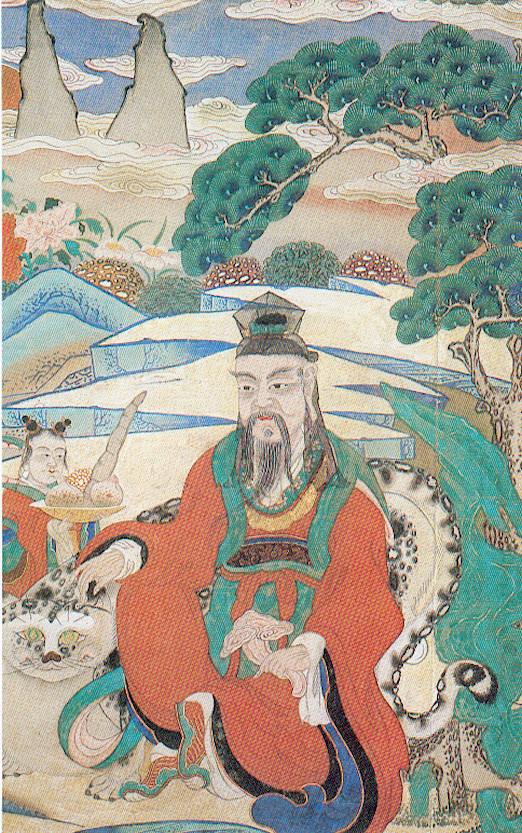
Another excellent one, from the late 19th
Century. San-shin has standard hair and
headgear, and holds a bullocho sprig while
petting his tiger. The dongja boy offers
sacred peaches-of-immortality and a
not-too-subtle root as male-virility symbol
(a bit echoed by the unrealistic twin
mountain-peaks above him). The tiger is
the amazing feature here -- fat and with
psychedelic green eyes, it seems more like
an overgrown house-cat than the wild and
fearsome Lord of the Forests! This
painting is certainly the ancestor of the
one in the middle of this page.
Century. San-shin has standard hair and
headgear, and holds a bullocho sprig while
petting his tiger. The dongja boy offers
sacred peaches-of-immortality and a
not-too-subtle root as male-virility symbol
(a bit echoed by the unrealistic twin
mountain-peaks above him). The tiger is
the amazing feature here -- fat and with
psychedelic green eyes, it seems more like
an overgrown house-cat than the wild and
fearsome Lord of the Forests! This
painting is certainly the ancestor of the
one in the middle of this page.
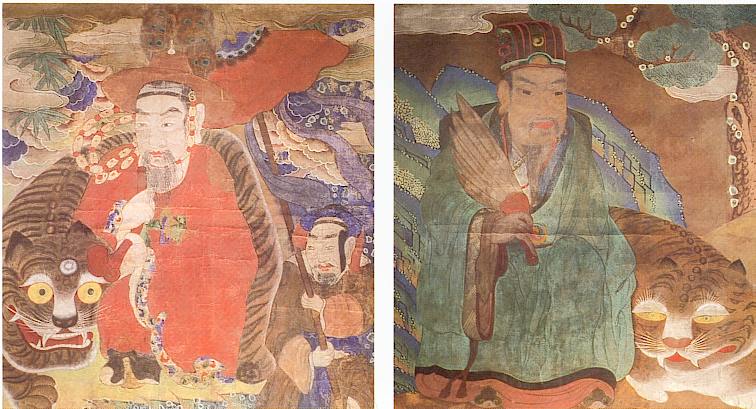
The Wired and the Zonked: On the left, San-shin wears a traditional horsehair kat that looks almost like
a cowboy hat (extremely rare), with a fancy beaded chin-strap like Korean military officers used to
wear. His tiger has had too much coffee (tho his tail droops), and a guardian-figure holds a
rank-symbol sun-shade (extremely rare). On the right, San-shin wears a stiff felt court-official's hat, his
outer robe is green (extremely rare), and his tiger has yet to taste his coffee this morning.
a cowboy hat (extremely rare), with a fancy beaded chin-strap like Korean military officers used to
wear. His tiger has had too much coffee (tho his tail droops), and a guardian-figure holds a
rank-symbol sun-shade (extremely rare). On the right, San-shin wears a stiff felt court-official's hat, his
outer robe is green (extremely rare), and his tiger has yet to taste his coffee this morning.
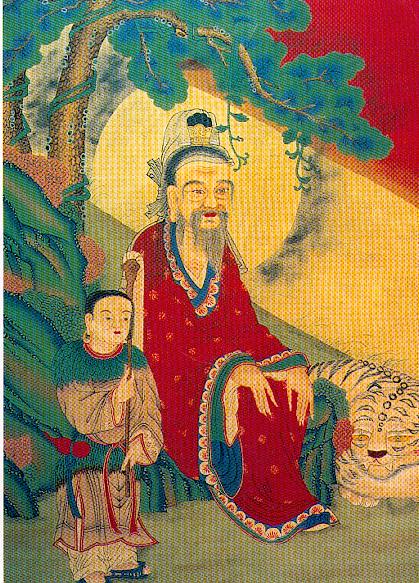
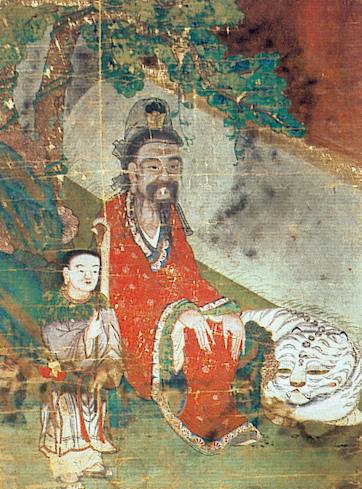
The antique on the left
was copied by Horae
in exact detail to make
the new version shown
on the right.
The dongja attendant-
boy holds a Zen
meditation-master's
fly-wisk. Note the
leaf-mantle on the boy
and the (sacred)
white tiger; both
motifs are fairly rare.
was copied by Horae
in exact detail to make
the new version shown
on the right.
The dongja attendant-
boy holds a Zen
meditation-master's
fly-wisk. Note the
leaf-mantle on the boy
and the (sacred)
white tiger; both
motifs are fairly rare.
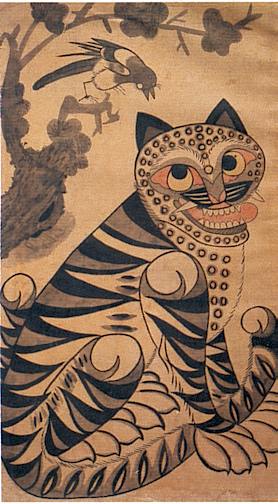
Horae's very favorite Korean
Tiger folk-painting, from the early 19th
Century, displaying the Kkachi-horangi
[magpie and tiger] motif.
This classic theme shows up in some
Sanshin paintings, such as the great one
in the Jung-ak-dan [Central Peak Altar]
at Shinwon-sa (see pages 154-55 and
76-80 in my book).
Tiger folk-painting, from the early 19th
Century, displaying the Kkachi-horangi
[magpie and tiger] motif.
This classic theme shows up in some
Sanshin paintings, such as the great one
in the Jung-ak-dan [Central Peak Altar]
at Shinwon-sa (see pages 154-55 and
76-80 in my book).