| SPECIAL REPORT: The Rooster-Dragon-Platform Male and Female Dragon Pools [Gye-ryong-dae Ahm & Sut Yong-Chu] |
Gyeryong-san [Rooster-Dragon Mountain] has been one of Korea's most sacred areas for all its
recorded history. Important temples have been located here since the early Baekje Dynasty.
Especially the southern slope, a very steep drop down from the 850-meter Cheon-hwang-bong
[Heavenly-King Peak], and the valley formed at its foot called Shindoan [New-Dao-Peace, or "the
New Way of Peace"]. The founder-kings of both the Goryeo Dynasty (10th-14th cen) and
Joseon Dynasty (15th-19th cen) originally planned to locate their royal capitals in this valley, but
were persuaded to coose other sites further north (Gaeseong and Hanyang/Seoul, respectively).
Muhak-daesa, the legendary geomancer-monk who set up Seoul as the capital of the Joseon
Dynasty in 1390, predicted that it would last for only 500 years (which turned out to be roughly
true), and that the NEXT dynasty would be established with its palace on this very slope. In the
late Joseon, a geomancy-based book of prophecy called Jeonggam-rok revived the prediction
that Sindoan would be the royal capital for a "Jeong Dynasty" that would succeed Joseon. So,
this area attracted many religious communities of Mountain-Spirit-worshipping monks & shamans
over the last five centuries, hoping to kick-start the foundation of a new, stronger kingdom.
recorded history. Important temples have been located here since the early Baekje Dynasty.
Especially the southern slope, a very steep drop down from the 850-meter Cheon-hwang-bong
[Heavenly-King Peak], and the valley formed at its foot called Shindoan [New-Dao-Peace, or "the
New Way of Peace"]. The founder-kings of both the Goryeo Dynasty (10th-14th cen) and
Joseon Dynasty (15th-19th cen) originally planned to locate their royal capitals in this valley, but
were persuaded to coose other sites further north (Gaeseong and Hanyang/Seoul, respectively).
Muhak-daesa, the legendary geomancer-monk who set up Seoul as the capital of the Joseon
Dynasty in 1390, predicted that it would last for only 500 years (which turned out to be roughly
true), and that the NEXT dynasty would be established with its palace on this very slope. In the
late Joseon, a geomancy-based book of prophecy called Jeonggam-rok revived the prediction
that Sindoan would be the royal capital for a "Jeong Dynasty" that would succeed Joseon. So,
this area attracted many religious communities of Mountain-Spirit-worshipping monks & shamans
over the last five centuries, hoping to kick-start the foundation of a new, stronger kingdom.
Twenty-five years ago, the Military Government of South
Korea decided to move their official Military
Headquarters Base out of Seoul, and chose that same
site (just a coincidence, i'm sure!). The decision was
made late in the Park regime (and may be another sign of
the advancing meglomania that led to his downfall), and
was implemented in the 1980s by the Chun government.
The base opened in 1989.
It's said they kicked 15,000 shamans & monks & others off
the land, destroying hundreds of shrines & temples. A
remarkable and tragic act of cultural destruction. Some
shamans remained, hidden in camoflouged tents, while
others continued to slip in by hiking over the wild steep
ridges in the back. They would light candles and pray at
night -- soldiers caught glimpses of them and thought
they were Mountain-spirits!
Korea decided to move their official Military
Headquarters Base out of Seoul, and chose that same
site (just a coincidence, i'm sure!). The decision was
made late in the Park regime (and may be another sign of
the advancing meglomania that led to his downfall), and
was implemented in the 1980s by the Chun government.
The base opened in 1989.
It's said they kicked 15,000 shamans & monks & others off
the land, destroying hundreds of shrines & temples. A
remarkable and tragic act of cultural destruction. Some
shamans remained, hidden in camoflouged tents, while
others continued to slip in by hiking over the wild steep
ridges in the back. They would light candles and pray at
night -- soldiers caught glimpses of them and thought
they were Mountain-spirits!
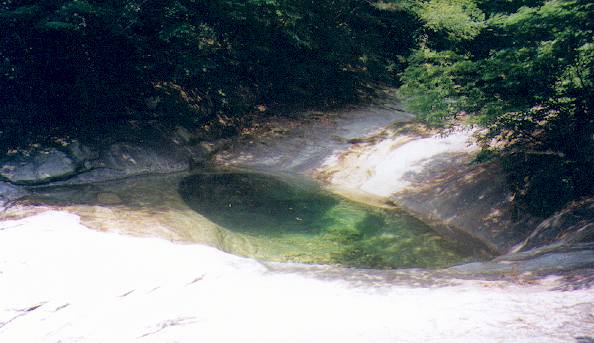
The Ahm-yong-chu [Female Dragon Pool] itself, water
flowing in from the top and out on the left. The dragoness
was believed to live in the underwater cave that looks like
a dark shadow in the center of this photo. Women,
especially Shamans, once prayed and bathed here for
feminine sorts of powers.
flowing in from the top and out on the left. The dragoness
was believed to live in the underwater cave that looks like
a dark shadow in the center of this photo. Women,
especially Shamans, once prayed and bathed here for
feminine sorts of powers.
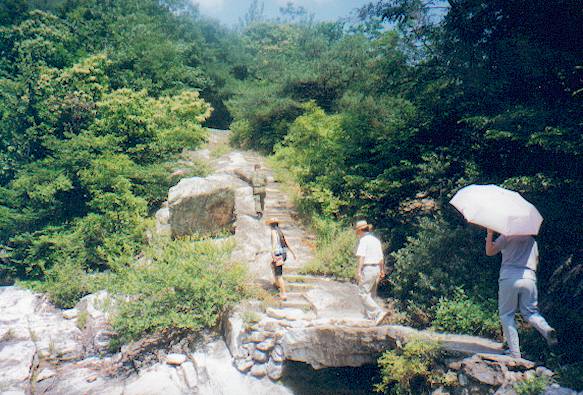
On our way up to the Female Dragon Pool, Sgt.Cho
leading the way, on a hot sunny June day, way back in
the near-wild northern area of Kyeryong-dae Base. The
site of a formerly-important Sam-shin-gak [Three-Spirits
Shrine] is near here, but we were unable to get to it due
to the heavy overgrowth of brush.
leading the way, on a hot sunny June day, way back in
the near-wild northern area of Kyeryong-dae Base. The
site of a formerly-important Sam-shin-gak [Three-Spirits
Shrine] is near here, but we were unable to get to it due
to the heavy overgrowth of brush.
Since i found out about all this 14 years or so ago, I've waited and hoped for a chance to go there, and finally
the chance came. My friend Ryu Je-hon (a professor of Cultural Geography and expert on the relationships
between Korea's landforms with its religions) got a connection with a general, and we made an appointment
for a tour to see the most sacred remaining sites there. A sergeant in charge of the base's security, real
strong & tough sort, escorted and guided us for 4 hours in his jeep and on foot. We saw the famous "Male
Dragon Pool" & "Female Dragon Pool" (in gorges, with waterfalls). He let me take all the photos i wished. He
insisted that due to tight security all Shamanic and Mountain-worship activity there had been stopped for 10
years --- but then i found a fresh candle in a stone niche next to the Male Dragon Pool -- oooops. He said a
soldier must have left it there...
the chance came. My friend Ryu Je-hon (a professor of Cultural Geography and expert on the relationships
between Korea's landforms with its religions) got a connection with a general, and we made an appointment
for a tour to see the most sacred remaining sites there. A sergeant in charge of the base's security, real
strong & tough sort, escorted and guided us for 4 hours in his jeep and on foot. We saw the famous "Male
Dragon Pool" & "Female Dragon Pool" (in gorges, with waterfalls). He let me take all the photos i wished. He
insisted that due to tight security all Shamanic and Mountain-worship activity there had been stopped for 10
years --- but then i found a fresh candle in a stone niche next to the Male Dragon Pool -- oooops. He said a
soldier must have left it there...
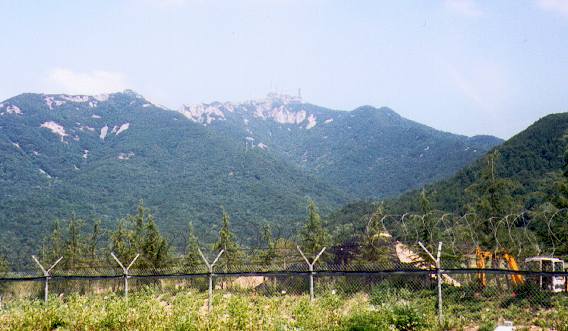
Gyeryong-san's highest peak, now topped with
military communications gear, from the south,
within the Kye-ryong-dae Base.
military communications gear, from the south,
within the Kye-ryong-dae Base.
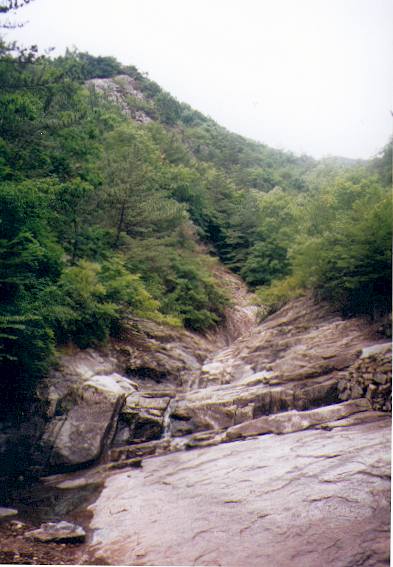
General area of the Male Dragon Pool, looking north.
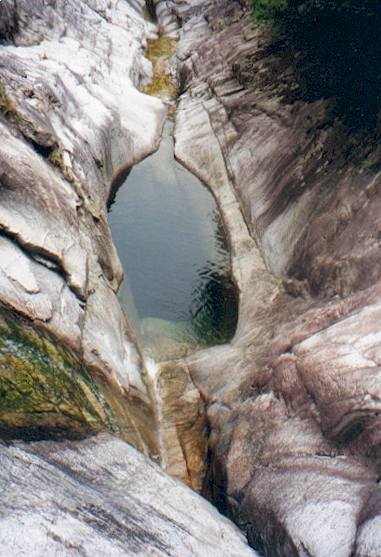
The Sut-yong-chu [Male Dragon Pool] seen from the top of
the waterfall that feeds it. It's shape resembles an
(uncircumcised) penis. With "outflow" at the tip... An
underwater cave can be seen. Women once bathed here
in hopes of having a son; Shamans would pray here for
masculine sorts of powers.
the waterfall that feeds it. It's shape resembles an
(uncircumcised) penis. With "outflow" at the tip... An
underwater cave can be seen. Women once bathed here
in hopes of having a son; Shamans would pray here for
masculine sorts of powers.
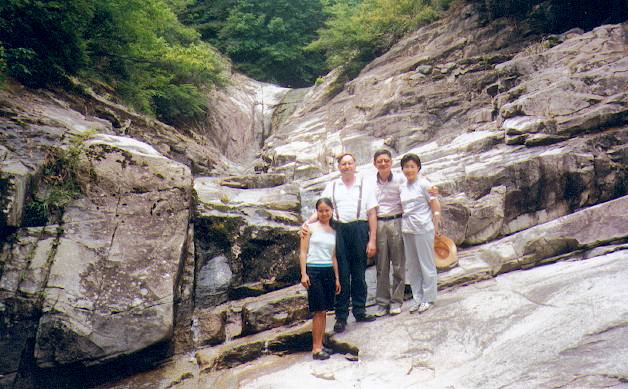
My wife, myself, Dr. Ryu and his wife --
below the Male Dragon Pool, June 22nd 2002.
below the Male Dragon Pool, June 22nd 2002.
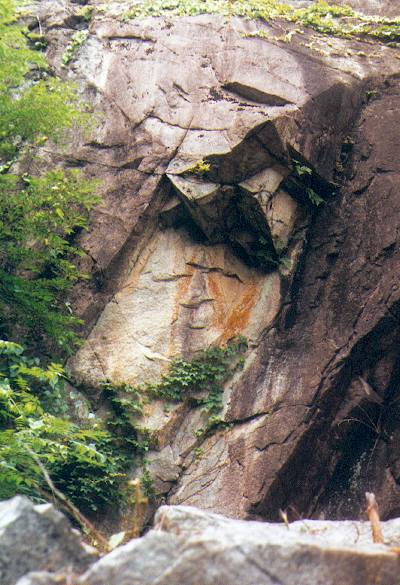
Right next to the Male Dragon Pool, TWO humanish faces
naturally appearing in the granite cliff-face -- below, a wise
if perhaps sleepy sage; above, a distorted, eye-injured ET-
sortta face. This surely MEANS something... and is one of
the reasons this site has long been one of Korea's most sacred.
naturally appearing in the granite cliff-face -- below, a wise
if perhaps sleepy sage; above, a distorted, eye-injured ET-
sortta face. This surely MEANS something... and is one of
the reasons this site has long been one of Korea's most sacred.
It's a high-security base now, called Kye-ryong-dae [Rooster-Dragon Platform], no public access, no photos
permitted. Only the sites of some major shrines & temples (with only foundation-stones remaining) can still be
found if you can get in at all. The Chinese character "platform" [dae] as suffix in the name means a very
special place, via Buddhism -- the platform was (and is) the small raised stage that a Buddhist master sits on
to deliver a sermon, thereby symbolizing Sakyamuni Buddha himself. Many pavilions atop hills and sites by
cliffs thought to have strong geomantic positions & powers are called xx-xx-dae in Korean.
permitted. Only the sites of some major shrines & temples (with only foundation-stones remaining) can still be
found if you can get in at all. The Chinese character "platform" [dae] as suffix in the name means a very
special place, via Buddhism -- the platform was (and is) the small raised stage that a Buddhist master sits on
to deliver a sermon, thereby symbolizing Sakyamuni Buddha himself. Many pavilions atop hills and sites by
cliffs thought to have strong geomantic positions & powers are called xx-xx-dae in Korean.