| NEXT PAGE ---> |
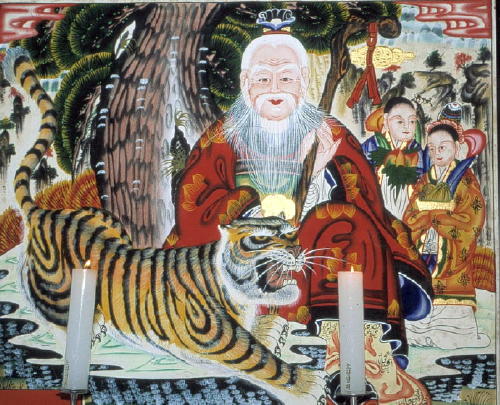
| This ordinary but well-done San-shin painting was found at the "Hwangdo Kut-dang" [Kingly Way Ritual Shrine]. The Mountain-spirit holds a holds a staff-with-bottle and golden bullocho sprig, and is being offered peaches-of-immortality and other fruit. |
| Some San-shin Icons Enshrined and Used by Shamans in Kyeonggi Province Part One |
 |
 |
| Purely Shamanic shrines run by Manshin or Mudang [Korean Shamans] and used for Kut [ritual ceremonies, usually involving spirit-posession] used to always disguise themselves as Buddhist temples, adopting temple-names like X-X-sa or X-X-am. But since the late 1990s, as Shamanism has become more accepted in South Korea as a key aspect of national heratige (if not yet legitimate as a religion or psychological therapy), many of them are openly using the title Kut-dang, a sort of public 'coming-out'. |
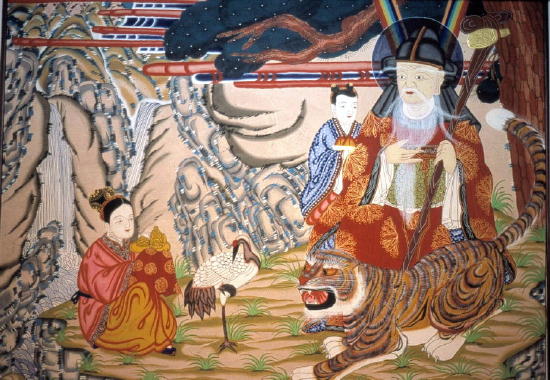 |
| This is very nicely done for a mushindo [painting of a spirit used by a Manshin]. The crane (symbol of the virtues of a Confucian scholar) standing on one leg and the dongja-girl kneeling while offering a matching ceramic bottle and turned-over cup (of longevity medicine or wine) to her master are unusual elaborations. |
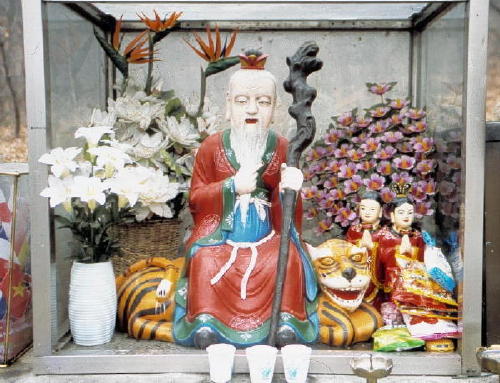
| All three of these San-shin icons are enshrined at the "Kwang-gyo Kut-dang" [Luminescent Bridge Ritual Shrine], in Kyeonggi-do. All the photos on this page and next were taken and provided to me by my friend and fellow researcher Dirk Schlottmann. |
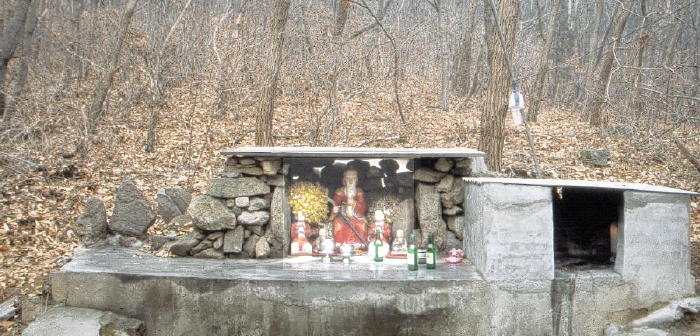 |
| This outdoor San-shin altar at the Kwang-gyo Kut-dang was built together with a spring-water well, and would in most cases would rather be a Yong-wang [Dragon-King of the Waters] shrine. The several opened bottles of soju [Korean crude liquor, like vodka] were left as offerings to this small mountain. |