| Sobaek-san's Biro-bong Biro-sa -- page two -- |
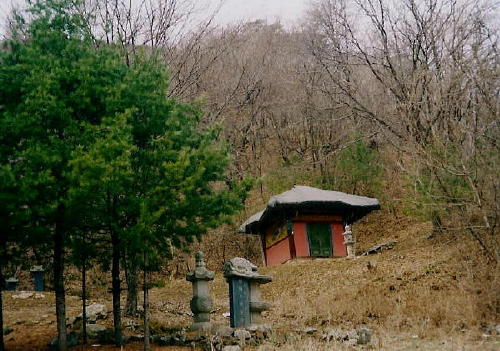
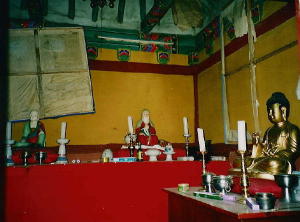
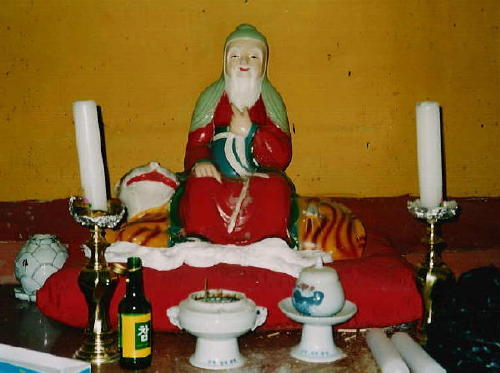
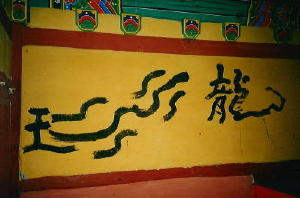
| The old San-shin Shrine of Biro-sa, just up to the right, has the temple's stone Budo [funerary monuments] in front of it. Inside is a simple display of an ordinary San-shin statue (in the Stroking Beard motif, with mantle on shoulders), flanked by Dok-seong and a Buddha. On the left wall (below) is a unique Chinese-character calligraphy (i don't know what it says). |
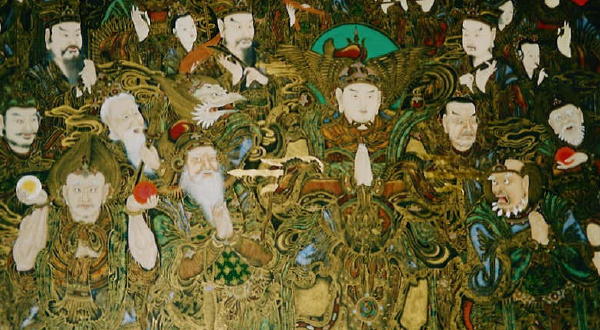
| San-shin is holding a master's staff over on the left of the Shin-jung painting of the Main Hall (just above-right the Sun & Moon Spirit). Yong-wang the Dragon King and his fishy deputy are over on the right, for balance. |
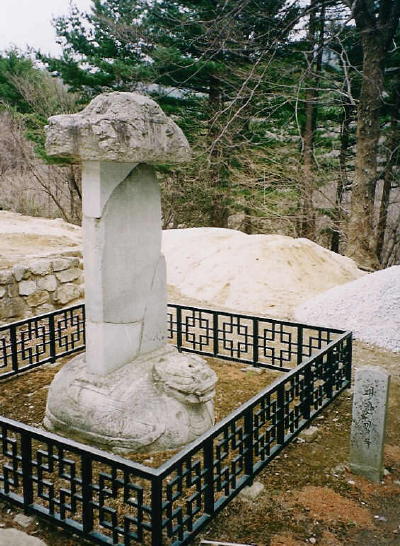
| In the lower courtyard of Biro-sa is preserved the Dragon-biseok-turtle monument for Jin-gong-daesa (855-937), a great Buddhist Master who led the transition from the exhausted Unified Shilla Dynasty to the revitalized Goryeo Dynasty. He reconstructed Biro-sa as part of those efforts to maintain a strong religion centered around the Hwa-eom [Lotus-Sutra] Sect. |
| INDEX of NEW---> |
 |
 |
 |
 |
 |
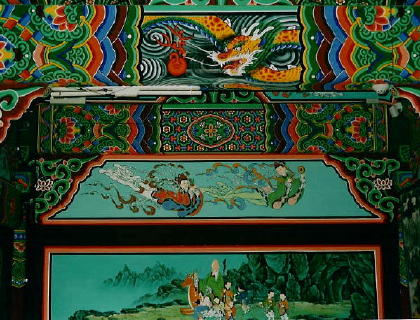 |
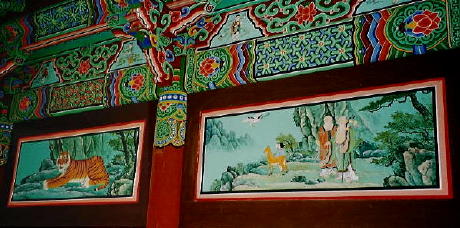
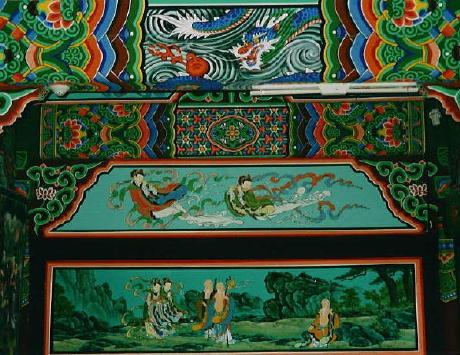
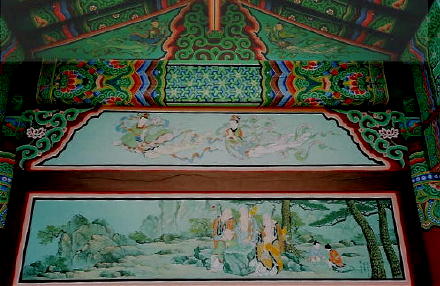
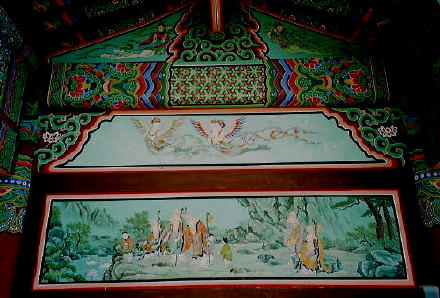
| Great paintings of Shin-seon [Spiritual-Immortals, fully enlightened people in total harmony with Nature, more a Daoist concept than actual Zen] cavorting in Korean scenery and Angels flying above, on the outer walls of the new Sam-seong-gak. This is a good example of the extensive-but-subtle Chinese Daoist influence on Korean Buddhism. |
 |
 |
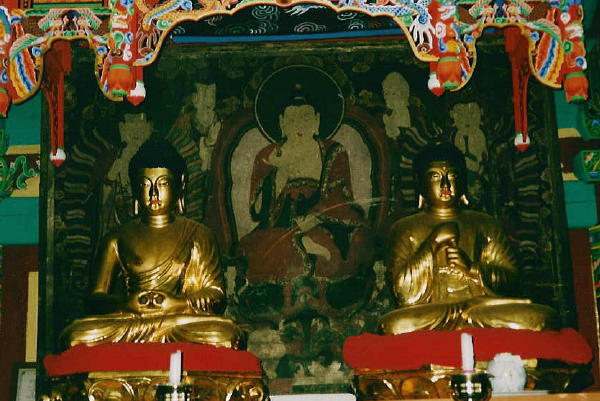 |
| Biro-sa's Main Hall enshrines excellent twin bronze statues of Amita Buddha (left) and Biro Buddha (right), probably cast in the Joseon Dynasty. Amita's mudra (hand-position) is pure focused meditation. Biro-bul (Vairocana)'s mudra manifests the Cosmic Unity of eum-yang (Yin / Yang), and the passionate intensity with which one aspiring to wisdom must pursue it. Called the "fist of knowledge," it is made up of the left-hand "diamond finger" (representing humanity) thrusting upwards into the right-hand "diamond fist" (representing the inspiration and protection of the Buddha-realms). Diamonds represent the supreme incisive strength and durability of Buddhist insight. |
 |
 |
 |
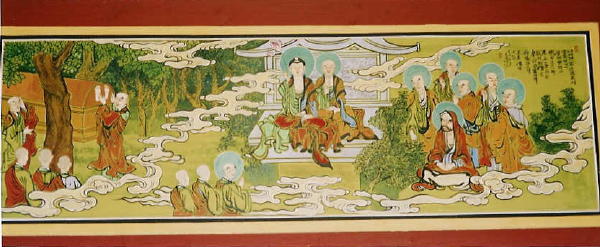
| A great painting on the outer wall of the Main Hall depicts the mythical historical origin of Zen Buddhism [Seon-bulgyo], which played such a big role in Korea, interacting with San-shin -- the Flower Sermon in the center, the funeral of Buddha on the left, and the first Six Patriarchs of Zen on the right. |
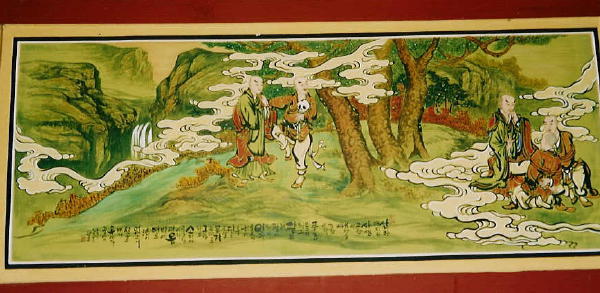
| A companion painting there depicts the story of two of Korea's greatest monks, Wonhyo and Euisang (founder of Biro-sa) -- the origins of Zen doctrine and consciousness in Korea, and together a major reason why Korean Buddhism is "Korean" and not just a branch of Chinese Buddhism... |
 |
 |