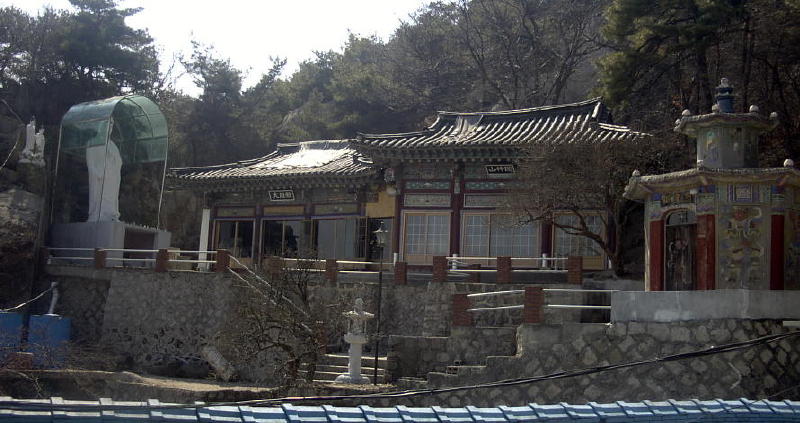
| Seoul's Three-Peaks Mountains Brotherhood Peak "Comfortable-Prosperity Temple", which contains a unique and important modern San-shin Shrine. From left to right: a large Gwanse-eum-bosal statue, the Main Hall, the unusually large and prominent San-shin-gak [Mountain-spirit Shrine], and the unique octagonal Deok-seong-gak. Constructed after the Korean War on an old Joseon-Dynasty temple-site (used for shamanic San-shin worship for centuries before that), Wangryeong-sa is reached by a dirt road, 20 minutes up from the trailhead next to the entrance of Kookmin University, near the eastern end of the Bugak Tunnel. |
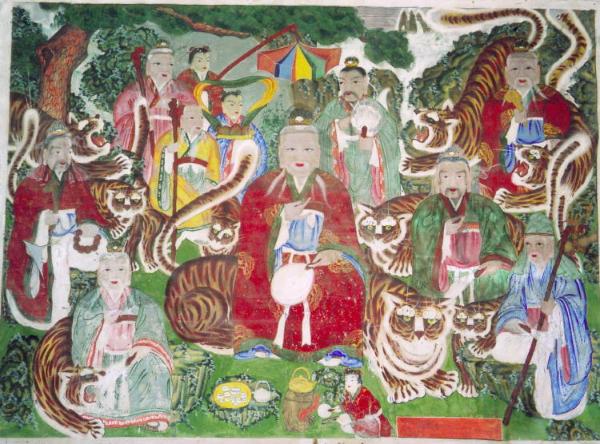
The unique and remarkable San-shin painting of Wangryeong-sa
...that depicts 9 different male Mountain-spirits, each with his own (realistic-looking) tiger. They display the full
variety of traditional headgear. One holds both a sprig of bullocho (mushroom of immortality) and a Buddhist
yeomju (prayer-beads), one has only the bullocho. One (in the Daoist cloud-cap) holds both a master's staff
and a white-crane-feather-fan, while two hold only a staff and three (including the larger central San-shin) hold
only a fan. Two dongja boys are shown near the top (left of center), one (with flying-scarf) offering three
peaches-of-immortality and the other holding a colorful canopy over the central San-shin (a motif indicating
royalty or Buddha-status). A third dongja boy is preparing Green Tea for everyone at center-bottom.
I would initially assume that this excellent icon was intended to depict the "Seonjong Gusan" [Nine Mountains
of the Seon (Meditational, J: Zen, Ch: Ch'an) Buddhist Sect], referring to the homes of the headquarters-temples of
the original nine Seon sects established in Korea in the 9th century CE -- and also reflecting an ancient
concept in Korea and China of nine sacred peaks that protect and nourish the Kingdom. Other shrines and
paintings of the Gu-san are exceedingly rare in this nation, but a few do exist. I do note that this identification
does not explain why one San-shin (and his tiger) are central and larger... (see further discussion below)
...that depicts 9 different male Mountain-spirits, each with his own (realistic-looking) tiger. They display the full
variety of traditional headgear. One holds both a sprig of bullocho (mushroom of immortality) and a Buddhist
yeomju (prayer-beads), one has only the bullocho. One (in the Daoist cloud-cap) holds both a master's staff
and a white-crane-feather-fan, while two hold only a staff and three (including the larger central San-shin) hold
only a fan. Two dongja boys are shown near the top (left of center), one (with flying-scarf) offering three
peaches-of-immortality and the other holding a colorful canopy over the central San-shin (a motif indicating
royalty or Buddha-status). A third dongja boy is preparing Green Tea for everyone at center-bottom.
I would initially assume that this excellent icon was intended to depict the "Seonjong Gusan" [Nine Mountains
of the Seon (Meditational, J: Zen, Ch: Ch'an) Buddhist Sect], referring to the homes of the headquarters-temples of
the original nine Seon sects established in Korea in the 9th century CE -- and also reflecting an ancient
concept in Korea and China of nine sacred peaks that protect and nourish the Kingdom. Other shrines and
paintings of the Gu-san are exceedingly rare in this nation, but a few do exist. I do note that this identification
does not explain why one San-shin (and his tiger) are central and larger... (see further discussion below)
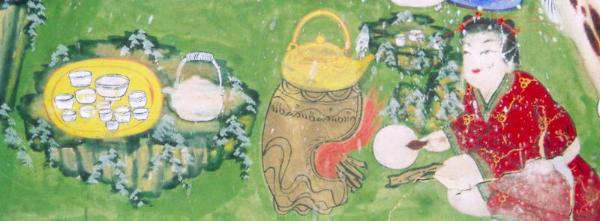
| detail of the attendant-boy making tea for everyone at bottom-center. |
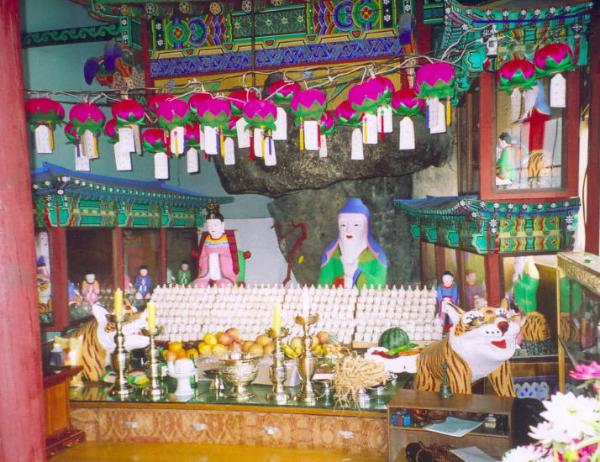
The unique and fascinating San-shin shrine interior at Wangryeong-sa
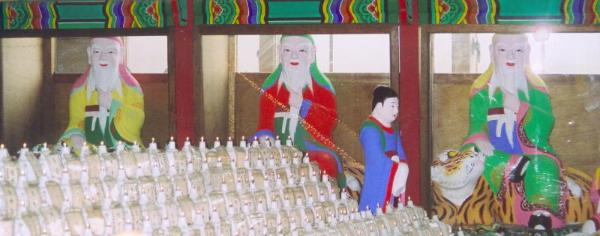
...which enshrines one large statue of San-shin wearing a cloud-cap and holding a crooked staff. Next to him is a
royally-dressed young woman with her hands clasped within sleeves, seated on a throne-chair -- she represents
his "Wife", the equal and complementary femine spirit of Korean mountains (for a full discussion of the theories and
depictions of San-shin gender, see pages 37-40 of my book). Two large wooden tigers are in front of them.
Behind the main San-shin is a natural outcropping of granite rock that forms a natural canopy over him -- this
entire wooden shrine-building, and the attached Main Hall, was built over it. A wooden canopy-front has been
built over its top, to enhance it. On the rock (seen to the statue's right) is carved the four Chinese characters
"San-wang-dae-shin" [Mountain King (is a) Great Spirit], Korea's primary chanted-prayer to the San-shin. This
rock was probably the original shamanic San-shin shrine on this site, that the Buddhist temple was built around.
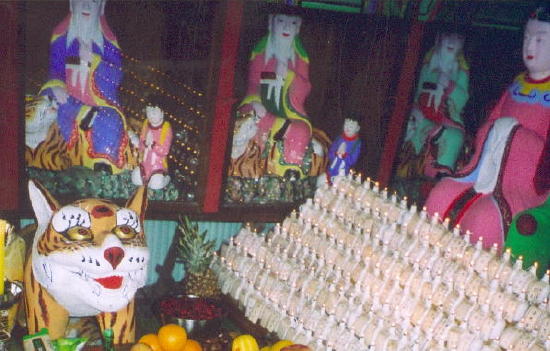
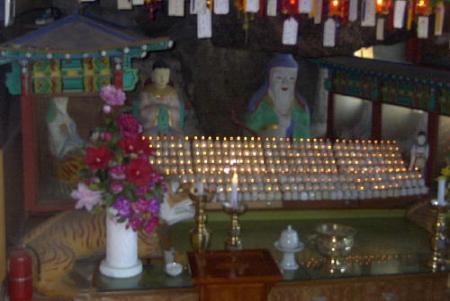
In front of it all is a full offering-altar, with white electric candles lit for the monthly subscribers to this shrine.
...which enshrines one large statue of San-shin wearing a cloud-cap and holding a crooked staff. Next to him is a
royally-dressed young woman with her hands clasped within sleeves, seated on a throne-chair -- she represents
his "Wife", the equal and complementary femine spirit of Korean mountains (for a full discussion of the theories and
depictions of San-shin gender, see pages 37-40 of my book). Two large wooden tigers are in front of them.
Behind the main San-shin is a natural outcropping of granite rock that forms a natural canopy over him -- this
entire wooden shrine-building, and the attached Main Hall, was built over it. A wooden canopy-front has been
built over its top, to enhance it. On the rock (seen to the statue's right) is carved the four Chinese characters
"San-wang-dae-shin" [Mountain King (is a) Great Spirit], Korea's primary chanted-prayer to the San-shin. This
rock was probably the original shamanic San-shin shrine on this site, that the Buddhist temple was built around.
In front of it all is a full offering-altar, with white electric candles lit for the monthly subscribers to this shrine.
However, Wangryeong-sa's Abbot Ja-in Seunim explained in April 2006 that he regards both this Shrine
and its accompanying painting (which were here when he arrived) as not depicting the Seonjong
Gusan, but rather that the larger central figure is the "leader" of all national San-shin, representing them
all collectively, and also National Founding-King Dan-gun (who became a San-shin upon retirement from
his semi-divine throne). The other eight statues in the cabinets represent the "Paldo-Sanshin"
[Mountain-spirits of Korea's traditional Eight Provinces]. This is certainly a reasonable and meaningful
theory, although the labels previously on them do not correspond to any one-per-province scheme --
three of the eight listed above are in Gangwon Province alone....
and its accompanying painting (which were here when he arrived) as not depicting the Seonjong
Gusan, but rather that the larger central figure is the "leader" of all national San-shin, representing them
all collectively, and also National Founding-King Dan-gun (who became a San-shin upon retirement from
his semi-divine throne). The other eight statues in the cabinets represent the "Paldo-Sanshin"
[Mountain-spirits of Korea's traditional Eight Provinces]. This is certainly a reasonable and meaningful
theory, although the labels previously on them do not correspond to any one-per-province scheme --
three of the eight listed above are in Gangwon Province alone....
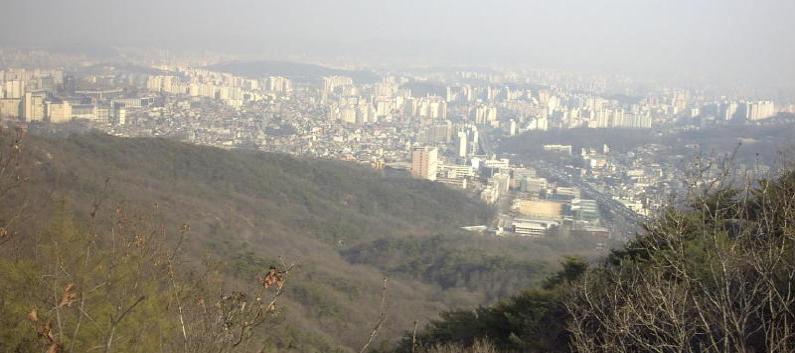
| The view of northeastern Seoul from Wangryeong-sa |
FURTHER PAGES in this SECTION:
More Features of Wangryeong-sa
the 2005 San-shin-je Ceremony & Tour there
the 2006 San-shin-je Ceremony & Tour there
San-shin Site Contents Page
More Features of Wangryeong-sa
the 2005 San-shin-je Ceremony & Tour there
the 2006 San-shin-je Ceremony & Tour there
San-shin Site Contents Page
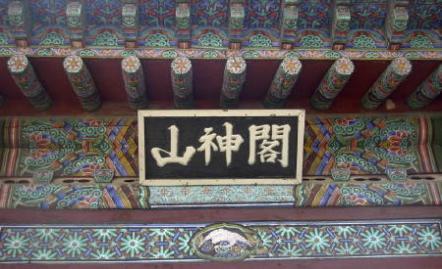
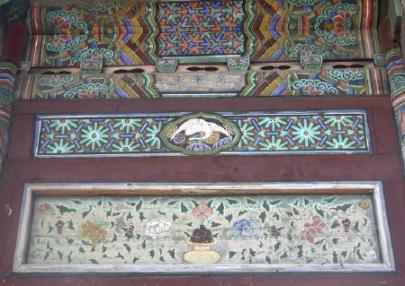
the excellent signboard and decorative
paintings on the front of the San-shin shrine
paintings on the front of the San-shin shrine
| There is no other San-shin shrine in Korea quite like this one... |
| Samgak-san Hyeongje-bong Wang-ryeong-sa |
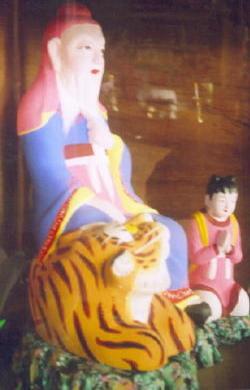
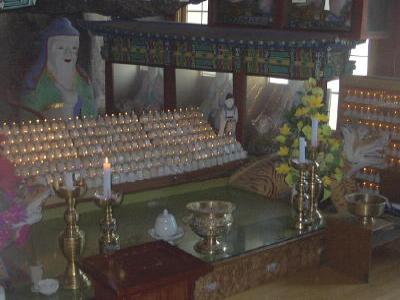
This shrines also features eight identical (although painted in different colors) statues of San-shin wearing cloud-caps
and not holding anything, sitting on tigers with one praying dongja-boy each -- each in an individual glass cabinet
(three on the left and five on the right). Until late 1995 each of these had a little sign in front of it with the name of a
very famous holy Korean Mountain -- not the Seonjong Gusan, but simply some of the most sacred. The list was
Baekdu-san, Myohyang-san, Geumgang-san, Odae-san, Taebaek-san, Gyeryong-san, Jiri-san and Halla-san (see this
page). These signs were removed when the shrine was refurbished in late 2005. There was no label on the central
figure and his wife, who I assumed represents the local host-mountain Samgak-san.
and not holding anything, sitting on tigers with one praying dongja-boy each -- each in an individual glass cabinet
(three on the left and five on the right). Until late 1995 each of these had a little sign in front of it with the name of a
very famous holy Korean Mountain -- not the Seonjong Gusan, but simply some of the most sacred. The list was
Baekdu-san, Myohyang-san, Geumgang-san, Odae-san, Taebaek-san, Gyeryong-san, Jiri-san and Halla-san (see this
page). These signs were removed when the shrine was refurbished in late 2005. There was no label on the central
figure and his wife, who I assumed represents the local host-mountain Samgak-san.