| Biseul-san Yuga-sa 瑜伽寺 유가사 One of Korea's Great Ancient Monasteries, Southwest of Daegu City |
| Biseul-san Index Page Yongyeon-sa Yongcheon-sa Nam-Jijang-sa Neo-Confucian Seowon and Hyanggyo San-shin Site CONTENTS PAGE |
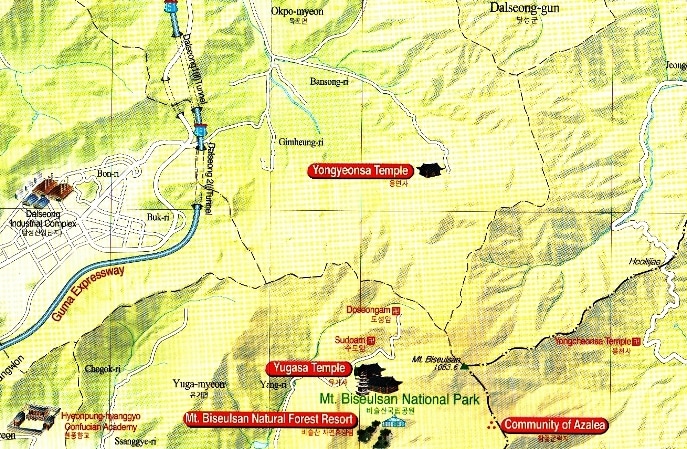
This old monastery is located on the western slopes of Biseul-san's summit, in Daegu Metropolitan
City's Dalseong County, Yuga District (달성군 유가면). It was founded in 827 CE, the 2nd year of
the Unified Shilla Dynasty's King Heungdeok (as the kingdom was in severe decline, and the Seon/Zen
School was being established nationwide), by one of the last-appearing scholastic-sect leaders, Master
Doseong [道成 도성 Dao-Accomplishment; not to be confused with National Master Doseon]; it was then
refurbished by his 2nd-generation disciple Master Tanjam [坦岑 탄잠] in 889 as Shilla neared its end.
Yuga is what Koreans call the Yogachara School of early Mahayana Buddhism (not really extant as
a distinct sect since Medieval times), once an influential sect of Buddhist philosophy and psychology
that emphasized phenomenology, ontology, epistemology, cognition, perception and consciousness,
seen through the interior lens provided by intensive meditative and Hindu yogic practices. Its full
name in Korean is 유식유가행파 Yusik-Yugahaeng-pa. Master Jajang studied it in China along with
the Vinaya. It was influential in Three-Kingdoms-Era Korean Buddhism but then superseded and
absorbed by the new Chinese Mahayana schools in the 600s. This temple represents its final surge
as a factor in Korean thought; it became a study-center for Hwaeom philosophy in the Goryeo Dynasty.
Yuga-sa has two major hermitages above it that I have not yet visited, Sudo-am and Doseong-am.
Most of the photos on this page were provided to me by my friend Dale Quarrington.
City's Dalseong County, Yuga District (달성군 유가면). It was founded in 827 CE, the 2nd year of
the Unified Shilla Dynasty's King Heungdeok (as the kingdom was in severe decline, and the Seon/Zen
School was being established nationwide), by one of the last-appearing scholastic-sect leaders, Master
Doseong [道成 도성 Dao-Accomplishment; not to be confused with National Master Doseon]; it was then
refurbished by his 2nd-generation disciple Master Tanjam [坦岑 탄잠] in 889 as Shilla neared its end.
Yuga is what Koreans call the Yogachara School of early Mahayana Buddhism (not really extant as
a distinct sect since Medieval times), once an influential sect of Buddhist philosophy and psychology
that emphasized phenomenology, ontology, epistemology, cognition, perception and consciousness,
seen through the interior lens provided by intensive meditative and Hindu yogic practices. Its full
name in Korean is 유식유가행파 Yusik-Yugahaeng-pa. Master Jajang studied it in China along with
the Vinaya. It was influential in Three-Kingdoms-Era Korean Buddhism but then superseded and
absorbed by the new Chinese Mahayana schools in the 600s. This temple represents its final surge
as a factor in Korean thought; it became a study-center for Hwaeom philosophy in the Goryeo Dynasty.
Yuga-sa has two major hermitages above it that I have not yet visited, Sudo-am and Doseong-am.
Most of the photos on this page were provided to me by my friend Dale Quarrington.
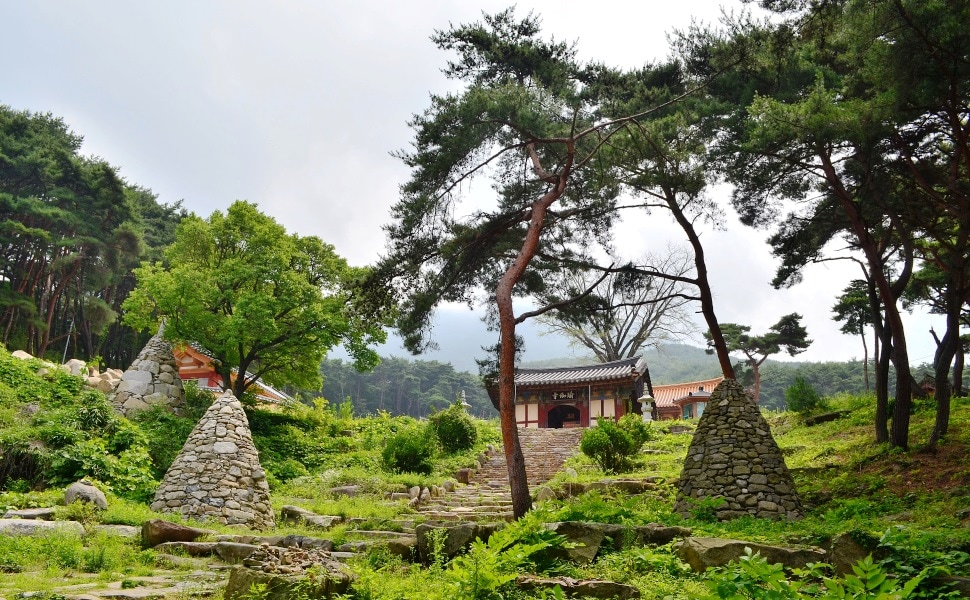

| A Joseon-era Seonang-dang [Guardian-Spirit Shrine] at the entranceway. |


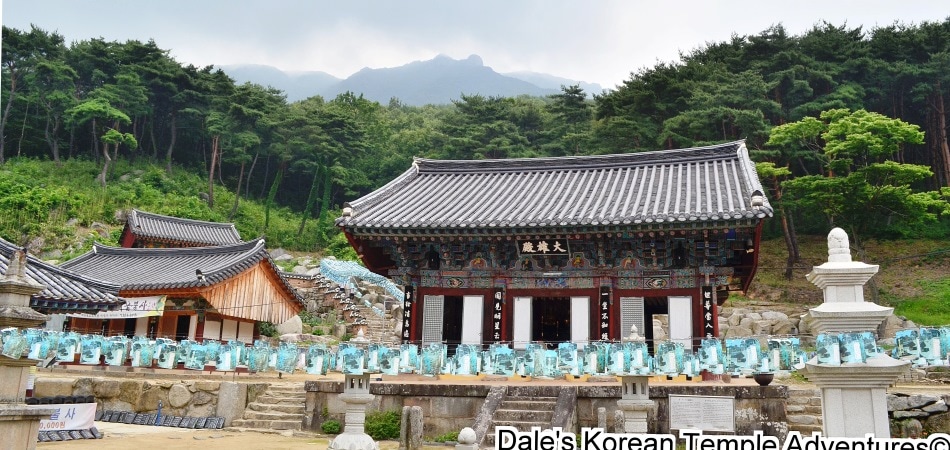
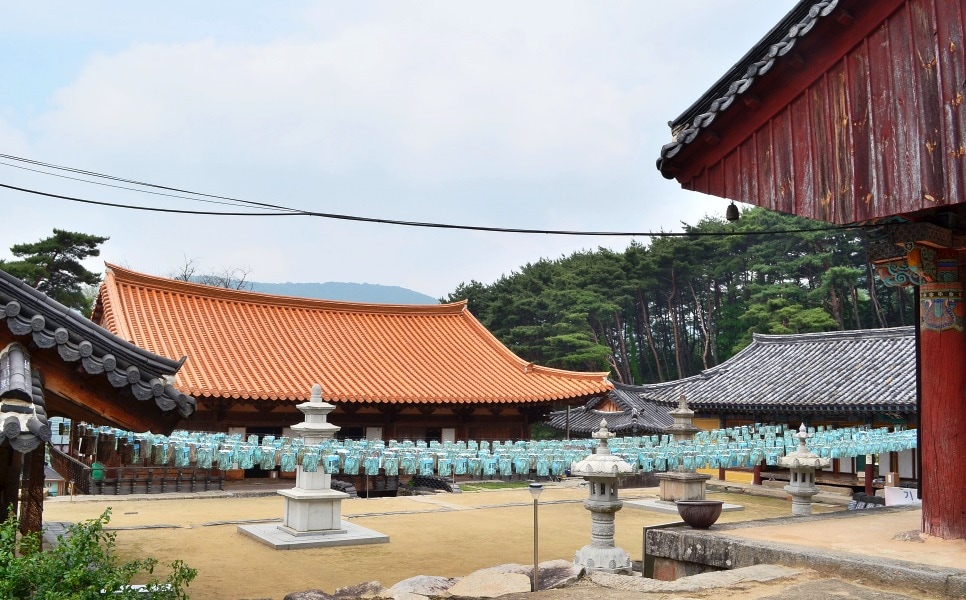
| The main courtyard has a rare two-twin-pagodas design; the east one was lost and replaced in modern times, while the west one is authentic from the 9th century. |

| A heavily-worn stone Sakyamuni Buddha from the Goryeo Era is now kept in an open shrine in the courtyard. |

| The Samseong-gak [Three Saints Shrine] is up the slope at the rear. |

| Sanshin! |
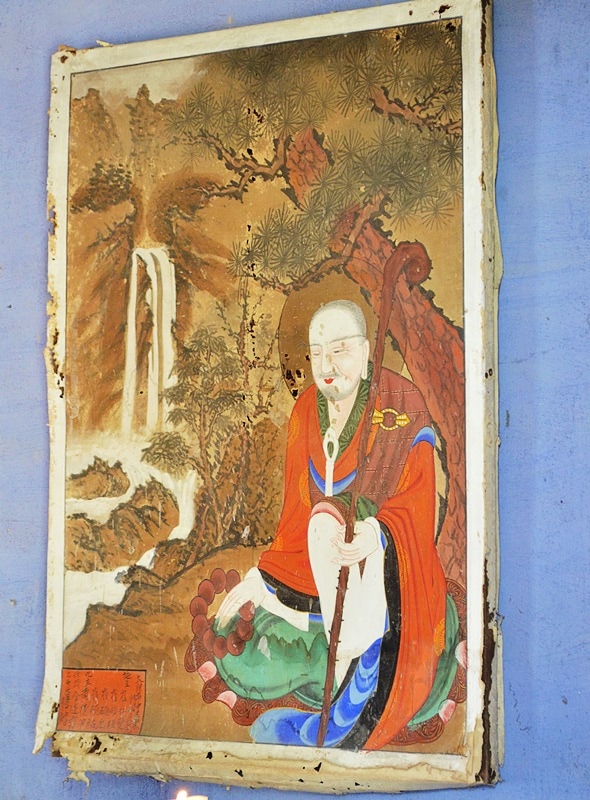
| Antique & standard Dokseong icon |
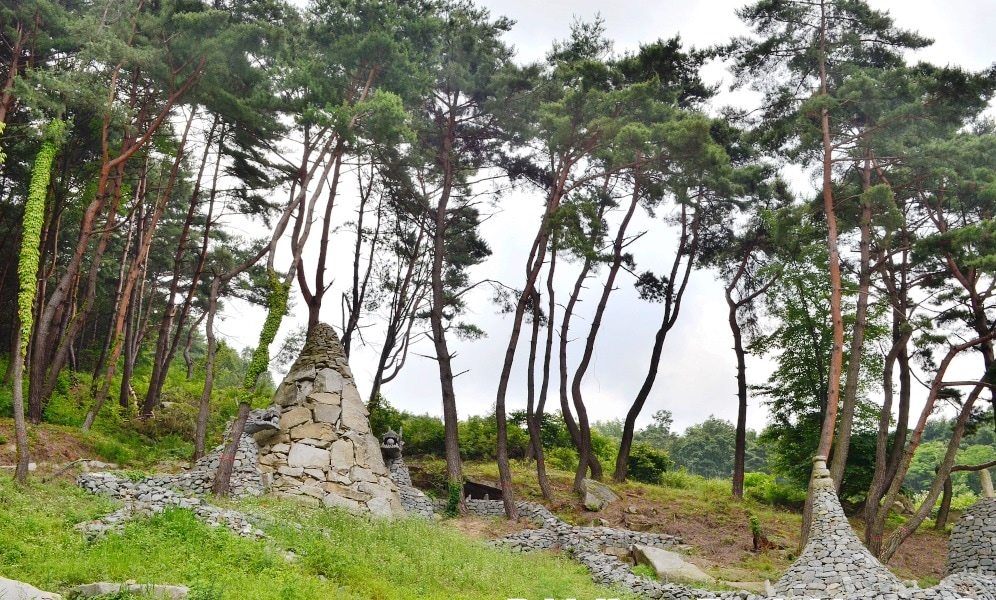
| Doltap, dol-dragons and young pines in the rear. |