| the Entranceway of Haein-sa |
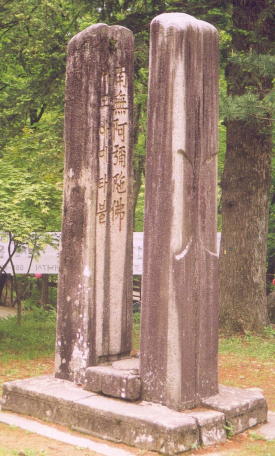
| original flagpole-supports, 800 CE |
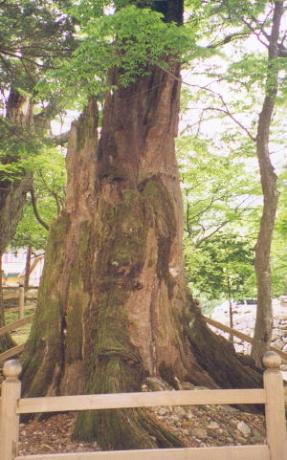
the "Gosa-mok-namu", an ancient ginko tree
that is said to have been granted by the king
of Shilla, and planted soon after Haein-sa's
foundation. It lived for over 1100 years, and
finally dying when Korea was divided in 1945.
Its children are growing all around it, some
of them already centuries old.
that is said to have been granted by the king
of Shilla, and planted soon after Haein-sa's
foundation. It lived for over 1100 years, and
finally dying when Korea was divided in 1945.
Its children are growing all around it, some
of them already centuries old.
the Main Gateways
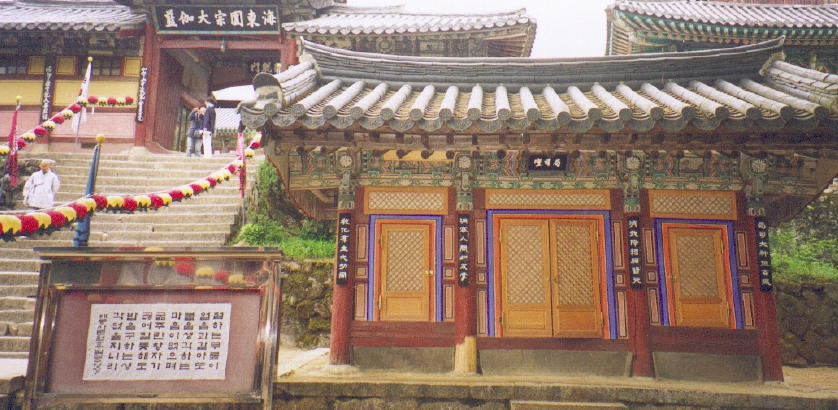
Above: the Guksa-dang or Guardian-spirit Shrine
in front of the Main Gate. Long ago it was once
a Sanshin-gak, and it is still labeled that way
in several guidebooks, which is now an error.
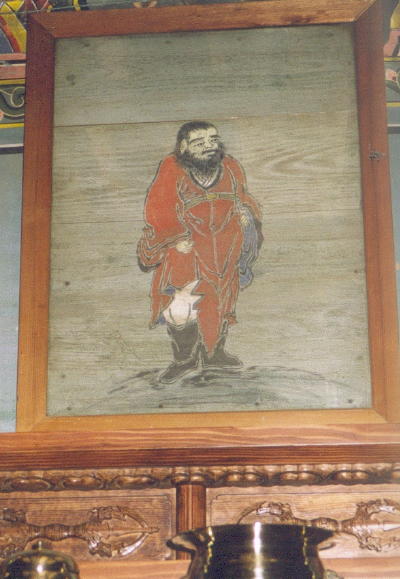
Left: the portrait of the guardian-spirit that was
the only icon in that shrine. Identity is not labeled;
it's unusual and mysterious. No background is
painted in, the wood was left bare. It's a little like
a Bodhidharma painting, but not much; he wears
the boots of a nobleman. He is surely not a
Buddhist figure of any kind. His clothing is like
that of a government official, but his beard is
untrimmed and his hair is not in a topknot --
suggesting that he's retired. Could this be the
great scholar Choi Chi-won, known to have
lived near Haein-sa near the end of his life...?
Monks at this temple denied to me that this is
Choi, but could not provide any alternate theory
of his identity -- just, "guksa guardian-spirit".
It is certainly not a San-shin, and "Go-un" Choi
Chi-won remains my own theory.
There must be some controversy over it, because
this painting was removed from this shrine in 2007!
It has been replaced by a more standard female
guardian image.
in front of the Main Gate. Long ago it was once
a Sanshin-gak, and it is still labeled that way
in several guidebooks, which is now an error.
Left: the portrait of the guardian-spirit that was
the only icon in that shrine. Identity is not labeled;
it's unusual and mysterious. No background is
painted in, the wood was left bare. It's a little like
a Bodhidharma painting, but not much; he wears
the boots of a nobleman. He is surely not a
Buddhist figure of any kind. His clothing is like
that of a government official, but his beard is
untrimmed and his hair is not in a topknot --
suggesting that he's retired. Could this be the
great scholar Choi Chi-won, known to have
lived near Haein-sa near the end of his life...?
Monks at this temple denied to me that this is
Choi, but could not provide any alternate theory
of his identity -- just, "guksa guardian-spirit".
It is certainly not a San-shin, and "Go-un" Choi
Chi-won remains my own theory.
There must be some controversy over it, because
this painting was removed from this shrine in 2007!
It has been replaced by a more standard female
guardian image.
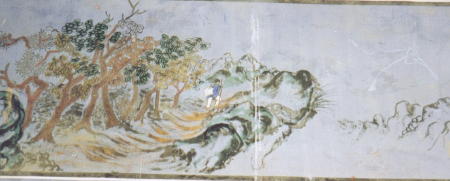
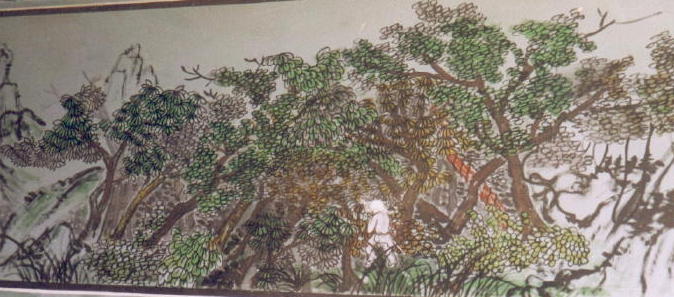
| one of the interior wall-pantings in that shrine. It seems to be a wise old man hiking through Mt. Gaya-san's deep forests -- is this Choi Chi-won, leaving Haein-sa to climb to Gaya's summit, to attain his final transition to a shinseon [Daoist Immortal]....?? |
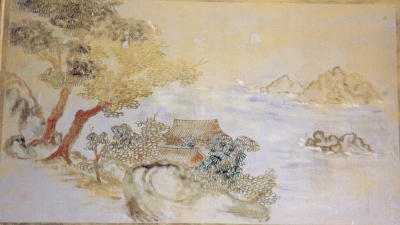
exterior wall-pantings on that shrine, very simple nature-
scenes. Daoist-flavored, like the Zen "10 Ox" series.
scenes. Daoist-flavored, like the Zen "10 Ox" series.
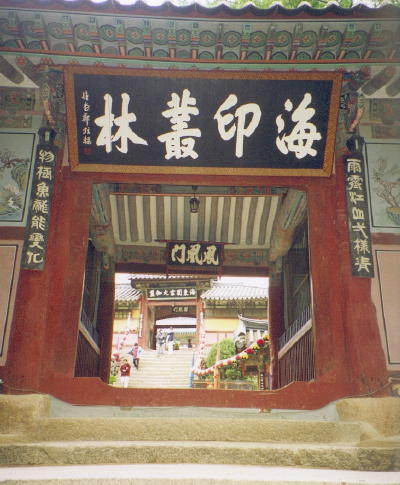
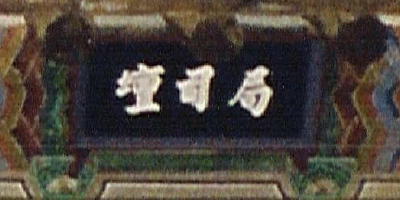
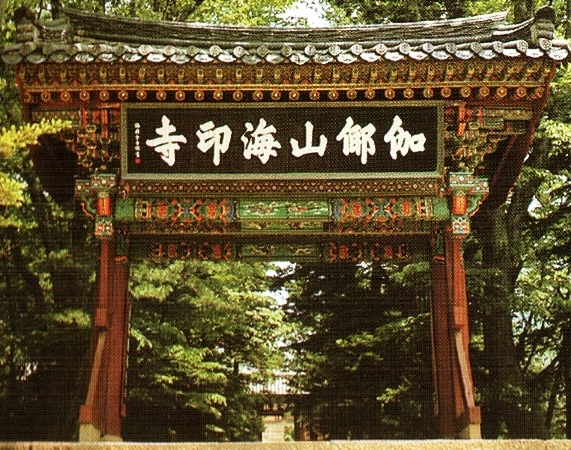
The Ilchul-mun first-gate, with signboard (R to L): "Ga-ya-san Hae-in-sa"
An info-sign recently placed in front of this shrine states
that when it was founded is "still unclear", and it is only
known that it was repaired in 1855, 1899, 1961 & 2007.
It says that this "Palace" enshrines a female deity named
Jeonggyun-myeoju, who is considered as the Guardian
of Gaya-san, and people can pray to her here for good
fortune. it says that "Jeonggyun-myeoju" refers to "the
mother of enlightenment" and founding matriarch of the
Gaya tribal-confederations (proto-kingdoms) on Korea's
southeast coast around 100-500 CE. According to some
record, her first son established "Great Gaya (DaeGaya
or Goryeong Gaya), while her second son established
Geumgwan Gaya (Gimhae Gaya, near Busan).
that when it was founded is "still unclear", and it is only
known that it was repaired in 1855, 1899, 1961 & 2007.
It says that this "Palace" enshrines a female deity named
Jeonggyun-myeoju, who is considered as the Guardian
of Gaya-san, and people can pray to her here for good
fortune. it says that "Jeonggyun-myeoju" refers to "the
mother of enlightenment" and founding matriarch of the
Gaya tribal-confederations (proto-kingdoms) on Korea's
southeast coast around 100-500 CE. According to some
record, her first son established "Great Gaya (DaeGaya
or Goryeong Gaya), while her second son established
Geumgwan Gaya (Gimhae Gaya, near Busan).