| Gyeryong-san Gap-sa Temple's Daejeok-jeon Hall of Buddha's Great Silence |
This is the original site of Gap-sa's foundation by Master Ado (supposedly in 420 CE), just a few minutes
walk SW from what is now the main temple complex. The rare name Daejeok-jeon 大寂殿 대적전
means "Great Silence Hall", referring to the absolute peace/quiet of a Buddha that has passed into
final Nirvana. It is similar to the more common halls' named Daejeokgwang-jeon 대적광전, a Biro-jeon that enshrines the
Variocana Buddha of Infinite Cosmic Light, and also the Jeokmyeol-bogung 寂滅寶宮 적멸보궁 temples with Shrines containing
Saria Relics of Sakyamuni Buddha. This highly sacred Dharma-hall sits right where the Gap-sa Main Hall
once was, built on the original foundation-stones (from 420? or...?). It is not known whether the current
Main Dharma Hall and Courtyard were constructed in their present location during the big expansion
in the late 7th century by Hwaeom Master Uisang, or the extensive refurbishment in 887 by Master
Muyeom. It is thought that this continued to be a less-public worship & study site ever since the move.
This current hall was last rebuilt in 1826, and is now designated as Tangible Cultural Property #106.
The information sign says "This hall is in great harmony with the surrounding natural landscape. It is
a traditional wooden structure [hanok] that gives visitors a sense of antiquity and spiritual intimacy
because it is not grandiose and its decoration is simple." The ancient Cheol Danggan Iron Flagpole
and its stone pillars still stand next to it; and the Gap-sa Budo Stupa was moved in front of it, instead
of the stone pagoda that probably once stood there, during the 1960s refurbishment of Gap-sa.
walk SW from what is now the main temple complex. The rare name Daejeok-jeon 大寂殿 대적전
means "Great Silence Hall", referring to the absolute peace/quiet of a Buddha that has passed into
final Nirvana. It is similar to the more common halls' named Daejeokgwang-jeon 대적광전, a Biro-jeon that enshrines the
Variocana Buddha of Infinite Cosmic Light, and also the Jeokmyeol-bogung 寂滅寶宮 적멸보궁 temples with Shrines containing
Saria Relics of Sakyamuni Buddha. This highly sacred Dharma-hall sits right where the Gap-sa Main Hall
once was, built on the original foundation-stones (from 420? or...?). It is not known whether the current
Main Dharma Hall and Courtyard were constructed in their present location during the big expansion
in the late 7th century by Hwaeom Master Uisang, or the extensive refurbishment in 887 by Master
Muyeom. It is thought that this continued to be a less-public worship & study site ever since the move.
This current hall was last rebuilt in 1826, and is now designated as Tangible Cultural Property #106.
The information sign says "This hall is in great harmony with the surrounding natural landscape. It is
a traditional wooden structure [hanok] that gives visitors a sense of antiquity and spiritual intimacy
because it is not grandiose and its decoration is simple." The ancient Cheol Danggan Iron Flagpole
and its stone pillars still stand next to it; and the Gap-sa Budo Stupa was moved in front of it, instead
of the stone pagoda that probably once stood there, during the 1960s refurbishment of Gap-sa.
NEXT: the Gongu-tap Meritorious Cow Pagoda
Entranceway Features
Sa-Cheonwang-mun Four Heavenly Kings Gate
Dae-ung-jeon Main Dharma Hall
Samseong-gak / Three Saints Shrine
Pyochung-won Shrine of Heroes
Guryong-am Nine Dragons Hermitage
Yongmun Pokpo Dragon-Gate Waterfall
Shinheung-am with Boulder Pagoda
Main Gap-sa Page
Mt. Gyeryong-san Index Page
Sanshin Site Contents Page
Entranceway Features
Sa-Cheonwang-mun Four Heavenly Kings Gate
Dae-ung-jeon Main Dharma Hall
Samseong-gak / Three Saints Shrine
Pyochung-won Shrine of Heroes
Guryong-am Nine Dragons Hermitage
Yongmun Pokpo Dragon-Gate Waterfall
Shinheung-am with Boulder Pagoda
Main Gap-sa Page
Mt. Gyeryong-san Index Page
Sanshin Site Contents Page
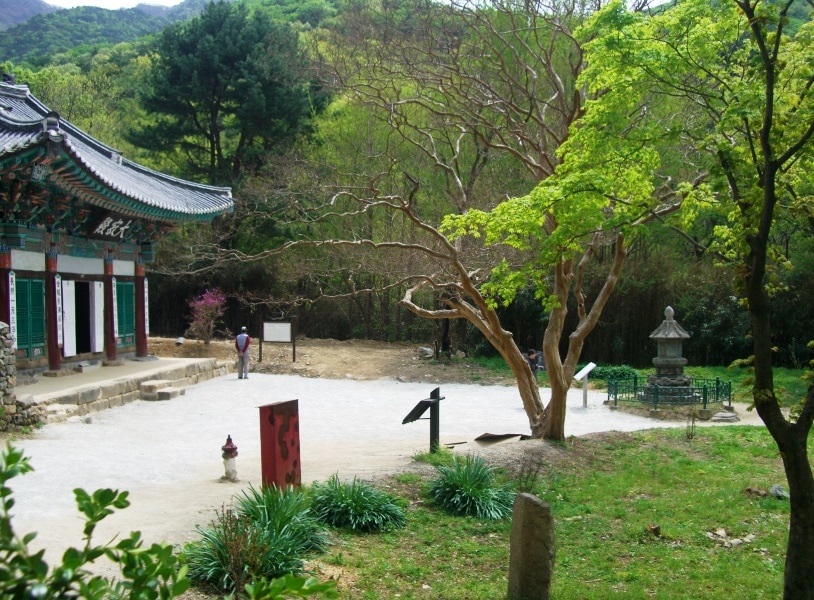
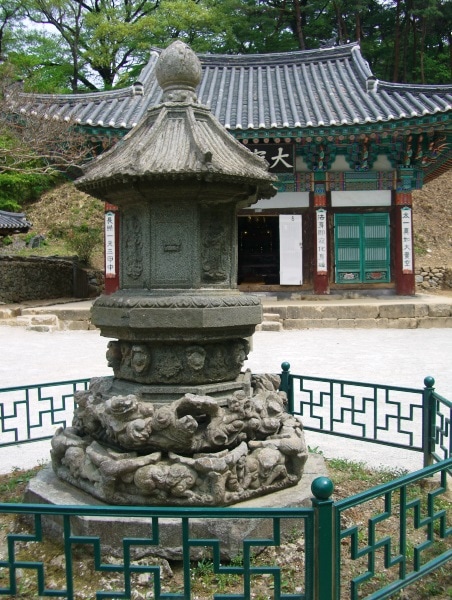
| The Gap-sa Budo Stupa in front of the Daejeok-jeon Hall |
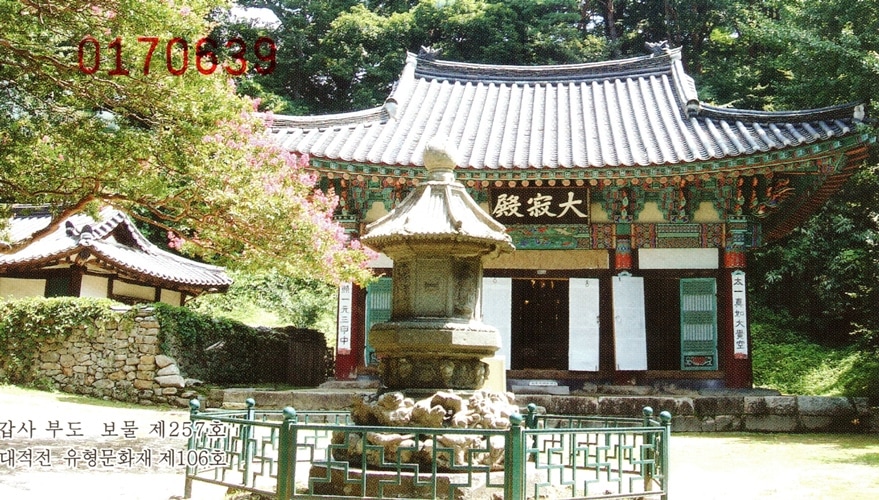
| The entrance-ticket to Gap-sa in 2012, showing the same view The building to the left is a monastic residence. |
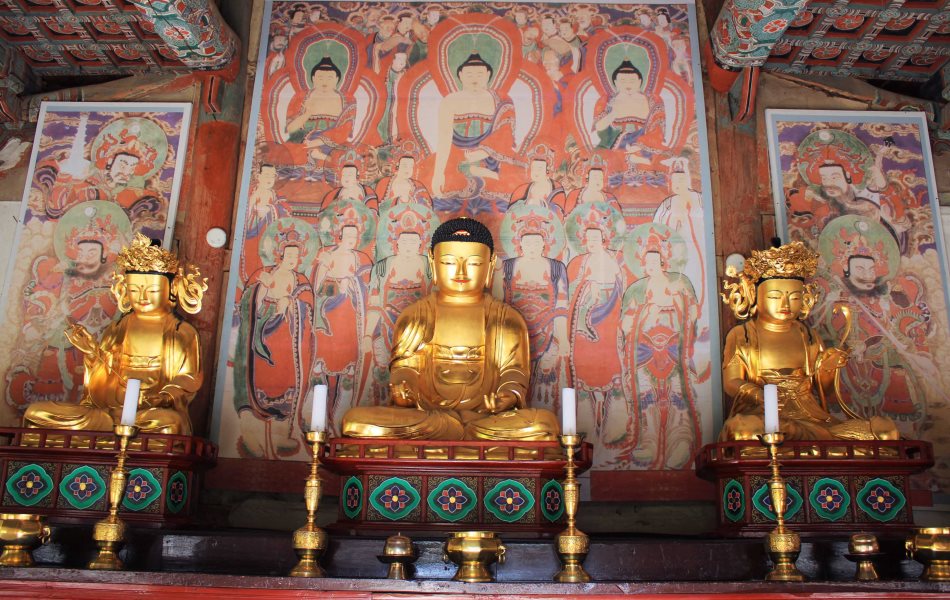
| The Main Altar of the Daejeok-jeon, with Statue of Sakyamuni the Original Buddha in a fairly rare "Teaching Mudra" mode; the painting behind him depicts the Buddhas of Past, Present and Future along with 12 Bodhisattvas below and the 16 Nahan Disciples above. He is flanked on his left by Munsu-bosal the Bodhisattva of Wisdom, who is flanked by the Cheonwang of North and West. He is flanked on his right by Bohyeon-bosal the Bodhisattva of Benevolent Action, who is flanked by the Cheonwang of East and South. |
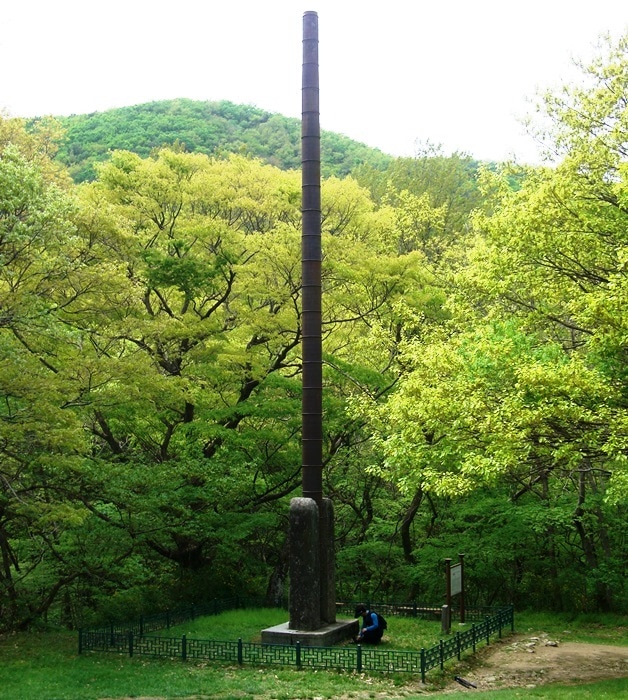
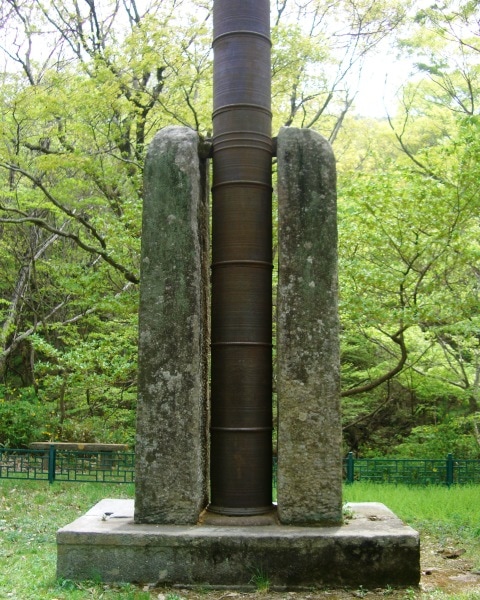
| The ancient Cheol Danggan Iron Flagpole and its pair of danggan-jiju or stone flag-pole support-pillars, thought to be from the late 7th century, designated as Korean Treasure #256. |
From my Encyclopedia of Korean Buddhism:
Danggan-jiju 당간지주 幢竿支柱 or stone flag-pole support-pillars are a pair of stone pillars usually placed before the
Main Dharma Hall in the Main Courtyard, or in any other large flat space for ceremonies, or in front of the One Pillar Gate
indicating the boundary of the temple grounds. The flagpole supports are made of typical Korean granite, often with
carvings of lotus petal leaves at the top. They have two or three parallel holes for support-struts, used to clamp the high
wooden (iron, in the case of wealthy & powerful temples) danggan flagpole. That single pole at the entrance would fly
dang flags indicating the Buddhist school being taught there, or hanging posters announcing temple events; moreover, the
flags were symbols of the temple being a holy place of Dharma-transmission. Many ancient traditional temples also have
two pairs of these pillars in their primary courtyard, in front of or beside the main Buddha hall, that were used to hold up twin
tall poles that would hold up a Gwaebul [괘불, 掛佛, gigantic hanging-scroll banner-painting of a Buddha] for outdoor ceremonies.
Danggan-jiju 당간지주 幢竿支柱 or stone flag-pole support-pillars are a pair of stone pillars usually placed before the
Main Dharma Hall in the Main Courtyard, or in any other large flat space for ceremonies, or in front of the One Pillar Gate
indicating the boundary of the temple grounds. The flagpole supports are made of typical Korean granite, often with
carvings of lotus petal leaves at the top. They have two or three parallel holes for support-struts, used to clamp the high
wooden (iron, in the case of wealthy & powerful temples) danggan flagpole. That single pole at the entrance would fly
dang flags indicating the Buddhist school being taught there, or hanging posters announcing temple events; moreover, the
flags were symbols of the temple being a holy place of Dharma-transmission. Many ancient traditional temples also have
two pairs of these pillars in their primary courtyard, in front of or beside the main Buddha hall, that were used to hold up twin
tall poles that would hold up a Gwaebul [괘불, 掛佛, gigantic hanging-scroll banner-painting of a Buddha] for outdoor ceremonies.
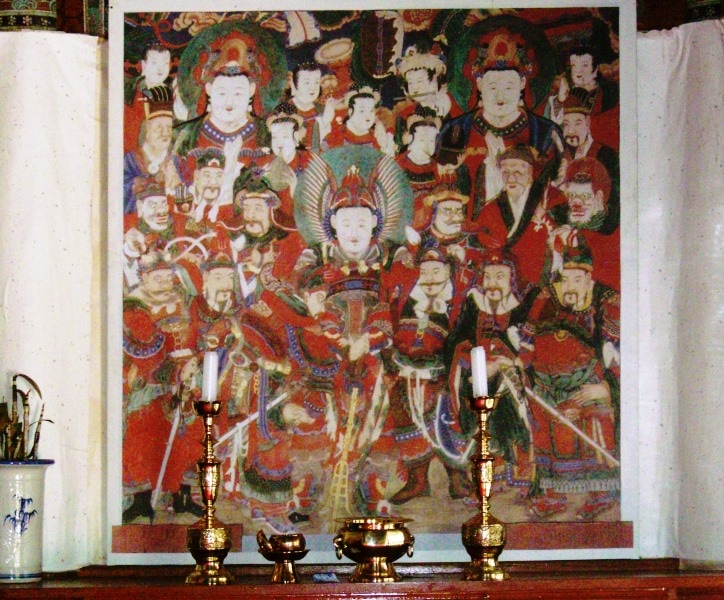
| The Shinjung Taenghwa or Assembly of Guardian Spirits Icon in the Daejeok-jeon |

| Huntsman, Sanshin and Yong-wang |
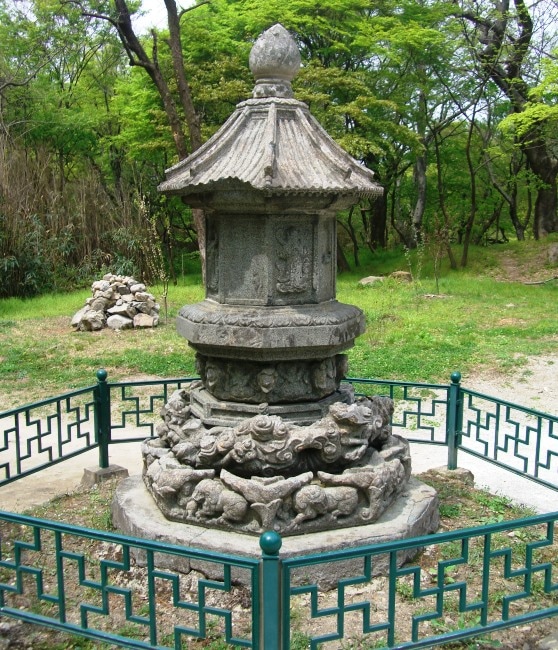
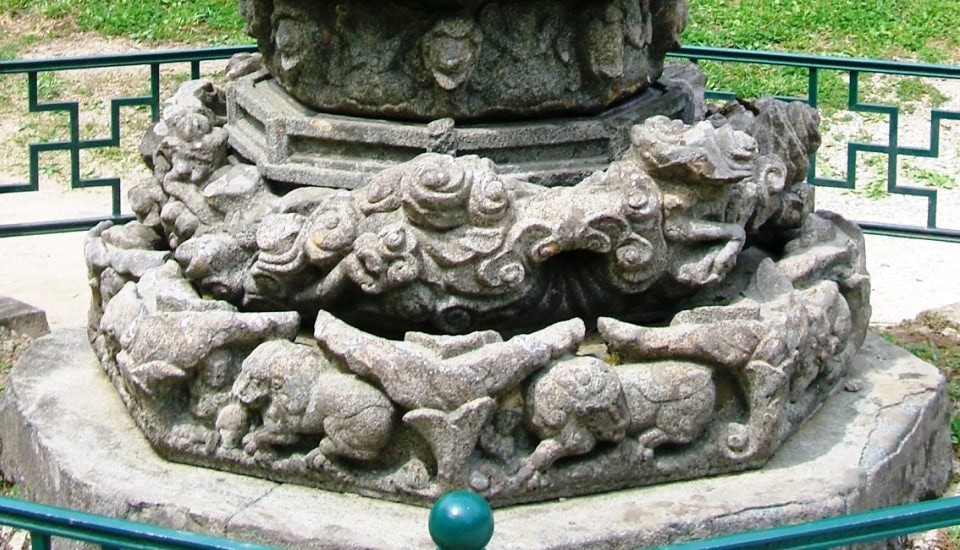
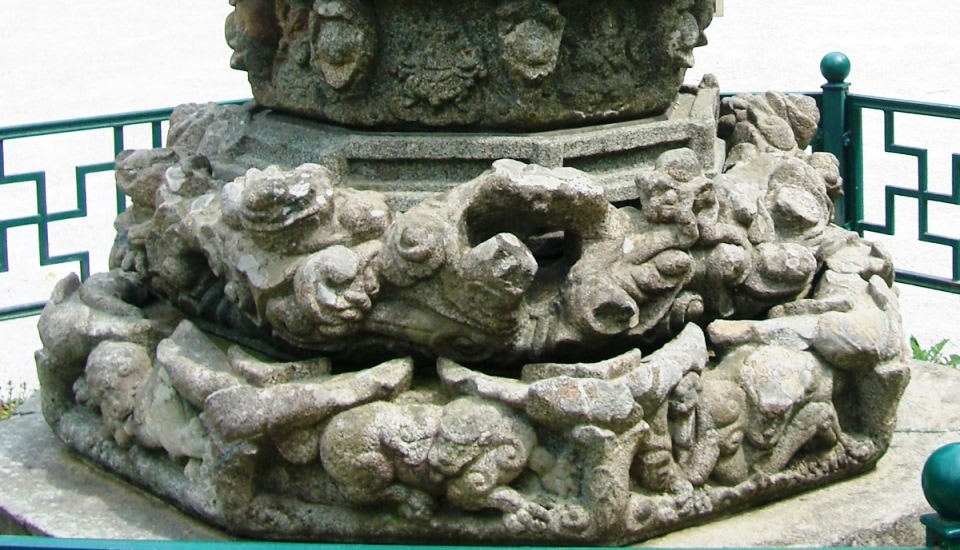
| The octagonal Gap-sa Budo Stupa in front of the Daejeok-jeon Hall, Korean Treasure #257. It is thought to date from the Late Unified Shilla Era (800s) and to be artistically excellent, but which master's saria cremains it once contained is unknown. It was moved here from the ruins of Jung-Saja-am [Central Lion Hermitage] in the 1960s. |