| Gyeryong-san Gap-sa Temple's Dae-ung Jeon Main Buddha-Dharma Hall |
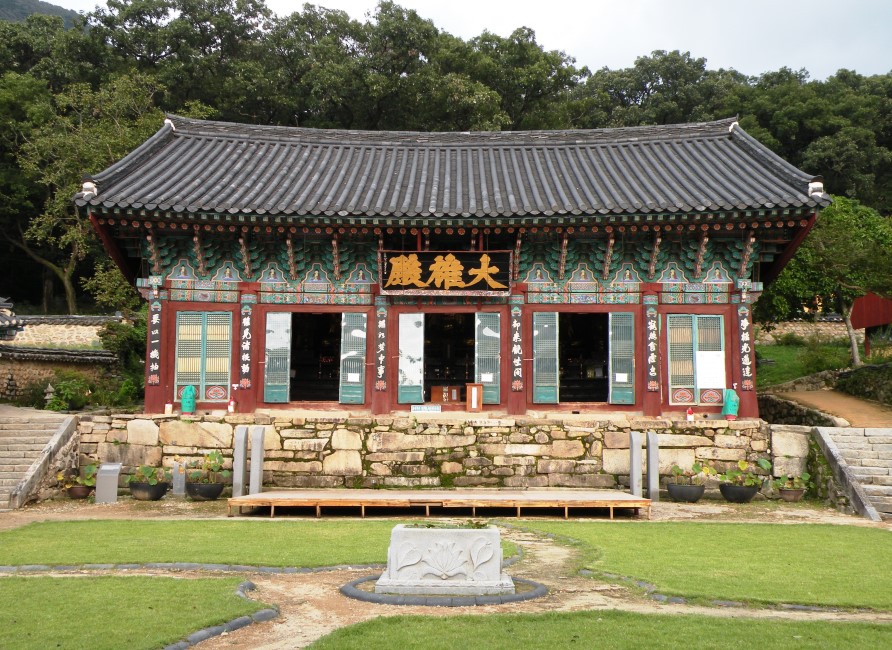
This is the classic Dae-ung-jeon 大雄殿 대웅전 Main Buddha-Dharma Hall of Gyeryong-san Gap-sa.
These are almost always situated on a high raised stone foundation on the north side of the main
courtyard of a temple, doorways facing south, with a mountain-slope rising behind. The very unusual
feature of this one is that it is on the east side of the courtyard facing west, for geomantic reasons --
usually, only halls enshrining a Bodhisattva are in this orientation. Another unusual feature of this
one is that it doesn't have three granite stairways in front of the three doors, but has two on the
sides, allowing for a ceremony performance stage to be set in front.
From my Encyclopedia of Korean Buddhism:
A Korean Daeung-jeon is the shrine-hall dedicated to Seokgamoni-bul 釋迦牟尼佛, the historical Siddhartha Gautama Sakyamuni
Buddha, founder of Buddhism as a branch-off from Hinduism. It is usually the main and central shrine-hall in a Korean Buddhist
temple compound, and often the largest one. It is one type of Beop-dang 法堂, Dharma-shrine or Main Hall, often informally
called that because it is the hall in which the most common and important temple activities take place, such as the Yebul 禮佛,
(morning, noon and evening chanting ceremony to venerate Buddha), lectures or Dharma talks, rituals for monks or laymen, etc.
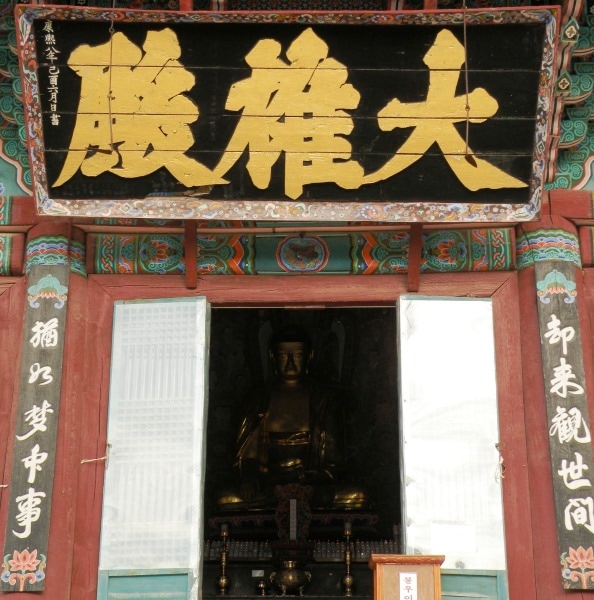
Its title denoted on a pyeon-aek (扁額, formal wooden signboard) above the central front door is usually Dae-ung-jeon 大雄殿
which means "Great Hero / Victory Hall", which is a translation of the Sanskrit term mahavira derived from the Beophwa-gyeong
法華經, the Lotus Sutra, which refers to Sakyamuni Buddha as a great hero who defeated the four mara (demons of illusion /
temptation), won the great victory over them. In the remote past it was often called the Geum-dang 金堂 or Golden Hall.
Inside the hall, the Buddha is seated on a large wooden altar called both the Bul-dan 佛壇 or Buddha Altar and the Sumi-dan
須彌壇 or Sumeru Altar; the latter refers to the mythical Mt. Sumeru, axis of the Buddhist universe, which is represented in
miniature by this altar decorated with all kinds of animals, human beings as well as deities who are living in that sacred place.
Above the throne for each Buddha statue is installed a sort of small wooden shelter, called a datjip 닫집 or heavenly canopy.
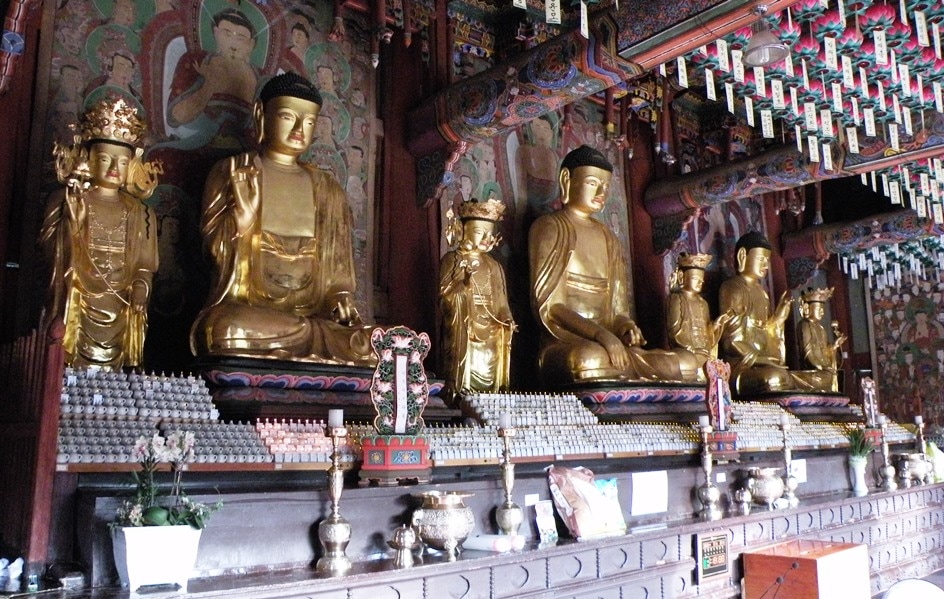
There are usually at least three deities enshrined on this main altar, as statues and also large paintings behind them, with
Seokgamoni-bul always in the center. The flanking figures vary according to each temple. A common arrangement is to have
two attendant Bodhisattvas flanking the Buddha, most commonly Munsu-bosal (文殊菩薩, Manjusri, the Bodhisattva of Wisdom)
on the left and Bohyeon-bosal (普賢菩薩, Samantabhadra, the Bodhisattva of Benevolent Action) on the right. Some other
Bodhisattvas are sometimes utilized. In other cases the two major disciples of Sakyamuni, Kasyapa (representing meditation
and wisdom) and Ananda (symbolizing doctrine and devotion), stand flanking him as attendants.
Frequently in Korea and China, the Daeung-jeon enshrines three Buddha statues (sometimes with the above Bodhisattvas and
other ones in-between them). This set may be the Buddhas of the Three Times 三世佛 composed of the Past Buddha Dipamkara
然燈佛 on left, the Present Buddha Sakyamuni in the center and Mireuk-bul 彌勒佛 (Maitreya, the Future Buddha) on the right.
The triad might also be the Three Bodies of the Buddha 三身佛, consisting of the Dharma Body 法身 unchanging fundamental
aspect of the Buddha) represented by Birojana-bul 毘盧遮那佛 (Vairocana, the Buddha of Cosmic Light) at center, the Reward
Body 報身 (the aspect of the Buddha's destiny) represented by Amita-bul 阿彌陀佛 (Amitabha, the Buddha of Western Paradise)
or possibly Yaksa-yeorae 藥師如來 (Bhaisajya-guru, the Medicinal Healer) on left, and the Transformation Body 化身 (incarnate
manifestation of Buddha) represented by Seokgamoni-bul on the right. In this case the shrine-hall is often entitled Daeung-
bojeon 大雄寶殿 (Great Hero Treasure-Hall) instead of merely Daeung-jeon.
Other important Buddhist altars and paintings are usually found in a Daeung-jeon or Daeung-bojeon, to the sides of or behind
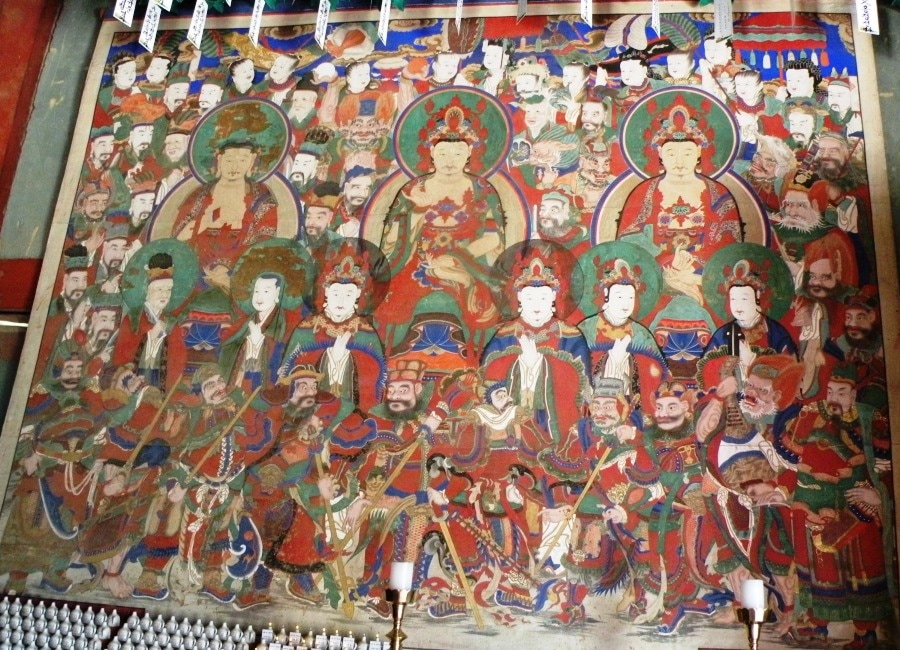
the main altar, varying with each temple. A Shinjung-taenghwa 神衆幀畵 or Guardian-Spirits Assembly Icon-Painting is almost
always placed on the right-hand interior wall (the east wall) or right-rear wall. A Gamno-do 甘露圖 (Sweet-Dew Teachings of the
Buddha Painting) or other similar icon may be on the left-hand (west) interior wall. There might also be Bodhisattvas or other
less-formal deities such as the Sanshin 山神 or Mountain-spirit, Chilseong 七星 (Seven Stars of Big Dipper & Destiny) or
Dokseong 獨聖 (Lonely Saint) if the temple is not large enough to have separate shrines for them.
In Seon (Meditational Buddhism; Chan or Zen) -oriented temples the outsides of a Daeung-jeon are usually painted with the
Sip-u-do 十牛圖 (Ten Ox-Herding Pictures) series, and often also above it the Life of Buddha series.
These are almost always situated on a high raised stone foundation on the north side of the main
courtyard of a temple, doorways facing south, with a mountain-slope rising behind. The very unusual
feature of this one is that it is on the east side of the courtyard facing west, for geomantic reasons --
usually, only halls enshrining a Bodhisattva are in this orientation. Another unusual feature of this
one is that it doesn't have three granite stairways in front of the three doors, but has two on the
sides, allowing for a ceremony performance stage to be set in front.
From my Encyclopedia of Korean Buddhism:
A Korean Daeung-jeon is the shrine-hall dedicated to Seokgamoni-bul 釋迦牟尼佛, the historical Siddhartha Gautama Sakyamuni
Buddha, founder of Buddhism as a branch-off from Hinduism. It is usually the main and central shrine-hall in a Korean Buddhist
temple compound, and often the largest one. It is one type of Beop-dang 法堂, Dharma-shrine or Main Hall, often informally
called that because it is the hall in which the most common and important temple activities take place, such as the Yebul 禮佛,
(morning, noon and evening chanting ceremony to venerate Buddha), lectures or Dharma talks, rituals for monks or laymen, etc.
Its title denoted on a pyeon-aek (扁額, formal wooden signboard) above the central front door is usually Dae-ung-jeon 大雄殿
which means "Great Hero / Victory Hall", which is a translation of the Sanskrit term mahavira derived from the Beophwa-gyeong
法華經, the Lotus Sutra, which refers to Sakyamuni Buddha as a great hero who defeated the four mara (demons of illusion /
temptation), won the great victory over them. In the remote past it was often called the Geum-dang 金堂 or Golden Hall.
Inside the hall, the Buddha is seated on a large wooden altar called both the Bul-dan 佛壇 or Buddha Altar and the Sumi-dan
須彌壇 or Sumeru Altar; the latter refers to the mythical Mt. Sumeru, axis of the Buddhist universe, which is represented in
miniature by this altar decorated with all kinds of animals, human beings as well as deities who are living in that sacred place.
Above the throne for each Buddha statue is installed a sort of small wooden shelter, called a datjip 닫집 or heavenly canopy.
There are usually at least three deities enshrined on this main altar, as statues and also large paintings behind them, with
Seokgamoni-bul always in the center. The flanking figures vary according to each temple. A common arrangement is to have
two attendant Bodhisattvas flanking the Buddha, most commonly Munsu-bosal (文殊菩薩, Manjusri, the Bodhisattva of Wisdom)
on the left and Bohyeon-bosal (普賢菩薩, Samantabhadra, the Bodhisattva of Benevolent Action) on the right. Some other
Bodhisattvas are sometimes utilized. In other cases the two major disciples of Sakyamuni, Kasyapa (representing meditation
and wisdom) and Ananda (symbolizing doctrine and devotion), stand flanking him as attendants.
Frequently in Korea and China, the Daeung-jeon enshrines three Buddha statues (sometimes with the above Bodhisattvas and
other ones in-between them). This set may be the Buddhas of the Three Times 三世佛 composed of the Past Buddha Dipamkara
然燈佛 on left, the Present Buddha Sakyamuni in the center and Mireuk-bul 彌勒佛 (Maitreya, the Future Buddha) on the right.
The triad might also be the Three Bodies of the Buddha 三身佛, consisting of the Dharma Body 法身 unchanging fundamental
aspect of the Buddha) represented by Birojana-bul 毘盧遮那佛 (Vairocana, the Buddha of Cosmic Light) at center, the Reward
Body 報身 (the aspect of the Buddha's destiny) represented by Amita-bul 阿彌陀佛 (Amitabha, the Buddha of Western Paradise)
or possibly Yaksa-yeorae 藥師如來 (Bhaisajya-guru, the Medicinal Healer) on left, and the Transformation Body 化身 (incarnate
manifestation of Buddha) represented by Seokgamoni-bul on the right. In this case the shrine-hall is often entitled Daeung-
bojeon 大雄寶殿 (Great Hero Treasure-Hall) instead of merely Daeung-jeon.
Other important Buddhist altars and paintings are usually found in a Daeung-jeon or Daeung-bojeon, to the sides of or behind
the main altar, varying with each temple. A Shinjung-taenghwa 神衆幀畵 or Guardian-Spirits Assembly Icon-Painting is almost
always placed on the right-hand interior wall (the east wall) or right-rear wall. A Gamno-do 甘露圖 (Sweet-Dew Teachings of the
Buddha Painting) or other similar icon may be on the left-hand (west) interior wall. There might also be Bodhisattvas or other
less-formal deities such as the Sanshin 山神 or Mountain-spirit, Chilseong 七星 (Seven Stars of Big Dipper & Destiny) or
Dokseong 獨聖 (Lonely Saint) if the temple is not large enough to have separate shrines for them.
In Seon (Meditational Buddhism; Chan or Zen) -oriented temples the outsides of a Daeung-jeon are usually painted with the
Sip-u-do 十牛圖 (Ten Ox-Herding Pictures) series, and often also above it the Life of Buddha series.
Entranceway Features
Samseong-gak with Sanshin
Pyochung-won Shrine of Heroes
Daejeok-jeon and Gongu-tap Pagoda
Yongmun-pokpo Dragon-Gate Waterfall
Shinheung-am with Boulder Pagoda
Main Gap-sa Temple Page
Gyeryong-san Index Page
Sanshin Site Contents Page
Samseong-gak with Sanshin
Pyochung-won Shrine of Heroes
Daejeok-jeon and Gongu-tap Pagoda
Yongmun-pokpo Dragon-Gate Waterfall
Shinheung-am with Boulder Pagoda
Main Gap-sa Temple Page
Gyeryong-san Index Page
Sanshin Site Contents Page
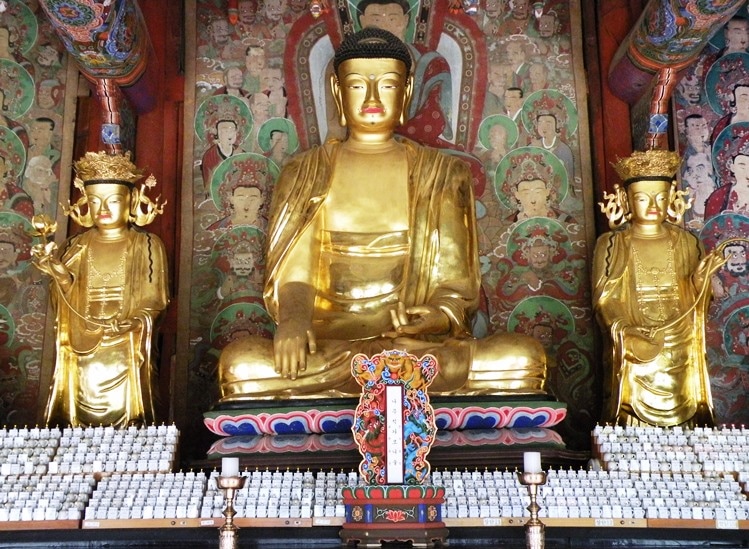
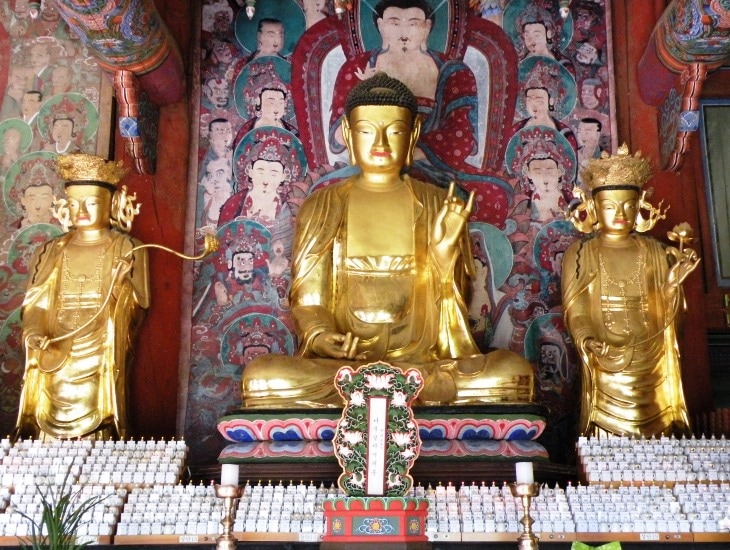
| Three Buddha statues (Amita, Sakyamuni and Yaksa) with the four major Bodhisattvas (Gwaneum, Munsu, Bohyeon and Jijang) |
| Amita Buddha, on the left (west) |
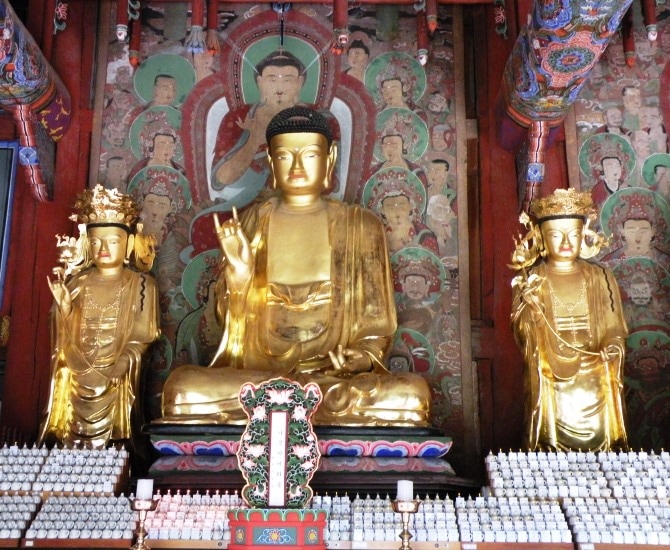
| Sakyamuni Buddha, in the center |
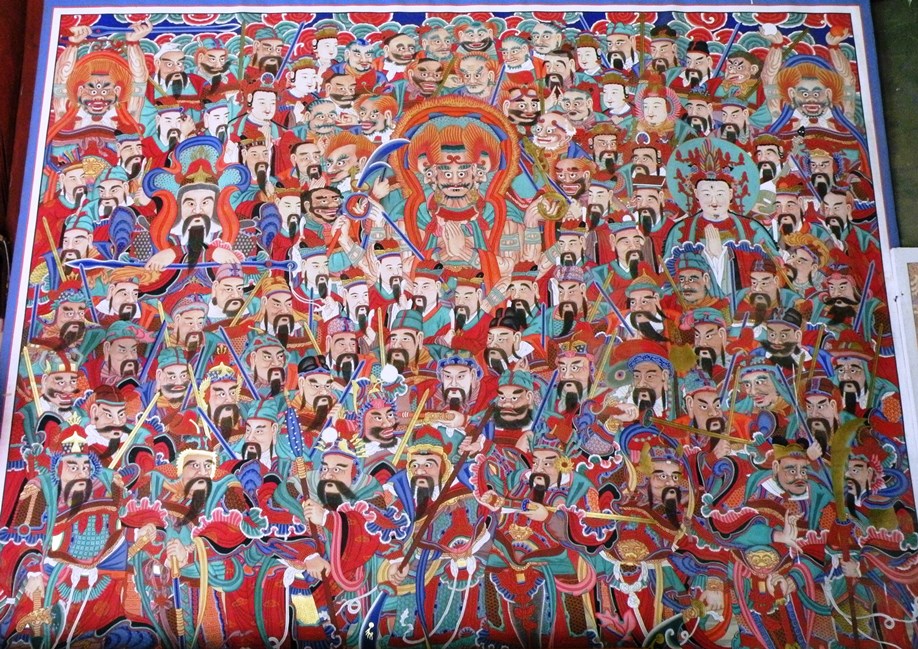
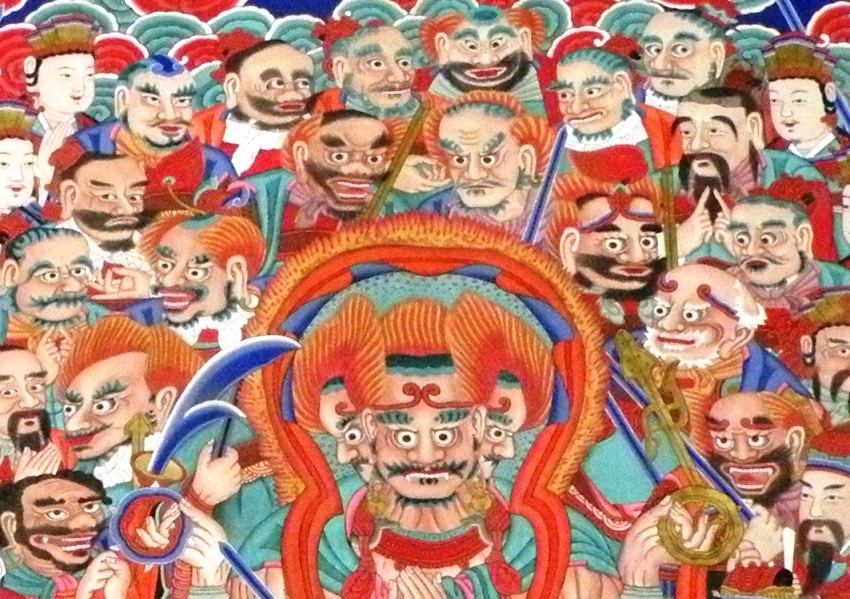
| Shinjung-taenghwa 神衆幀畵 or Guardian-Spirits Assembly Icon-Painting, on the right-rear wall. This one is very "complete" with 108 figures, but a particular Sanshin is hard to find in it. |
| Yaksa Yeorae the Medicinal Buddha, on the right (east) |
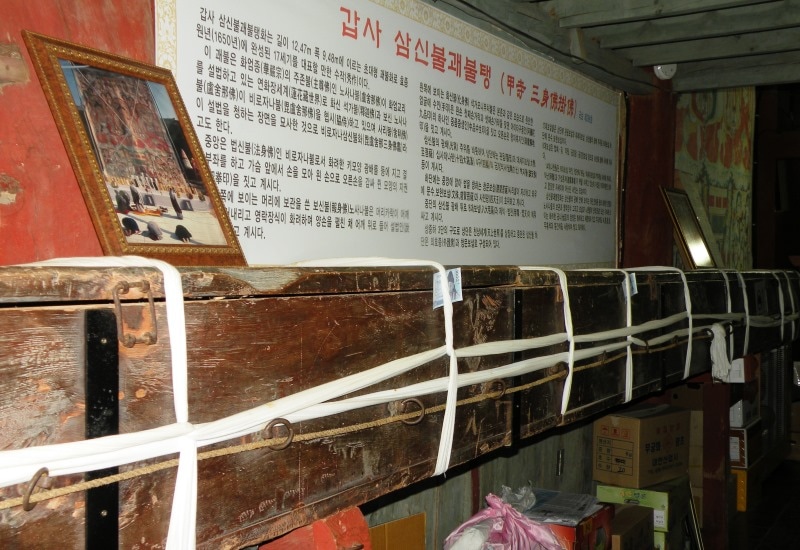
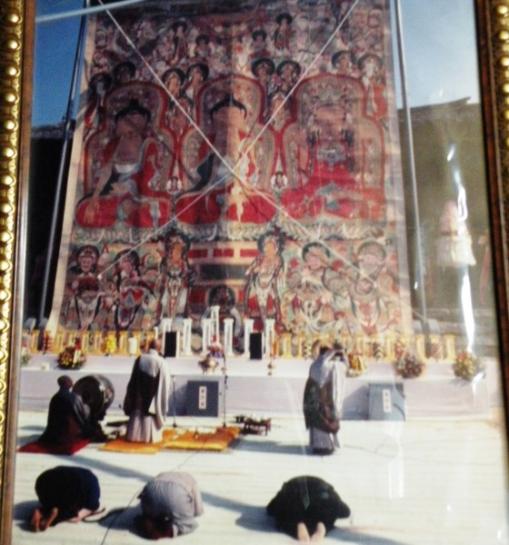
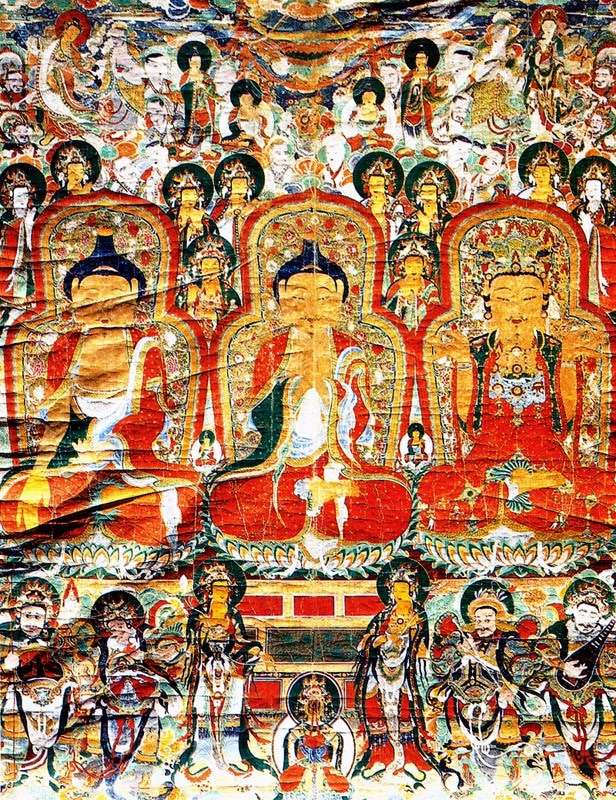
The Gap-sa Samshin-bul Gwaebul Taenghwa [Foremost Temple Three-Spiritual-Buddhas Giant-Hanging-Buddha-Icon],
National Treasure #298 and created in 1650, in its wooden box, stored behind the Main Altar. This Gwaebul
괘불 掛佛 is a huge painting hung in the courtyard in front of this Daeung-jeon on some Buddhist holidays,
and grand ceremonies with ritual prayers are performed to it. The three Buddhas here are Sakyamuni on
the left, Biro-bul or Vairocana Buddha of Cosmic light in the middle, and Nosana-bul* on the right, all
preaching the Dharma. This Gwaebul is 9.5 meters high and 2.5 meters wide. In the upper section there
are the images of two Bodhisattvas, the 16 major Disciples of Sakyamuni, and some guardian deities. In
the lower part are a Buddha-Sarira urn-altar, two more Bodhisattvas, and the Four Guardian Kings.
National Treasure #298 and created in 1650, in its wooden box, stored behind the Main Altar. This Gwaebul
괘불 掛佛 is a huge painting hung in the courtyard in front of this Daeung-jeon on some Buddhist holidays,
and grand ceremonies with ritual prayers are performed to it. The three Buddhas here are Sakyamuni on
the left, Biro-bul or Vairocana Buddha of Cosmic light in the middle, and Nosana-bul* on the right, all
preaching the Dharma. This Gwaebul is 9.5 meters high and 2.5 meters wide. In the upper section there
are the images of two Bodhisattvas, the 16 major Disciples of Sakyamuni, and some guardian deities. In
the lower part are a Buddha-Sarira urn-altar, two more Bodhisattvas, and the Four Guardian Kings.
*= 盧舍那佛 노사나불, Sambhogakaya Buddha, which represents the
"blissfull fruit of practice" form of Buddhahood, and the "communion of
the absolute and relative realms," the path-stage of spiritual maturity.
His mudra [hand position] is "both hands raised, palms outward", which
represents "teaching, protection and compassionately dispelling fear."
"blissfull fruit of practice" form of Buddhahood, and the "communion of
the absolute and relative realms," the path-stage of spiritual maturity.
His mudra [hand position] is "both hands raised, palms outward", which
represents "teaching, protection and compassionately dispelling fear."
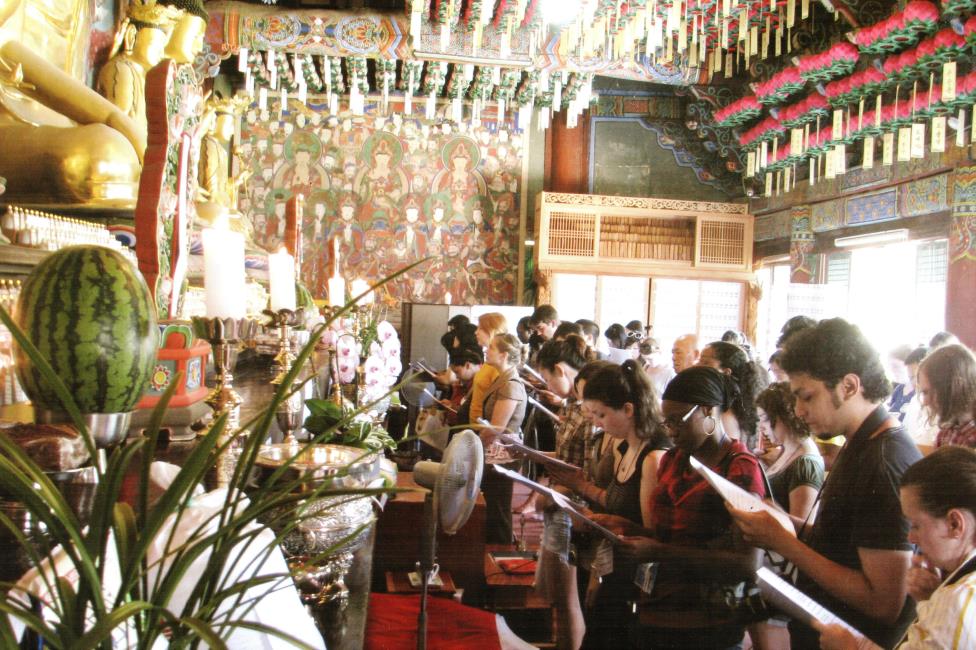
| Temple-Stay ceremony in this Main Dharma Hall, 2017, with Three Bodhisattvas Painting in the background |
| the 1800-era Three Bodhisattvas Painting on the east wall -- Jijang, Munsu and Bohyeon |
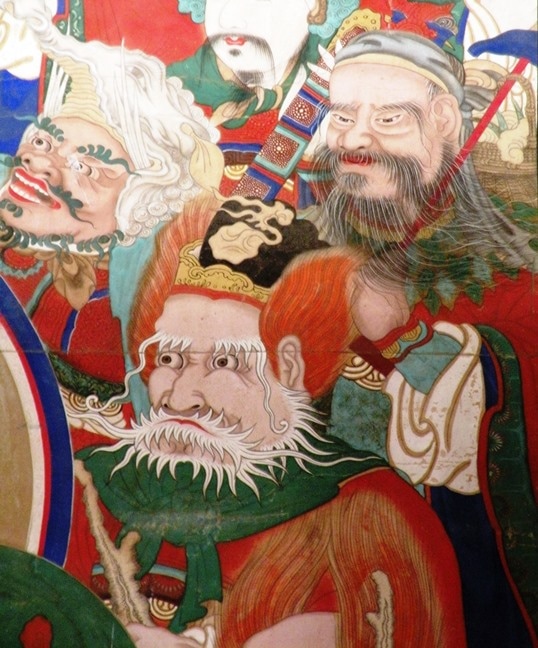
| "the White-Elephant-Head guy", Sanshin (note the leaf-mantle) and Yong-wang! |
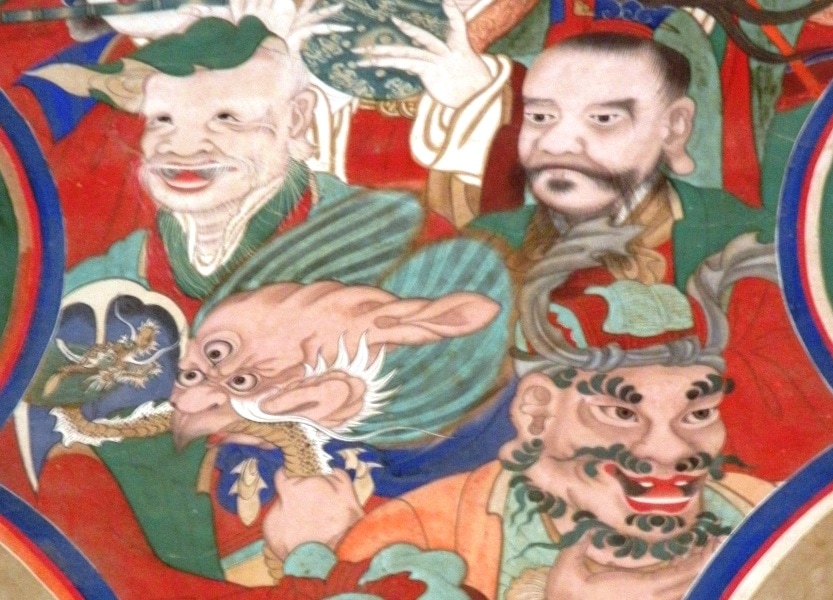
| "the bird-like guy that eats dragons", and companions -- two happy, one grim |
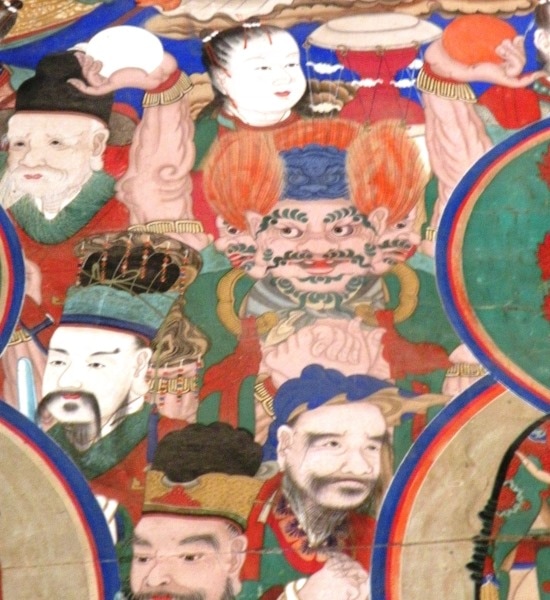
| 4-faced Brahma holding-up the Sun and Moon, as an Il-wol-bosal, with a Sanshin-similar figure below |
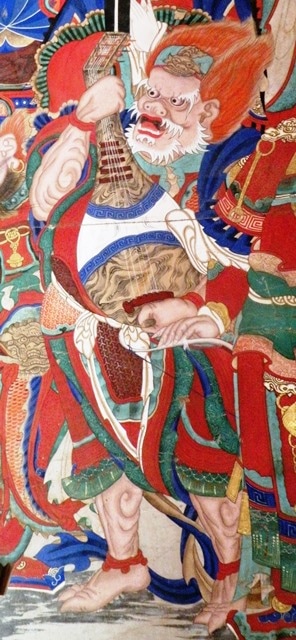
| Yong-wang the Dragon-King (of the eastern seas), conflated with the East King (who plays a lute) of the "Four Guardian Heavenly Kings" set! Reminds me of Keith Richards.... |