| Gyeryong-san Gap-sa Temple's Sa-Cheonwang-mun Four Heavenly-Kings Gate |
Other Features of the Entranceway
Dae-ung-jeon Main Dharma Hall
Samseong-gak with Sanshin
Pyochung-won Shrine of Heroes
Daejeok-jeon and Gongu-tap Pagoda
Guryong-am Nine-Dragons Hermitage
Yongmun Pokpo Dragon-Gate Waterfall
Shinheung-am with Boulder Pagoda
Gap-sa Temple Main Page
Gyeryong-san Index Page
Sanshin Site Contents Page
Dae-ung-jeon Main Dharma Hall
Samseong-gak with Sanshin
Pyochung-won Shrine of Heroes
Daejeok-jeon and Gongu-tap Pagoda
Guryong-am Nine-Dragons Hermitage
Yongmun Pokpo Dragon-Gate Waterfall
Shinheung-am with Boulder Pagoda
Gap-sa Temple Main Page
Gyeryong-san Index Page
Sanshin Site Contents Page
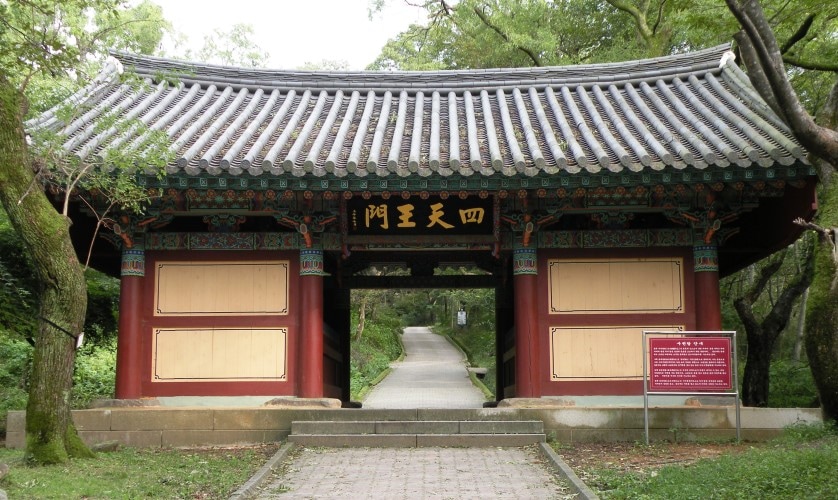
This is the classic modern Sa-Cheonwang-mun 四天王門 사천왕문 of Gyeryong-san Gap-sa.
From my Encyclopedia of Korean Buddhism:
The Four Heavenly Kings Gate is a medium-size gateway building (usually without doors) on the
main pathway leading into a mountain-based temple; in the full traditional set of five such gates this
is the third or middle one, just after the Ilju-mun [一柱門, One Pillar Gate] and Geumgang-mun [金剛門, Vajra
/ Diamond Gate], and before the Bul-i-mun [不二門, Non-duality Gate] and the final Boje-ru [普濟樓, Universal
Salvation Pavilion] that leads to the Main Dharma Hall and its courtyard. This is sometimes also called
simply a Cheonwang-mun (天王門, Heavenly Kings Gate).
Large images, usually elaborately painted wooden statues, sometimes backed by paintings or murals,
occasionally just the paintings or murals, of the Four Heavenly Kings are enshrined in the two side-
compartments of this gate. These are gigantic guardian deities that live at the four directional feet of
Sumi-san [Mt. Sumeru, mythical center-of-the-world or axis-mundi mountain, a concept that originated in Hinduism, often
identified with Mt. Kailash or 冈仁波齐峰 in Tibet], protecting the Bulbeop [佛前, Buddha-Dharma] in the four quarters
of heaven-and-earth, and, inspired by that Dharma, offer protection from ill-fortunes to those who
venerate them.
Each king watches over one cardinal direction and protects all beings in it from evil. Korean statues
of them are distinctive for their angry ferocity, rendered with broad faces, bulging eyes, black hair,
gritted teeth and the elaborate clothing and armor of a medieval Chinese or Mongol army general.
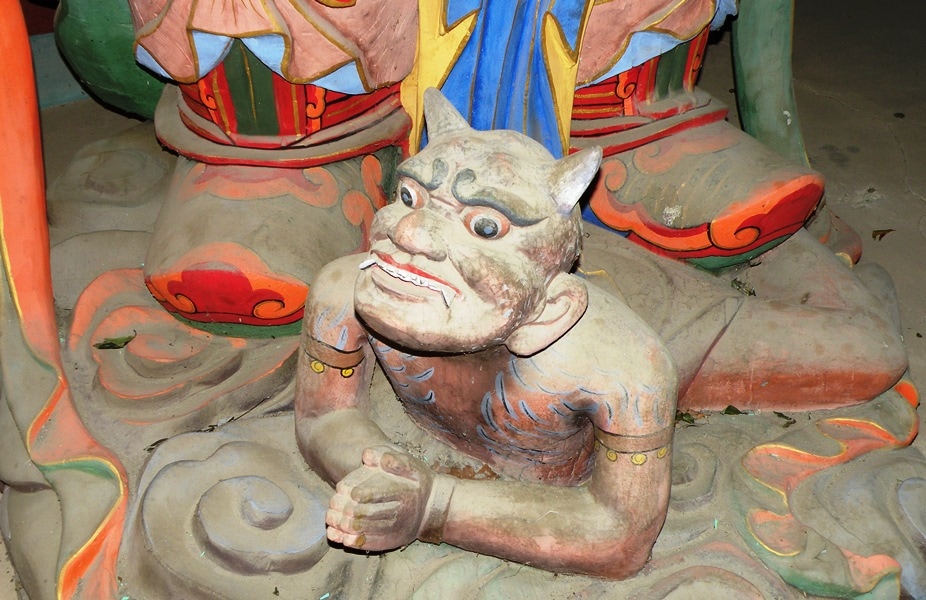
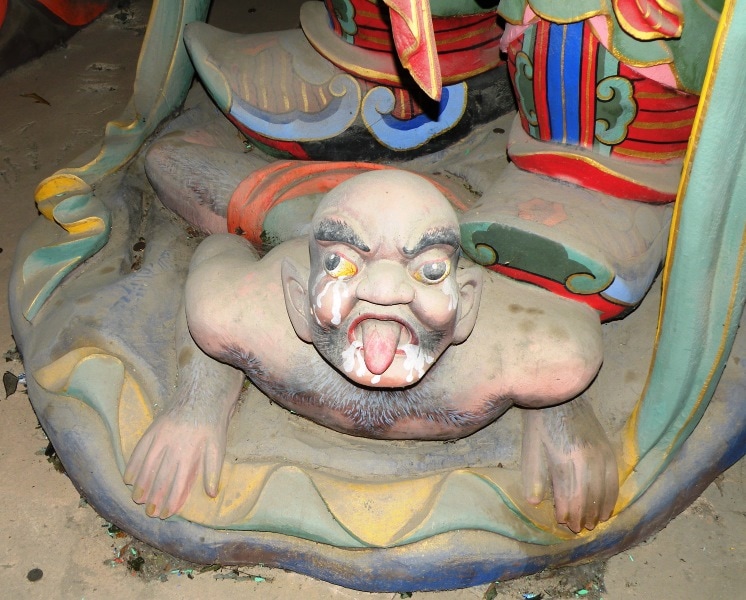
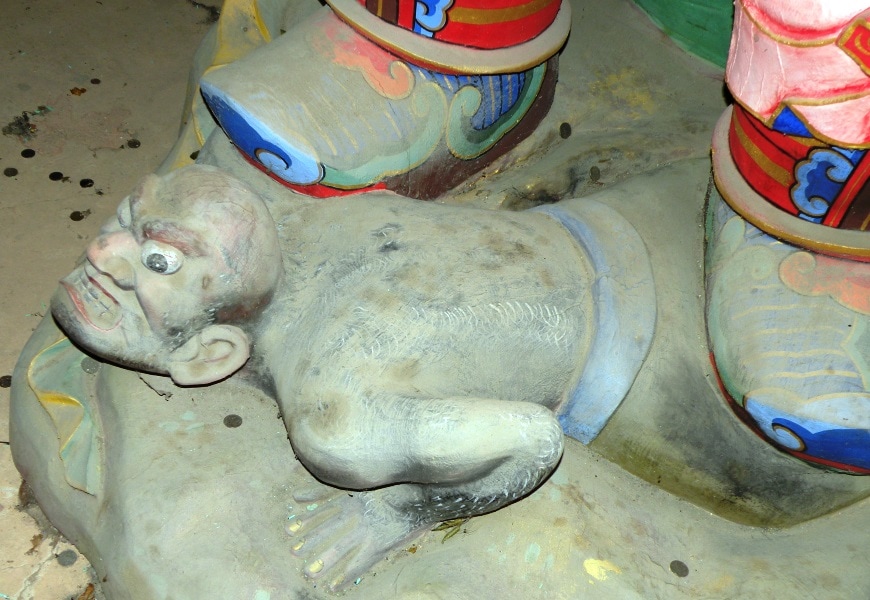
They are often depicted trampling piteous evil demons which symbolize ignorance, hatred and greed.
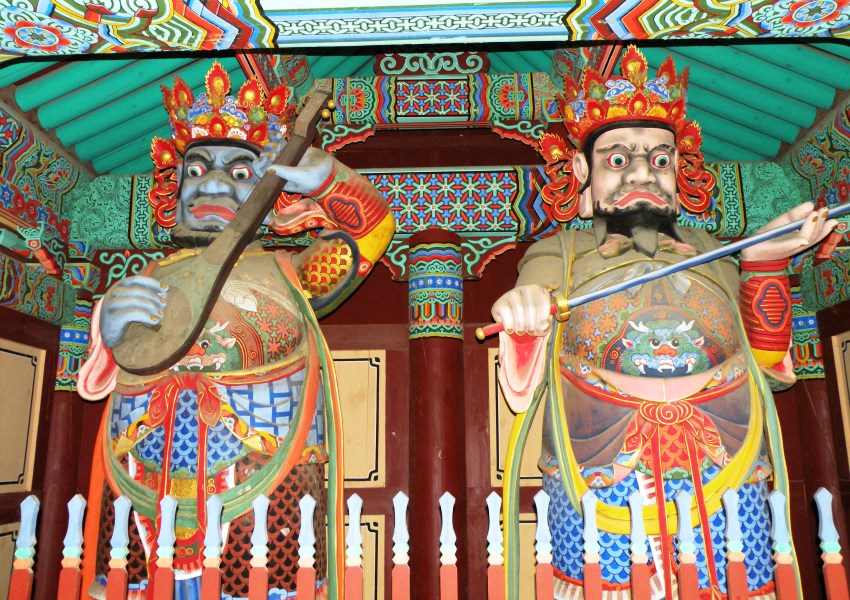
The King of the East stands in the northeast corner of the gate, playing a lute with a smile, the only
one of them that looks friendly. The King of the South stands in the southeast corner brandishing a
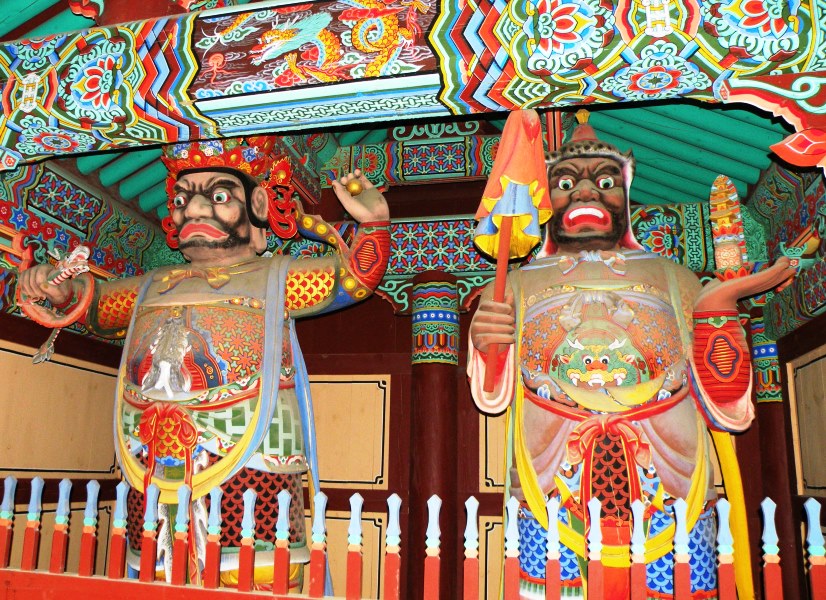
long sword with a fierce scowl. The West King stands in the southwest corner holding a dragon in
his lowered right hand and a flaming banya-jinju [wisdom pearl, or wish-granting jewel] in his raised left.
The King of the North stands in the northwest corner holding a seoktap [石塔, stone pagoda] in one
raised hand and a funerary banner-pole in his other hand (north is the death-direction). Visitors
show reverence and ask for protection as they pass between them, being warned by the stern
kings against harboring selfish thoughts and committing any improper acts within the temple.
From my Encyclopedia of Korean Buddhism:
The Four Heavenly Kings Gate is a medium-size gateway building (usually without doors) on the
main pathway leading into a mountain-based temple; in the full traditional set of five such gates this
is the third or middle one, just after the Ilju-mun [一柱門, One Pillar Gate] and Geumgang-mun [金剛門, Vajra
/ Diamond Gate], and before the Bul-i-mun [不二門, Non-duality Gate] and the final Boje-ru [普濟樓, Universal
Salvation Pavilion] that leads to the Main Dharma Hall and its courtyard. This is sometimes also called
simply a Cheonwang-mun (天王門, Heavenly Kings Gate).
Large images, usually elaborately painted wooden statues, sometimes backed by paintings or murals,
occasionally just the paintings or murals, of the Four Heavenly Kings are enshrined in the two side-
compartments of this gate. These are gigantic guardian deities that live at the four directional feet of
Sumi-san [Mt. Sumeru, mythical center-of-the-world or axis-mundi mountain, a concept that originated in Hinduism, often
identified with Mt. Kailash or 冈仁波齐峰 in Tibet], protecting the Bulbeop [佛前, Buddha-Dharma] in the four quarters
of heaven-and-earth, and, inspired by that Dharma, offer protection from ill-fortunes to those who
venerate them.
Each king watches over one cardinal direction and protects all beings in it from evil. Korean statues
of them are distinctive for their angry ferocity, rendered with broad faces, bulging eyes, black hair,
gritted teeth and the elaborate clothing and armor of a medieval Chinese or Mongol army general.
They are often depicted trampling piteous evil demons which symbolize ignorance, hatred and greed.
The King of the East stands in the northeast corner of the gate, playing a lute with a smile, the only
one of them that looks friendly. The King of the South stands in the southeast corner brandishing a
long sword with a fierce scowl. The West King stands in the southwest corner holding a dragon in
his lowered right hand and a flaming banya-jinju [wisdom pearl, or wish-granting jewel] in his raised left.
The King of the North stands in the northwest corner holding a seoktap [石塔, stone pagoda] in one
raised hand and a funerary banner-pole in his other hand (north is the death-direction). Visitors
show reverence and ask for protection as they pass between them, being warned by the stern
kings against harboring selfish thoughts and committing any improper acts within the temple.
| Kings of the East and South, on your right |
| Kings of the West and North, on your left |
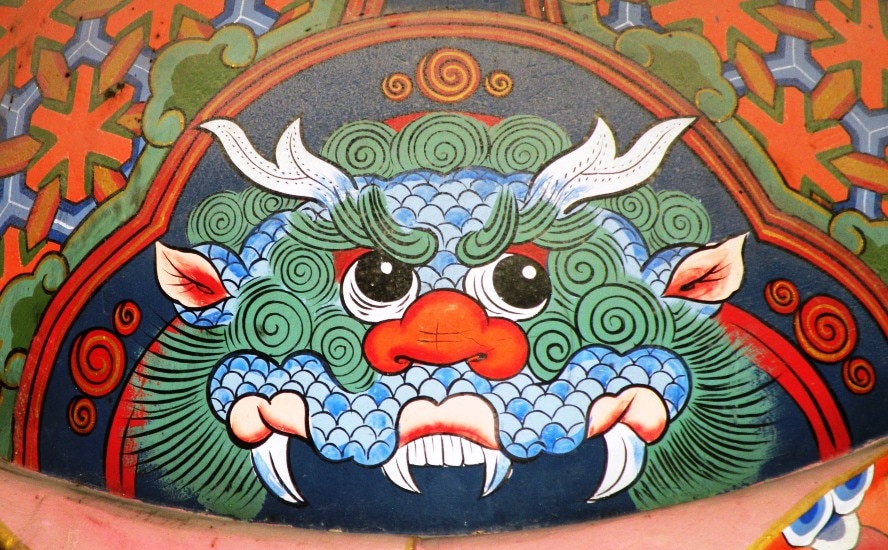
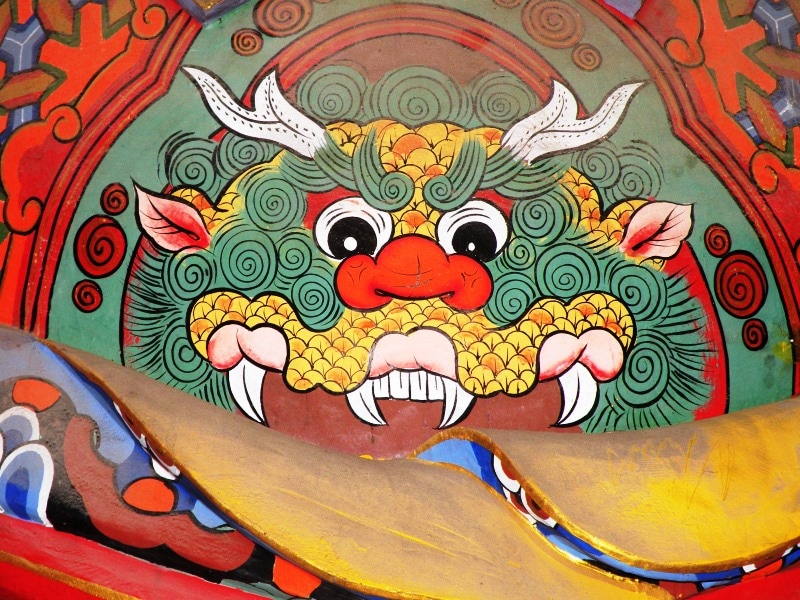
These are Nathwi, a dragon-ish face or "mask", a "smiling beast" unique to Korean folk-arts.
Derived from ancient Shaminist beliefs in spirits that inhabit all aspects of nature combined
with the ubiquitous Chinese dragon-deities, they serve as low-level guardians, protecting and
warning against bad behavior. Nathwi are typically painted on doors of temples and shrines,
protect both the buildings and the visitors from ill-fortune spirits. They look fierce with wide
noses and flaring nostrils, whiskers, horns, and sharp teeth, but also friendly with big smiles.
Koreans feel close to them and grateful for the protection they provide, not afraid. They are
usually painted (and carved in-relief) is color-symbolic sets, either looking straight-ahead or
looking in different directions, to be alert for danger approaching from those other directions.
Derived from ancient Shaminist beliefs in spirits that inhabit all aspects of nature combined
with the ubiquitous Chinese dragon-deities, they serve as low-level guardians, protecting and
warning against bad behavior. Nathwi are typically painted on doors of temples and shrines,
protect both the buildings and the visitors from ill-fortune spirits. They look fierce with wide
noses and flaring nostrils, whiskers, horns, and sharp teeth, but also friendly with big smiles.
Koreans feel close to them and grateful for the protection they provide, not afraid. They are
usually painted (and carved in-relief) is color-symbolic sets, either looking straight-ahead or
looking in different directions, to be alert for danger approaching from those other directions.
| "piteous evil demons" that symbolize ignorance, hatred and greed, being trampled |
| Yellow (West) and Blue (East) Nathwi "masks" |