| Gyeongju Nam-san's famous Bori-sa Buddha Statue |
Gyeongju Nam-san is listed as one of Korea's most
sacred places on Martin Gray's excellent Sacred
Sites of the World website, on this page about Korea.
For plenty of information and beautiful photos of the
world's holy pilgrimage destinations, get his excellent
new 275-page book:
Sacred Earth: Places of Peace and Power.
sacred places on Martin Gray's excellent Sacred
Sites of the World website, on this page about Korea.
For plenty of information and beautiful photos of the
world's holy pilgrimage destinations, get his excellent
new 275-page book:
Sacred Earth: Places of Peace and Power.
| Back to Bori-sa Page Nam-san Chilbul-am Sangseon-am Cliff-Buddha Gyeongju Nam-san Page Sacred Mountains of Gyeongju Index-Page San-shin Site Contents Page |
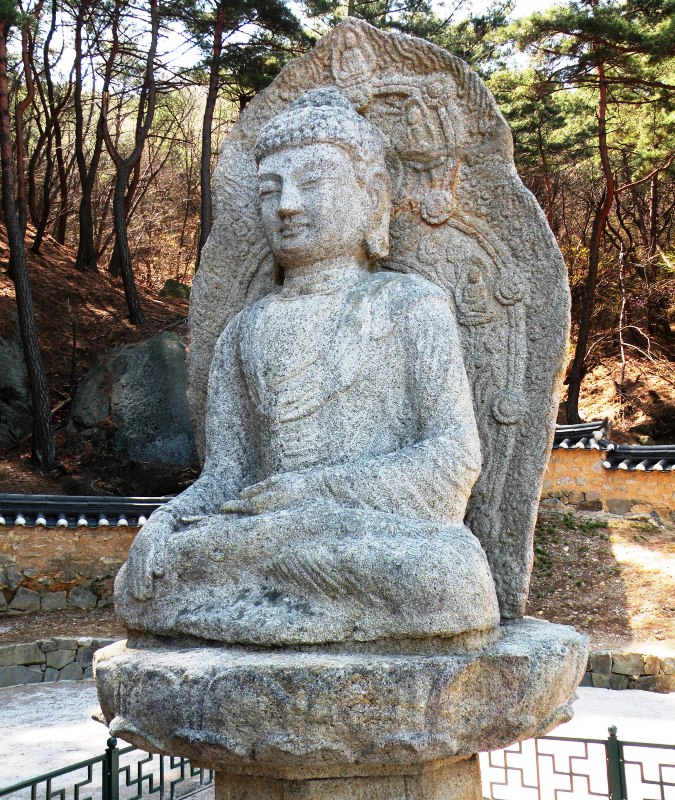
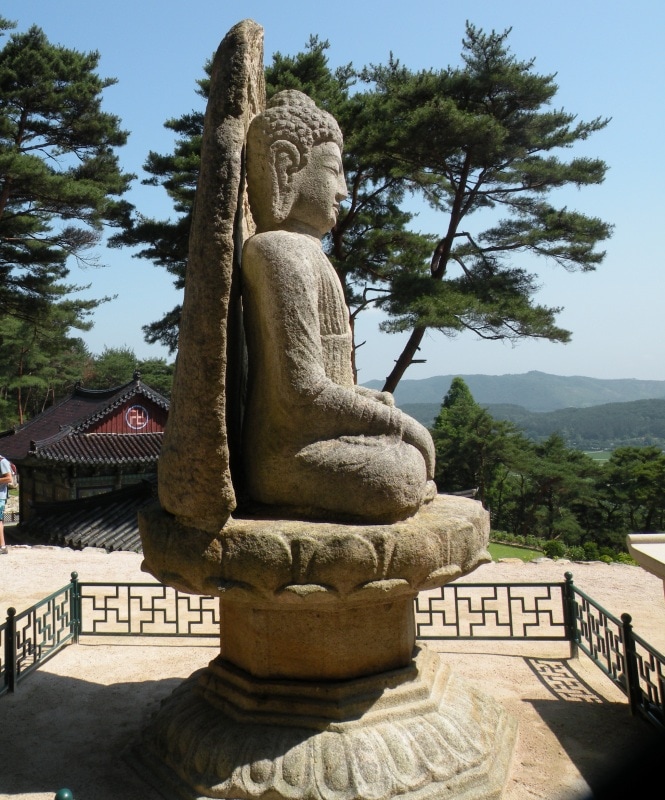
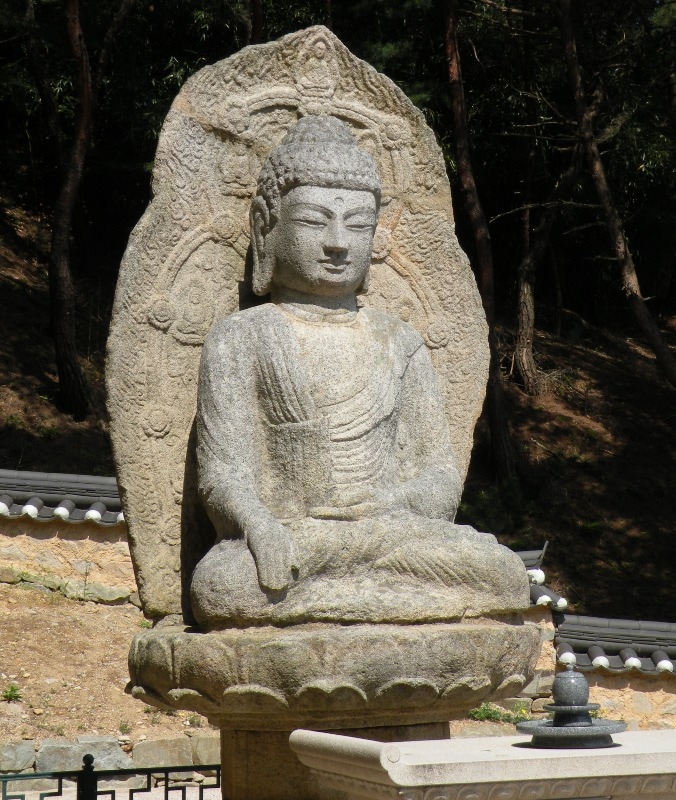
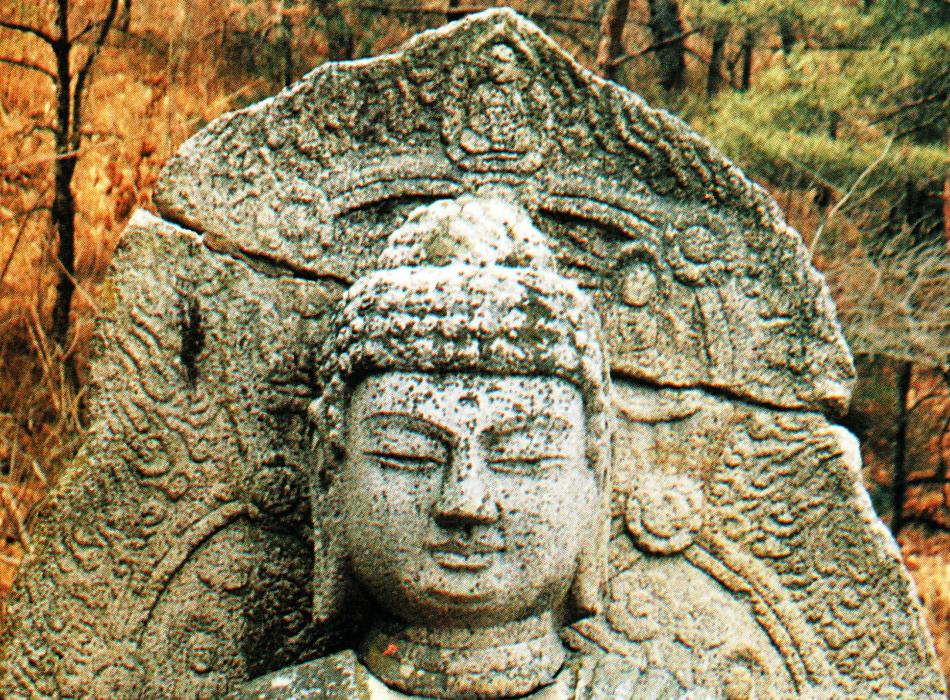
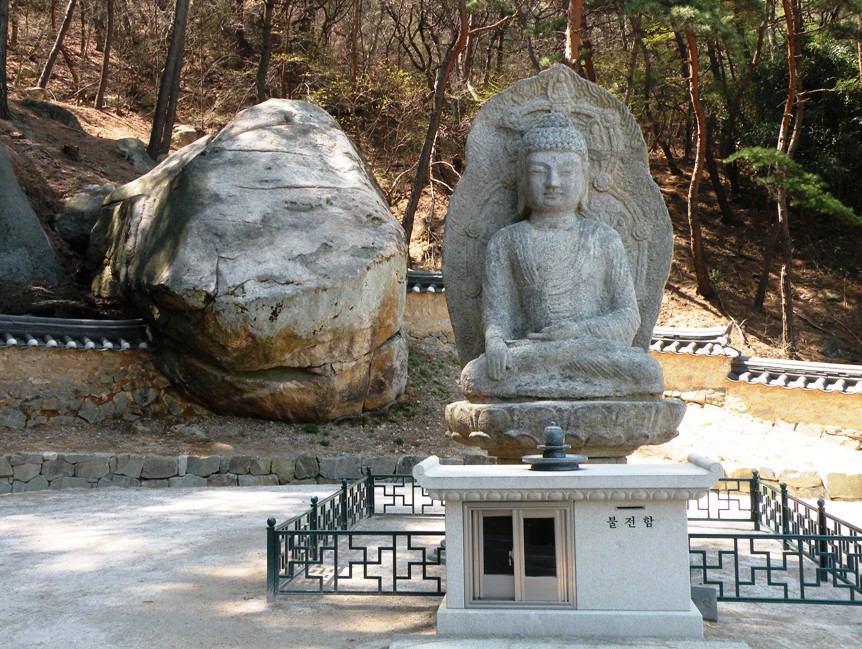
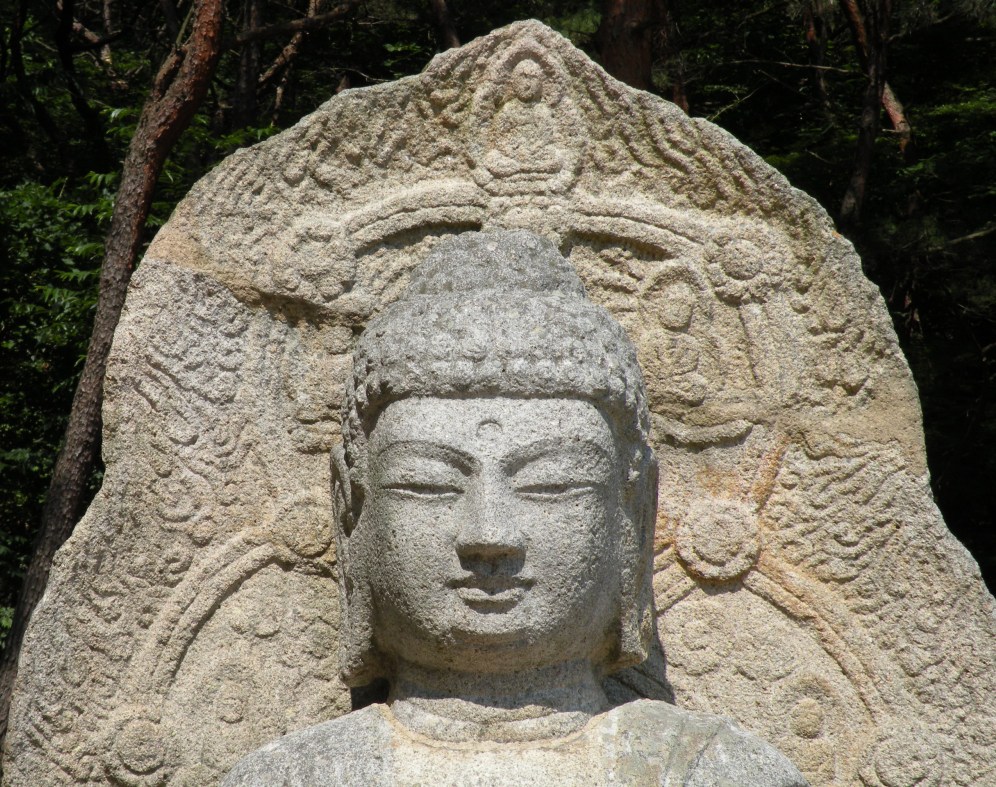
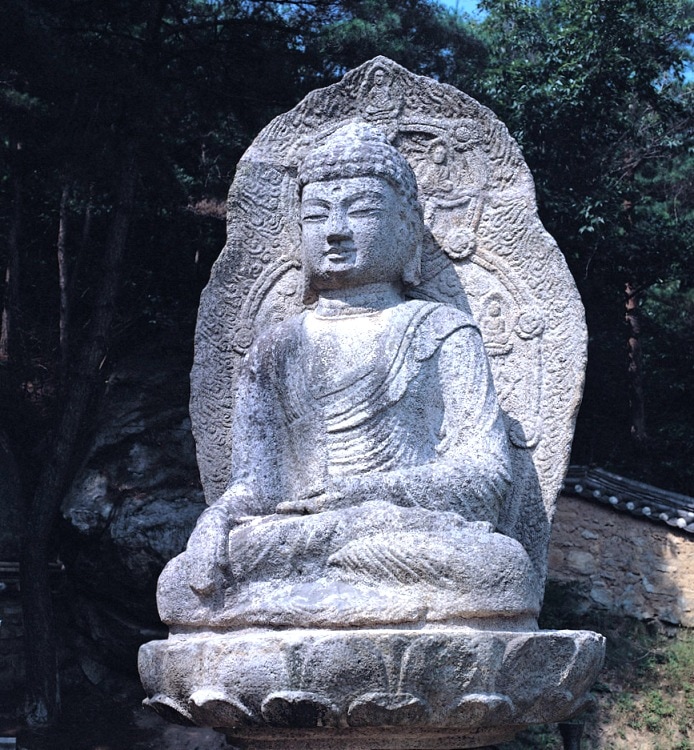
| Often said to be the second-best stone statue of Buddha in all Korea, after only Seokgul-am. This great spiritual artwork was probably carved in the early 8th Century. It is 4.36 meters tall. |

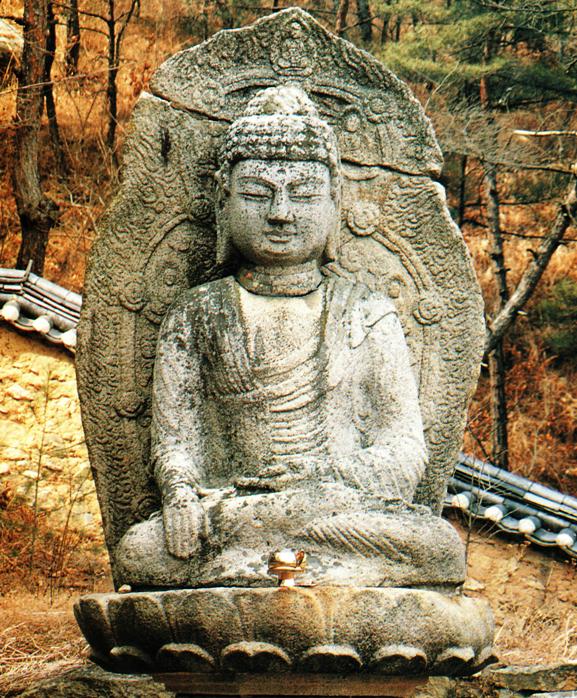

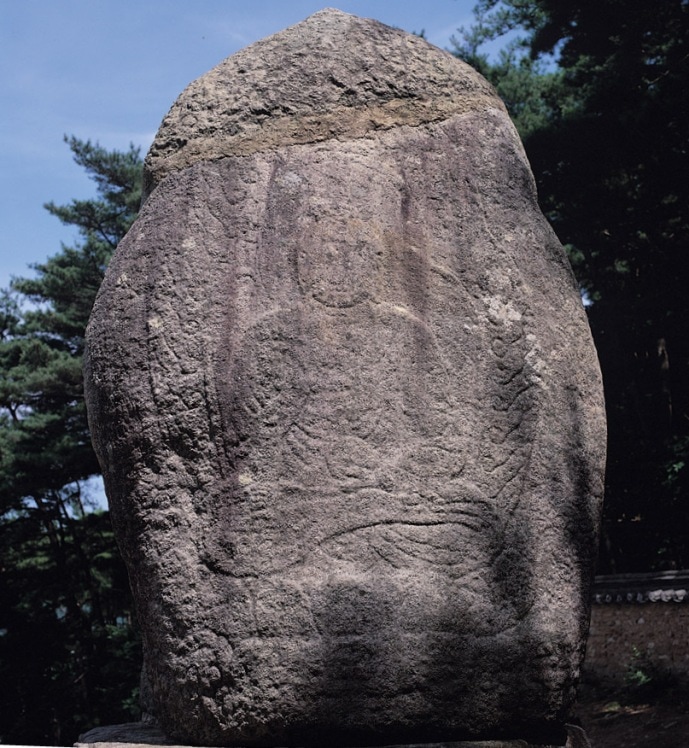
| carved on the back is a weather-worn shallow relief-carving of another buddha, the folk-buddhist Yaksa-yeorae-bul (藥師如來佛, Bhaisajya-guru the Medicinal or Healing Buddha) |
| Designated as Treasure #136 in 1963 “Stone Seated Buddha in Mireuk-gok Valley of Namsan Mountain, Gyeongju” (why this is only a "Treasure" and not a "National Treasure" is one of the great mysteries...) |
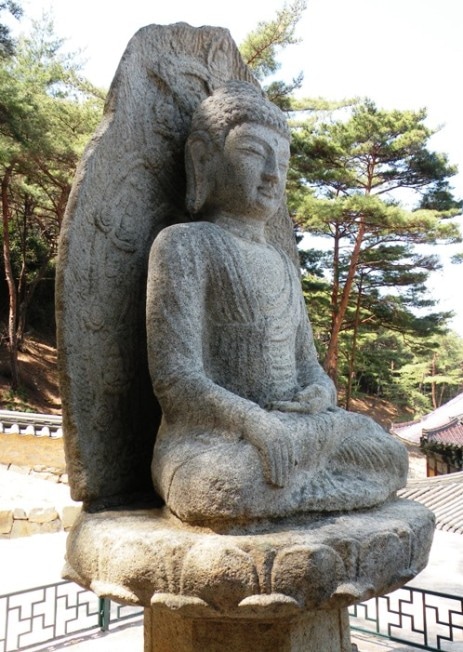
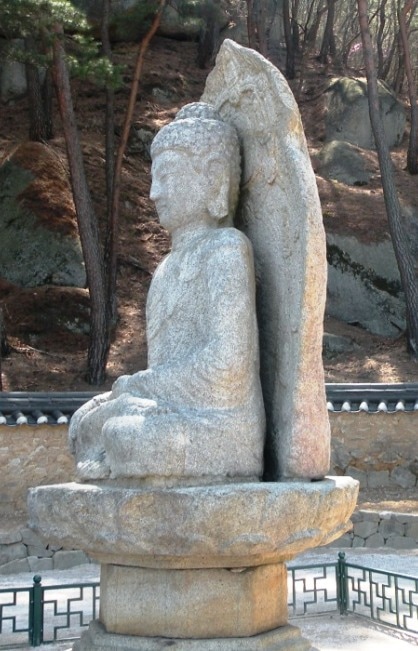
The face is strong yet peacefully concentrated, with a compassionate and wise smile.
The separate carved-stone dae-gwangbae or geoshin-gwang or mandorla of wisdom
[halo and nimbus] is extraordinary, one of the best ever carved in this nation -- although
broken-and-repaired. It contains two chains of lotus flowers, a reference to the Hwaeom
[Avatamsaka, Flower-Garland] school's philosophy, flames outside the chains that signify
his spectacularly dynamic energy even while in deep samadhi meditation, and seven small
Buddha-figures -- two inside the head-flower-chain, four inside the body-flower-chain, and
one above the head-flower-chain in the peak flames -- different from the others.
These elements are common in the many stone and metal dae-gwangbae of other Buddha
statues from Korea's medieval times (Unified Shilla and Goryeo Dynasties, 7th to 14th centuries).
They are part of statues of Sakyamuni Buddha, Amita-bul and Biro-bul, and no two of them
are just the same -- some have 7 small buddhas, some have 5 or 3, some have none; flames
or flower-patterns are often seen but always differ. There are no records detailing the
intentions or the artists or the exact meanings of these motif-factors, and books on Buddhist
iconography only mention them in-general; and therefore, it is impossible for us to definitively
interpret this artwork or all its relatives -- we can only theorize and appreciate.
The separate carved-stone dae-gwangbae or geoshin-gwang or mandorla of wisdom
[halo and nimbus] is extraordinary, one of the best ever carved in this nation -- although
broken-and-repaired. It contains two chains of lotus flowers, a reference to the Hwaeom
[Avatamsaka, Flower-Garland] school's philosophy, flames outside the chains that signify
his spectacularly dynamic energy even while in deep samadhi meditation, and seven small
Buddha-figures -- two inside the head-flower-chain, four inside the body-flower-chain, and
one above the head-flower-chain in the peak flames -- different from the others.
These elements are common in the many stone and metal dae-gwangbae of other Buddha
statues from Korea's medieval times (Unified Shilla and Goryeo Dynasties, 7th to 14th centuries).
They are part of statues of Sakyamuni Buddha, Amita-bul and Biro-bul, and no two of them
are just the same -- some have 7 small buddhas, some have 5 or 3, some have none; flames
or flower-patterns are often seen but always differ. There are no records detailing the
intentions or the artists or the exact meanings of these motif-factors, and books on Buddhist
iconography only mention them in-general; and therefore, it is impossible for us to definitively
interpret this artwork or all its relatives -- we can only theorize and appreciate.
| Mudra (su-in) of the Confirmation of Enlightenment of Sakyamuni Buddha (563-483 BCE) |
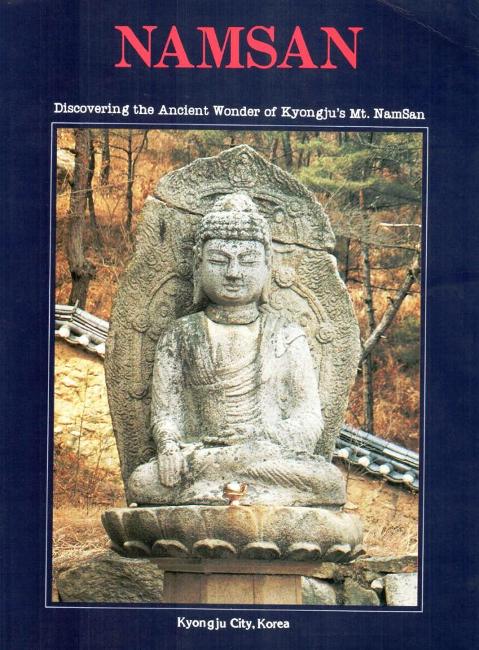
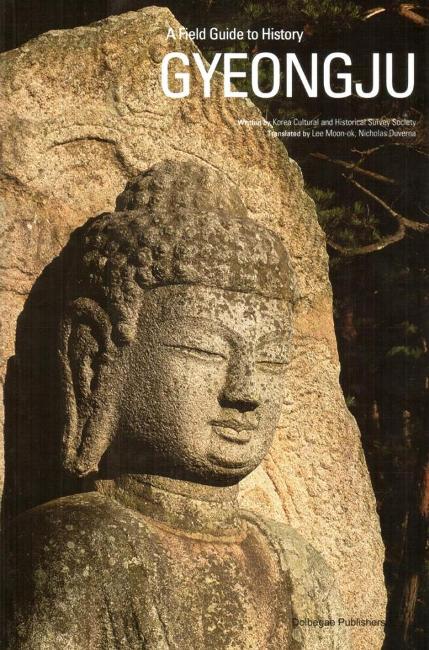
| This statue is so famous, important and beloved that it is on the covers of two of the best books about Gyeongju's heritage sites. |
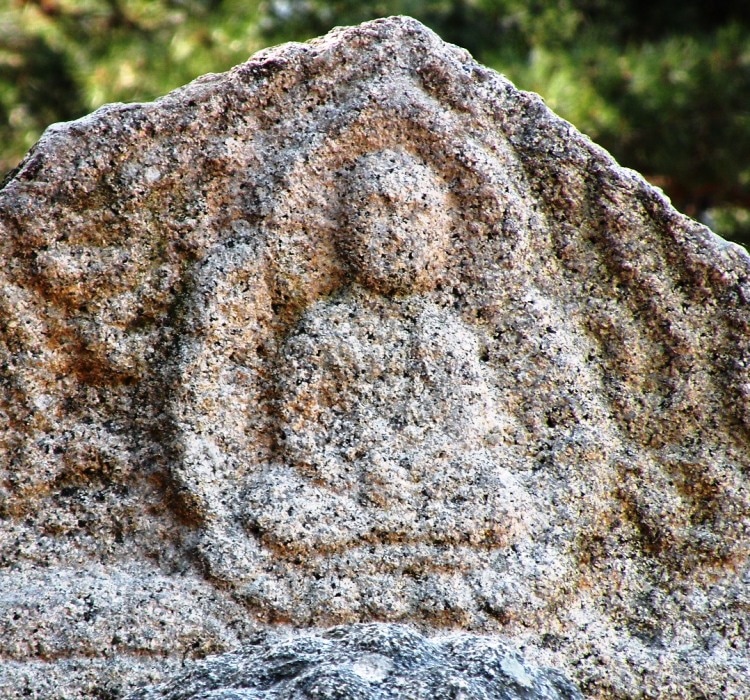
In my view, this figure at the top might be Birojana-bul (毘盧遮那佛,
Vairocana), the Buddha of Infinite yet Tranquil Cosmic Light and
Source of all Buddhas & Bodhisattvas. The left arm looks slightly
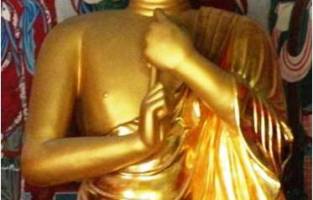
raised over the right, so he could be doing the Biro-su-in [mudra]
that is called “diamond wisdom fist” or “unity gesture" or "the jewel
within the lotus", as pictured here in the bronze Biro-bul statue at
Bulguk-sa (although with hands much lower, and right-hand over left is standard
for this). If this figure is seen as Biro-bul, then the other figures here
are deities that have manifested from him. I think that the two other
little Buddhas in the head-halo could be of the Past (Rocanna) and
the Future (Mireuk or Maitreya), with the main stature representing
Sakyamuni as the Present Buddha of this world -- trinity-triads of
past, present and future Buddhas are common on main altars of
temples devoted to the Hwaeom School...
Vairocana), the Buddha of Infinite yet Tranquil Cosmic Light and
Source of all Buddhas & Bodhisattvas. The left arm looks slightly
raised over the right, so he could be doing the Biro-su-in [mudra]
that is called “diamond wisdom fist” or “unity gesture" or "the jewel
within the lotus", as pictured here in the bronze Biro-bul statue at
Bulguk-sa (although with hands much lower, and right-hand over left is standard
for this). If this figure is seen as Biro-bul, then the other figures here
are deities that have manifested from him. I think that the two other
little Buddhas in the head-halo could be of the Past (Rocanna) and
the Future (Mireuk or Maitreya), with the main stature representing
Sakyamuni as the Present Buddha of this world -- trinity-triads of
past, present and future Buddhas are common on main altars of
temples devoted to the Hwaeom School...
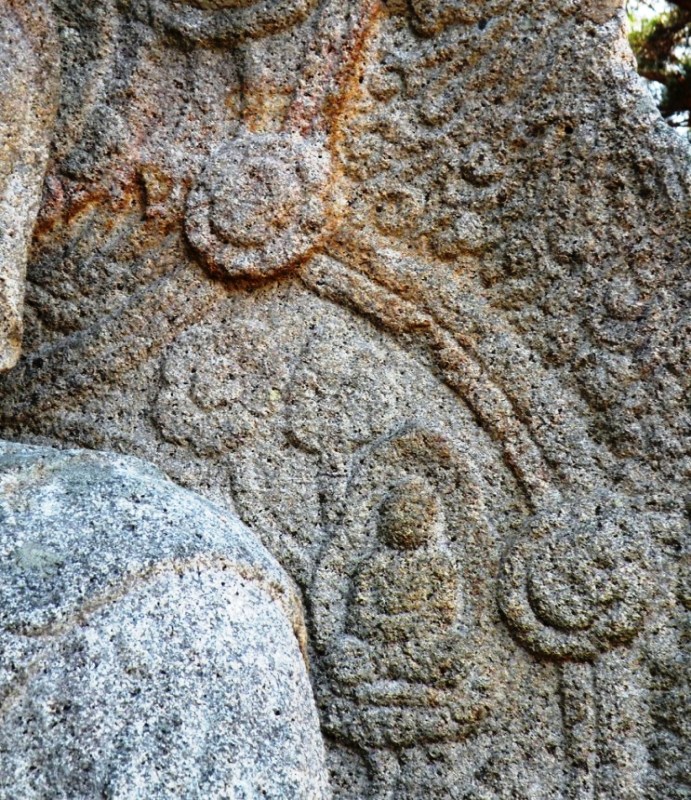
The shin-gwang or nimbus is filled with blooming lotus plants, a motif not seen on any
other dae-gwangbae of an ancient Buddha statue, or at least not so explicitly and
naturalistically. Four deity figures are within it, symmetrically arranged, seated in
meditation (arms and legs folded), with their own crude boat-shaped dae-gwangbae's.
Each is on a lotus-throne that is "blossoming" from a lotus stem -- a very rare motif in
traditional Korean artworks, but a very fitting and evocative one. This is the best-
preserved one, by his left shoulder (top-right in our perspective). The four are assumed
to also be generic Buddhas by all other experts I have reviewed; however, I think that
there is a distinct something-extra at the top of the head of the above figure, which
might be a ceremonial crown (and the arms meet at a higher level); and they are a bit
smaller than the three upper Buddhas. All these factors seem to indicate that these
are Bodhisattvas -- and because there are 4 principal Bodhisattvas venerated in Korean
Buddhism (Munsu / wisdom, Gwaneum / compassion, Bohyeon / benevolent practice and Jijang /
afterlife salvation), this would make further schematic sense. Because these smaller
figures are so badly worn by 1300 years of sitting outdoors in all seasons, however,
it is impossible to make a definitive identification.
other dae-gwangbae of an ancient Buddha statue, or at least not so explicitly and
naturalistically. Four deity figures are within it, symmetrically arranged, seated in
meditation (arms and legs folded), with their own crude boat-shaped dae-gwangbae's.
Each is on a lotus-throne that is "blossoming" from a lotus stem -- a very rare motif in
traditional Korean artworks, but a very fitting and evocative one. This is the best-
preserved one, by his left shoulder (top-right in our perspective). The four are assumed
to also be generic Buddhas by all other experts I have reviewed; however, I think that
there is a distinct something-extra at the top of the head of the above figure, which
might be a ceremonial crown (and the arms meet at a higher level); and they are a bit
smaller than the three upper Buddhas. All these factors seem to indicate that these
are Bodhisattvas -- and because there are 4 principal Bodhisattvas venerated in Korean
Buddhism (Munsu / wisdom, Gwaneum / compassion, Bohyeon / benevolent practice and Jijang /
afterlife salvation), this would make further schematic sense. Because these smaller
figures are so badly worn by 1300 years of sitting outdoors in all seasons, however,
it is impossible to make a definitive identification.
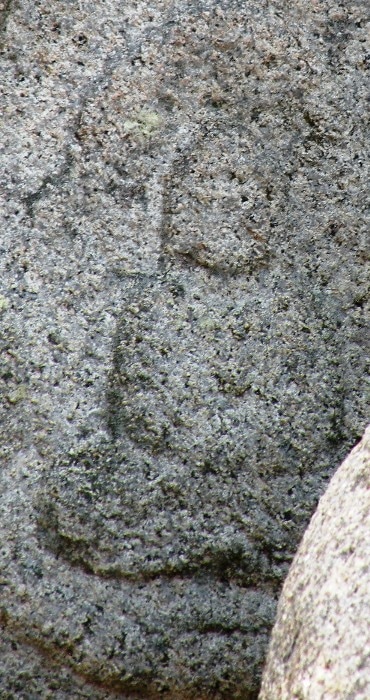
The figure by his left shoulder,
obscured by centuries of erosion.
obscured by centuries of erosion.
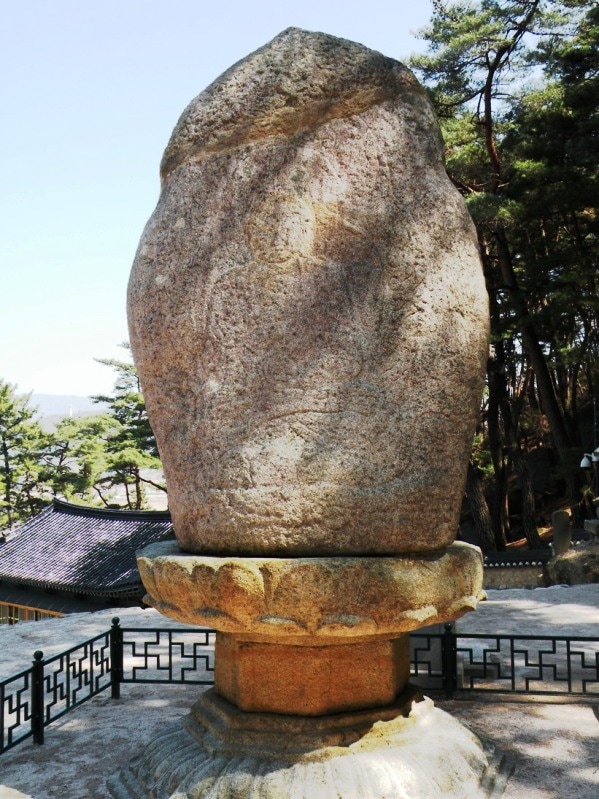
Now, because according to classical directional-iconographic theory the Yaksa-yeorae Buddha sits in
the east and faces west, and this is true here, and the corresponding deity sitting in the west and facing
east is Amita-bul [Amibatha, Teaching Buddha of the Western Paradise], many scholars have said
that the main figure here, facing east-south-east really, must be Amita-bul. But I disagree with this;
the Yaksa-yeorae here is so shallowly carved, it was probably added later for popular supplication,
and so has no necessary relation to the main Buddha's identity. Every other indication, especially his
su-in hand-mudra (above) indicates that this is Sakyamuni the historical Buddha, and ancient Korean
artists were not strict about the directional-iconographic rules -- see the four-sided-buddha rocks of
Nam-san Tap-gol, Nam-san Chilbul-am and Naepo Gaya-san.
Therefore my own overall theory is that the front-side of this artworks represents Biro-bul at the apex,
in the act of emanating universal cosmic light-energy (enlightenment & interconnection of all), and he
is manifesting the Three Temporal Buddhas -- the main stature representing Sakyamuni as the Present
Buddha of this world (and therefore the most prominent), with the Past (Rocanna) and Future (Mireuk
or Maitreya) Buddhas flanking his head within the geogwang halo -- and Biro-bul is also manifesting
the Four Principal Bodhisattvas venerated in Korean Buddhism (Munsu / wisdom, Gwanse-eum /
compassion, Bohyeon / benevolent practice and Jijang / afterlife salvation) in the shin-gwang nimbus
-- Buddhas as the "head" or higher-realm of this Dharma-existence, and Bodhisattvas as its "body".
This creates a coherent design concept for this exceedingly profound artwork.
the east and faces west, and this is true here, and the corresponding deity sitting in the west and facing
east is Amita-bul [Amibatha, Teaching Buddha of the Western Paradise], many scholars have said
that the main figure here, facing east-south-east really, must be Amita-bul. But I disagree with this;
the Yaksa-yeorae here is so shallowly carved, it was probably added later for popular supplication,
and so has no necessary relation to the main Buddha's identity. Every other indication, especially his
su-in hand-mudra (above) indicates that this is Sakyamuni the historical Buddha, and ancient Korean
artists were not strict about the directional-iconographic rules -- see the four-sided-buddha rocks of
Nam-san Tap-gol, Nam-san Chilbul-am and Naepo Gaya-san.
Therefore my own overall theory is that the front-side of this artworks represents Biro-bul at the apex,
in the act of emanating universal cosmic light-energy (enlightenment & interconnection of all), and he
is manifesting the Three Temporal Buddhas -- the main stature representing Sakyamuni as the Present
Buddha of this world (and therefore the most prominent), with the Past (Rocanna) and Future (Mireuk
or Maitreya) Buddhas flanking his head within the geogwang halo -- and Biro-bul is also manifesting
the Four Principal Bodhisattvas venerated in Korean Buddhism (Munsu / wisdom, Gwanse-eum /
compassion, Bohyeon / benevolent practice and Jijang / afterlife salvation) in the shin-gwang nimbus
-- Buddhas as the "head" or higher-realm of this Dharma-existence, and Bodhisattvas as its "body".
This creates a coherent design concept for this exceedingly profound artwork.
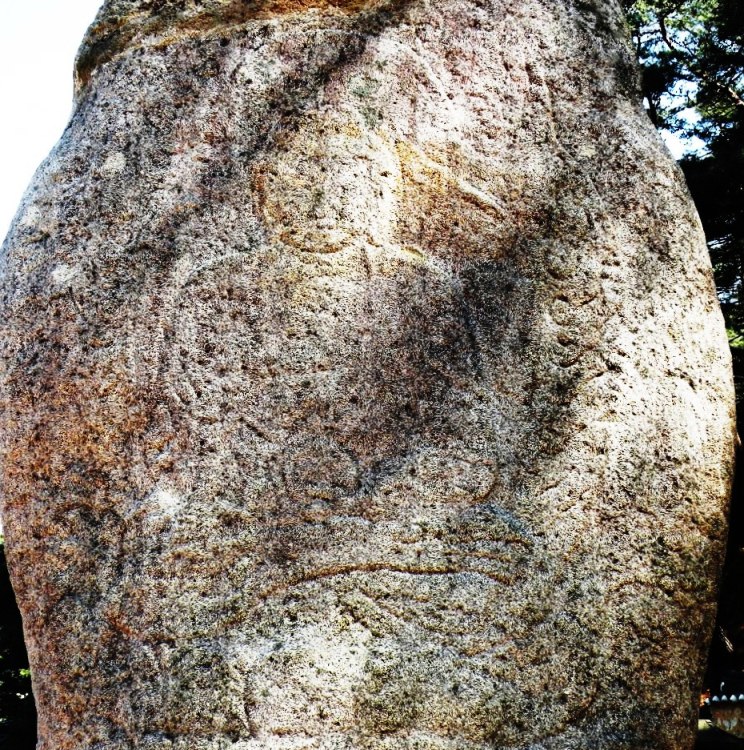
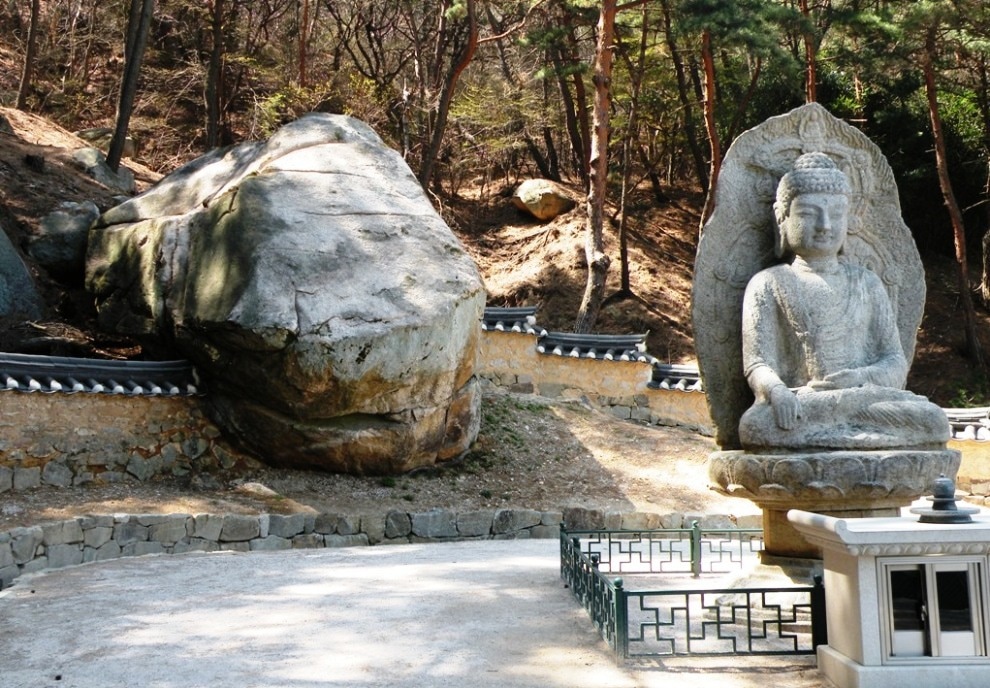
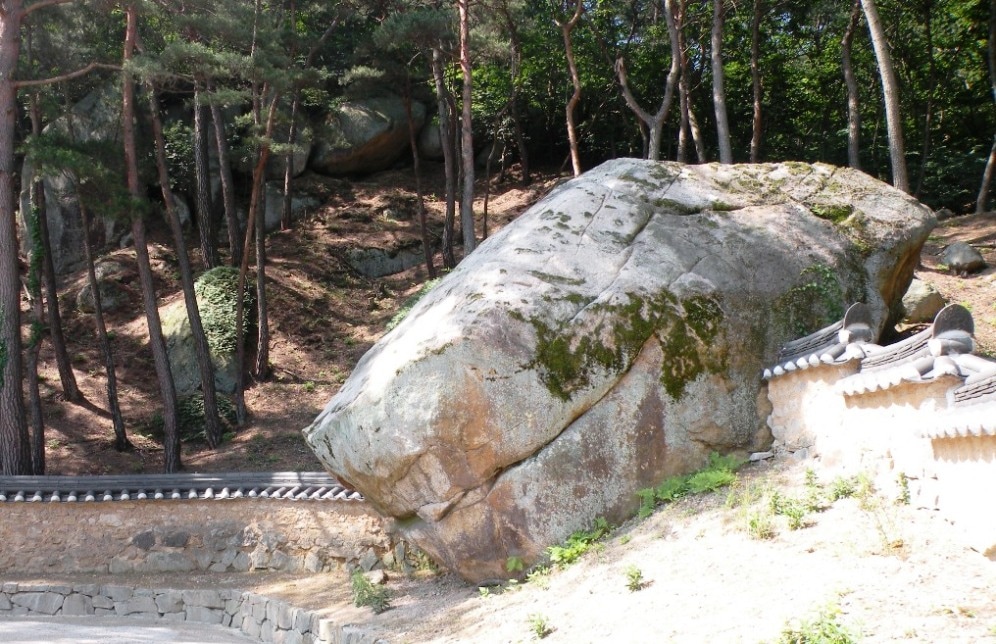
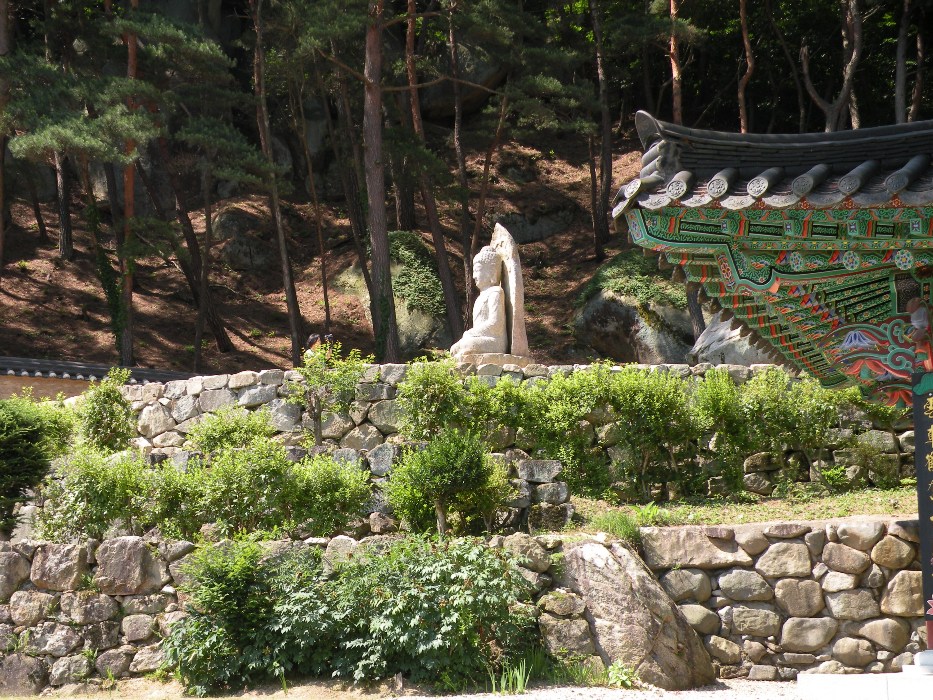
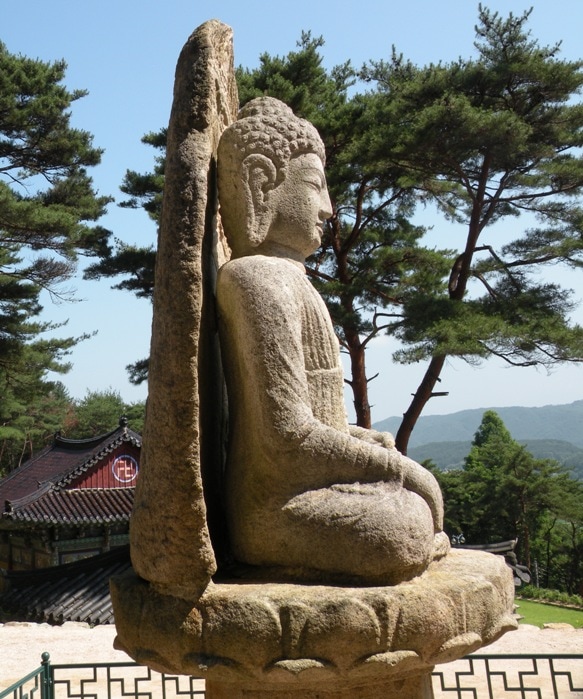
The siting of this beautiful statue is one of its most noteworthy aspects. I had just been ignoring "the big
rock behind it" (only focusing on the statue; i can be kinda oblivious to context sometimes) until my friend Daniella
pointed out to me that it is a "dragon head" -- and once I recognized that, it was quite stunningly clear!
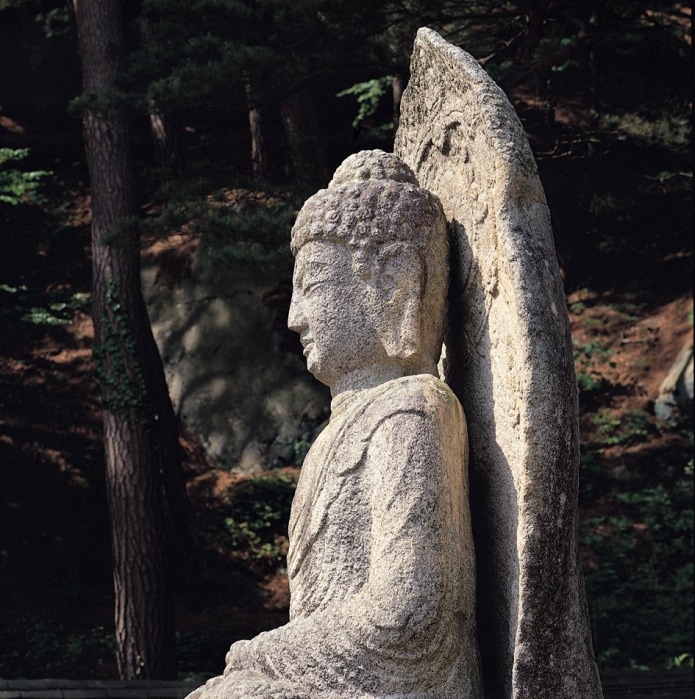
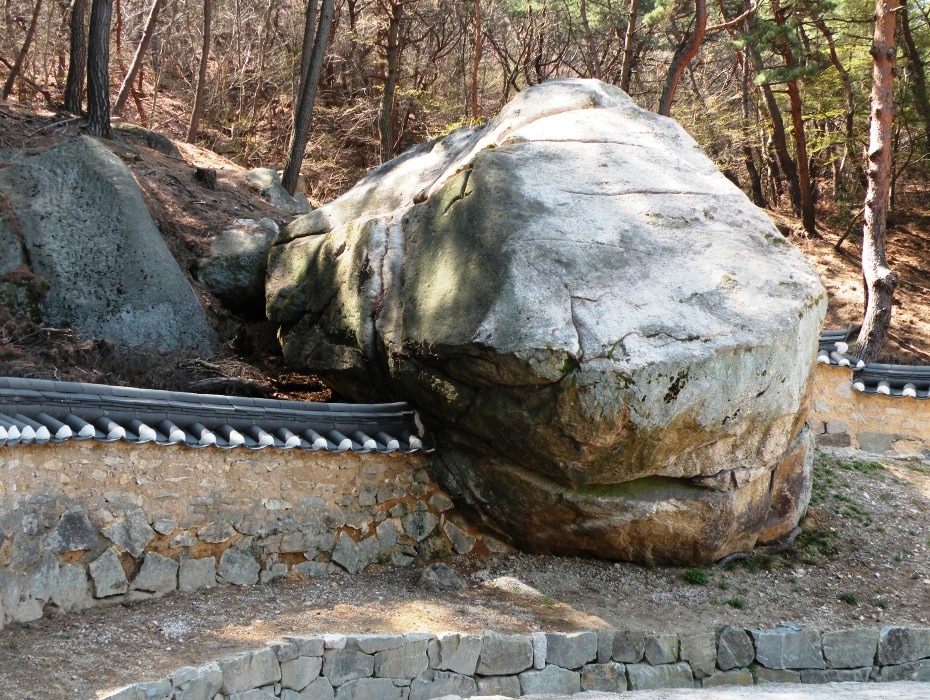
This is indeed one of the best natural (uncarved) seok-yongdu [stone dragon heads] figures in all of the
nation. Particularly on its left face seen below, the mouth, teeth, snout and one eye can clearly be seen
-- and a "tongue" is slightly protruding. It is a "snake" or "turtle-head" type dragon, out of the possible
historic motif-styles (see the carving here). This is a very powerful factor within Korea's pungsu-jiri theory,
making this a highly 'charged' site of earth-energy projecting outwards. We can easily assume that this
site was used for Shamanic mountain dragon worship usage long before Buddhism came to the Shilla
Kingdom; and this explains why this magnificent statue was enshrined in this very place.
rock behind it" (only focusing on the statue; i can be kinda oblivious to context sometimes) until my friend Daniella
pointed out to me that it is a "dragon head" -- and once I recognized that, it was quite stunningly clear!
This is indeed one of the best natural (uncarved) seok-yongdu [stone dragon heads] figures in all of the
nation. Particularly on its left face seen below, the mouth, teeth, snout and one eye can clearly be seen
-- and a "tongue" is slightly protruding. It is a "snake" or "turtle-head" type dragon, out of the possible
historic motif-styles (see the carving here). This is a very powerful factor within Korea's pungsu-jiri theory,
making this a highly 'charged' site of earth-energy projecting outwards. We can easily assume that this
site was used for Shamanic mountain dragon worship usage long before Buddhism came to the Shilla
Kingdom; and this explains why this magnificent statue was enshrined in this very place.
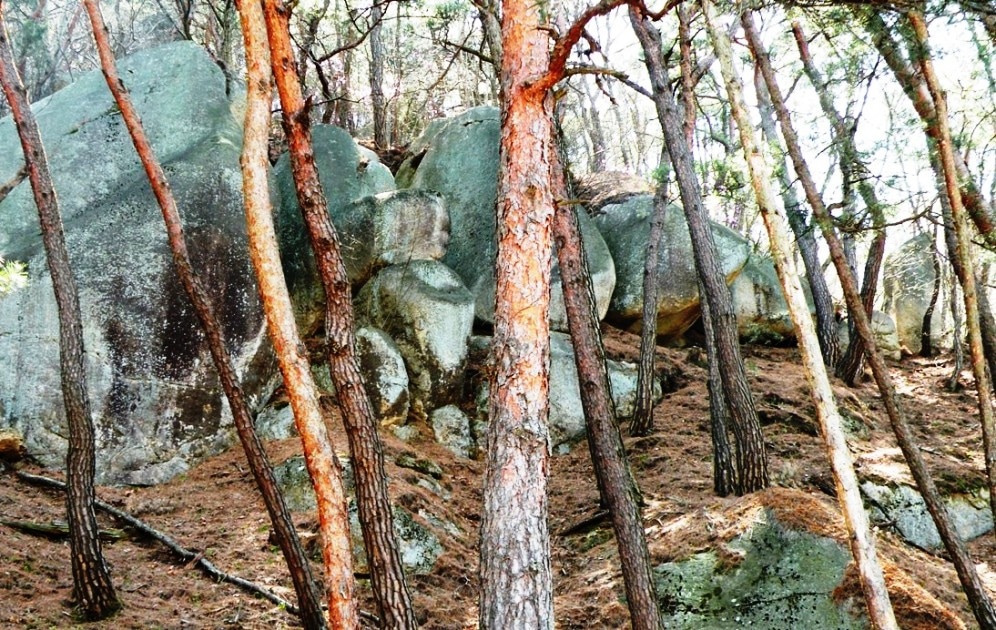
The dragon's "neck-spine" goes back into the slope, and appears to make a U-turn and become the
steep little ridge to the statue's south -- the dragon-earth-energy manifesting as a line of prominent
boulders along the ridge's top -- just like giant "scales" along a dragon's back! There is a nice relief-
carving of a Buddha on the big boulder on the southeast end of this line (see previous page here).
steep little ridge to the statue's south -- the dragon-earth-energy manifesting as a line of prominent
boulders along the ridge's top -- just like giant "scales" along a dragon's back! There is a nice relief-
carving of a Buddha on the big boulder on the southeast end of this line (see previous page here).
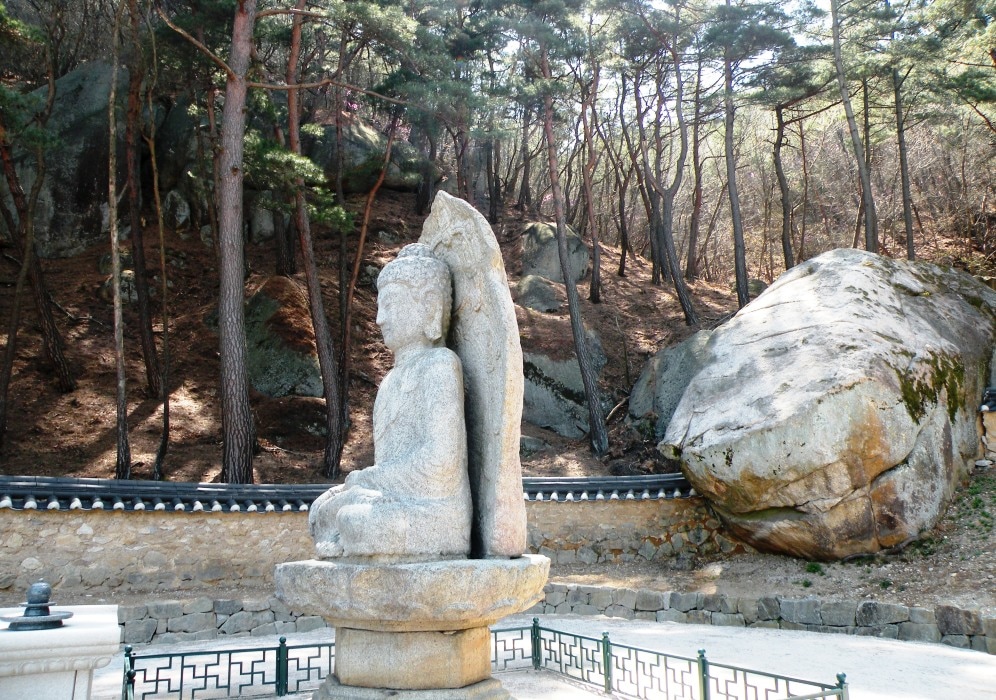
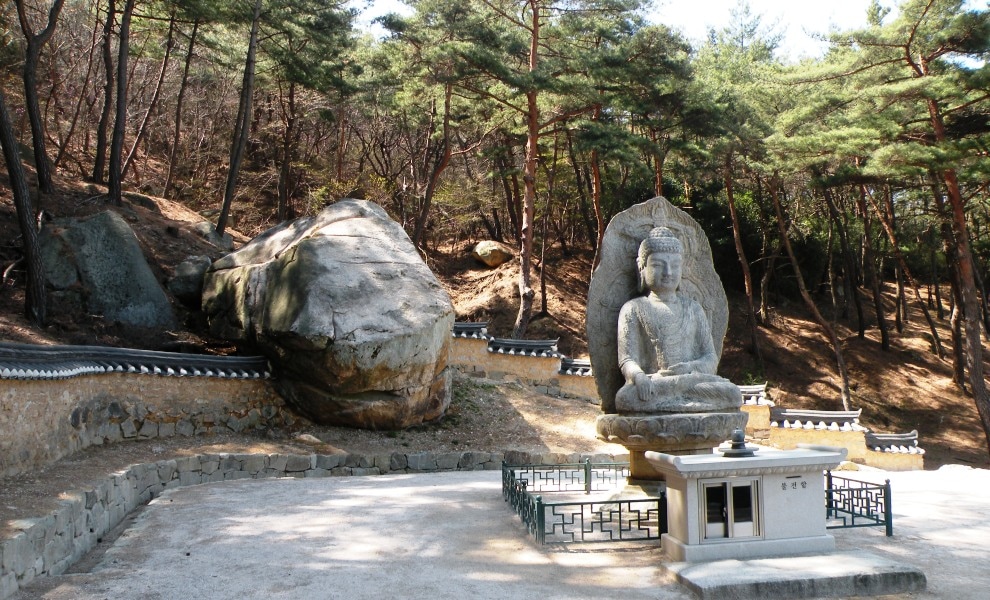
Whoever installed this statue here more than 1200 years ago could have cut away the big rock
behind it so as to make a consistent back-wall; or they could have built a wall further forward in
order to hide it -- but they did not do-so, rather they positioned the statue fairly in front of it, and
also built the wall so that rather emphasizes the effect -- it seems like the dragons head is thrusting
right through the wall towards the buddha! I can only suppose that this is quite deliberate, and
intended to amplify the telluric energy of this statue by having the stone dragon manifesting out
of the mountain "projecting energy into it" from behind (this is even a common theme -- there are many
oriental paintings showing dragons breathing an auspicious or fiery energy outwards into war on to some other
being, for their benefit -- most commonly seen in the paintings of the birth of Sakyamuni Buddha where nine
dragons of different colors are seen forming an umbrella over him and projecting a cloudlike positive "energy"
into the infant, presumably giving him divine powers). This arrangement exemplifies the usage of and
blending with korea's ancient shamanic-daoist traditions with the relatively new Buddhism that
was implanted from 1700 to 1100 years ago, in an explicit and dramatic fashion.
behind it so as to make a consistent back-wall; or they could have built a wall further forward in
order to hide it -- but they did not do-so, rather they positioned the statue fairly in front of it, and
also built the wall so that rather emphasizes the effect -- it seems like the dragons head is thrusting
right through the wall towards the buddha! I can only suppose that this is quite deliberate, and
intended to amplify the telluric energy of this statue by having the stone dragon manifesting out
of the mountain "projecting energy into it" from behind (this is even a common theme -- there are many
oriental paintings showing dragons breathing an auspicious or fiery energy outwards into war on to some other
being, for their benefit -- most commonly seen in the paintings of the birth of Sakyamuni Buddha where nine
dragons of different colors are seen forming an umbrella over him and projecting a cloudlike positive "energy"
into the infant, presumably giving him divine powers). This arrangement exemplifies the usage of and
blending with korea's ancient shamanic-daoist traditions with the relatively new Buddhism that
was implanted from 1700 to 1100 years ago, in an explicit and dramatic fashion.
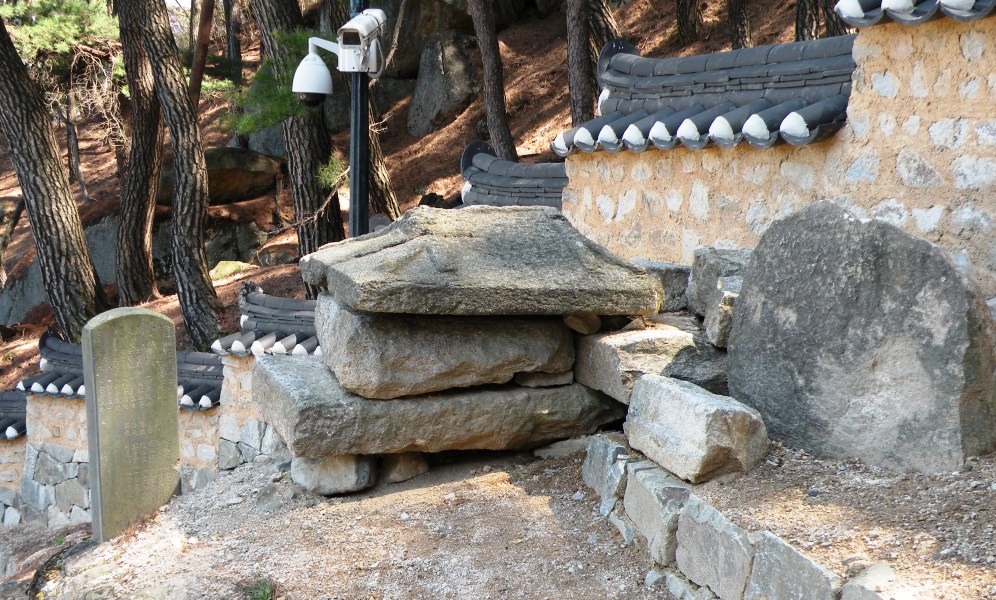
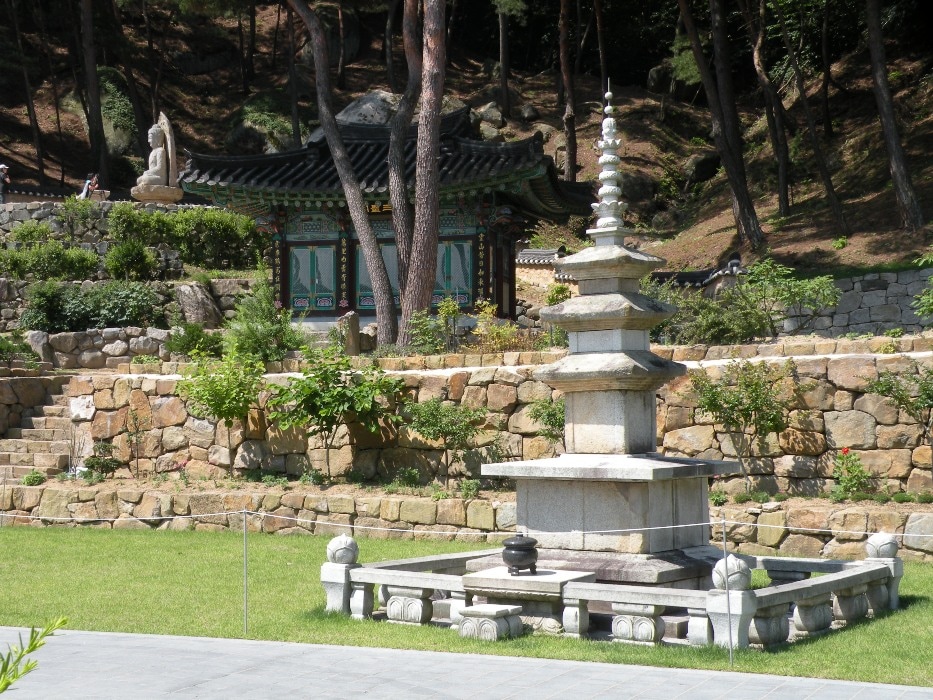
| in front of the statue on the left -- broken pieces of an 8th-century pagoda, a modern designation-monument, and a security video camera |
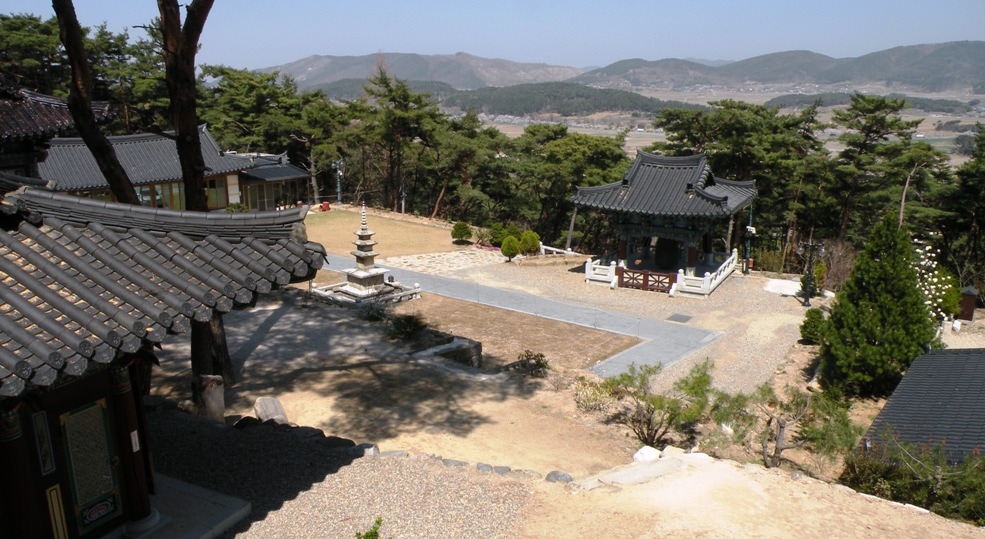
| the view from the Buddha -- NE to Nak-san hill and the NW sector of Toham-san |