Jincheon intro and Botap-sa
Kim Yu-shin's Birthplace
Jincheon Nong-dari Stone Bridge
San-shin Site Contents
Kim Yu-shin's Birthplace
Jincheon Nong-dari Stone Bridge
San-shin Site Contents
| More Features of Seongrim-sa Jincheon-gun Seongju-san Ten Ox Paintings and Goryeo Amita-bul Statue |
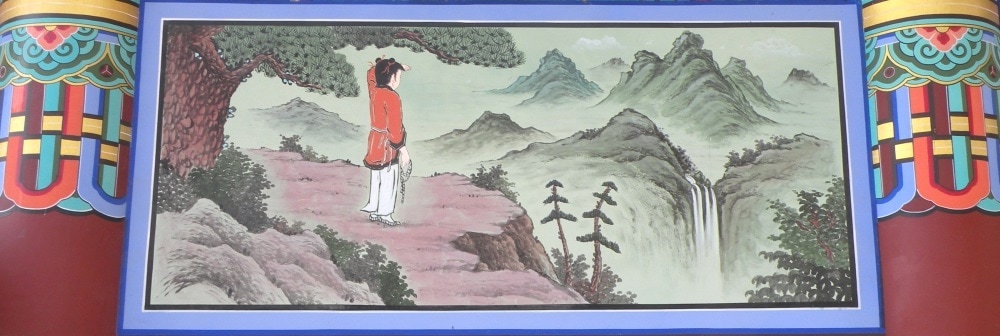
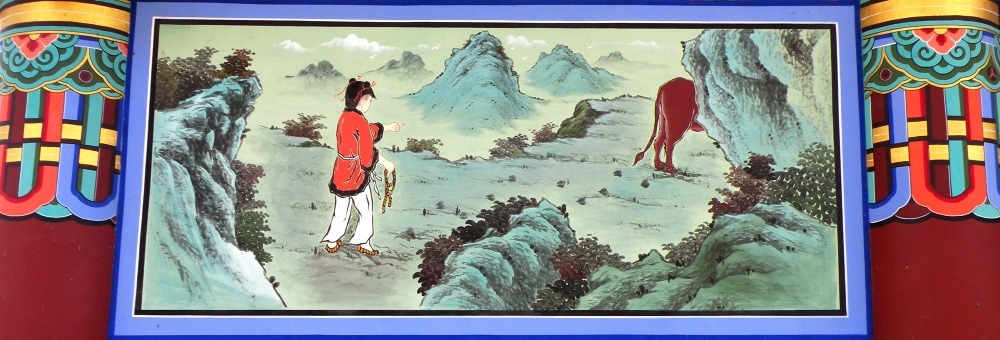
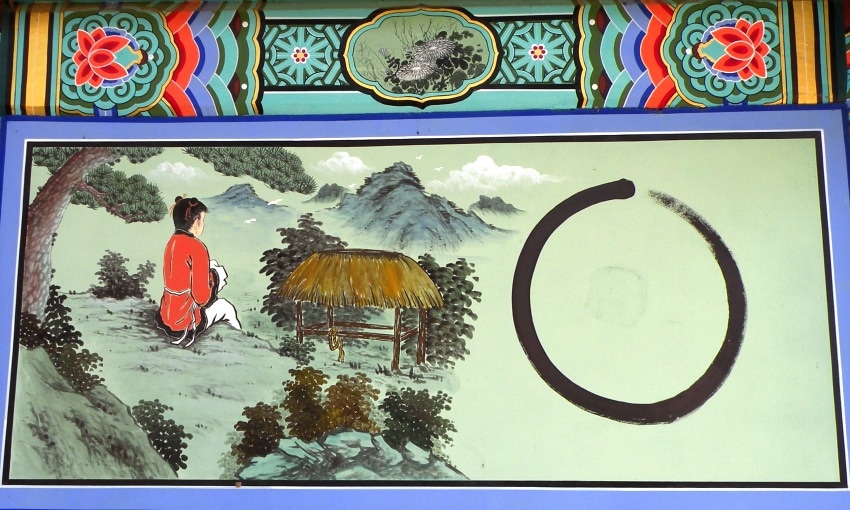
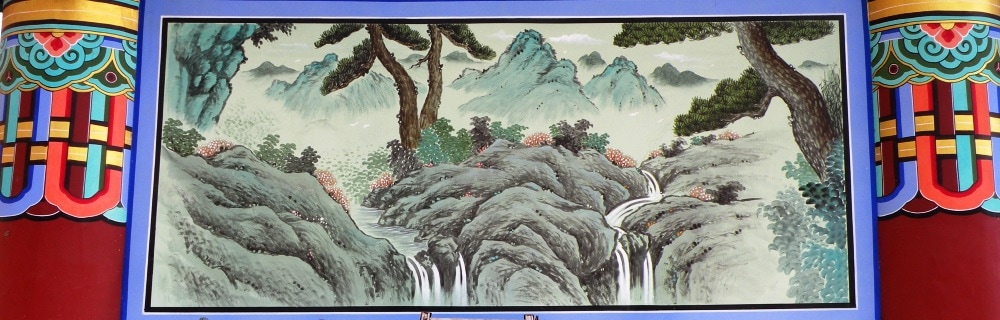
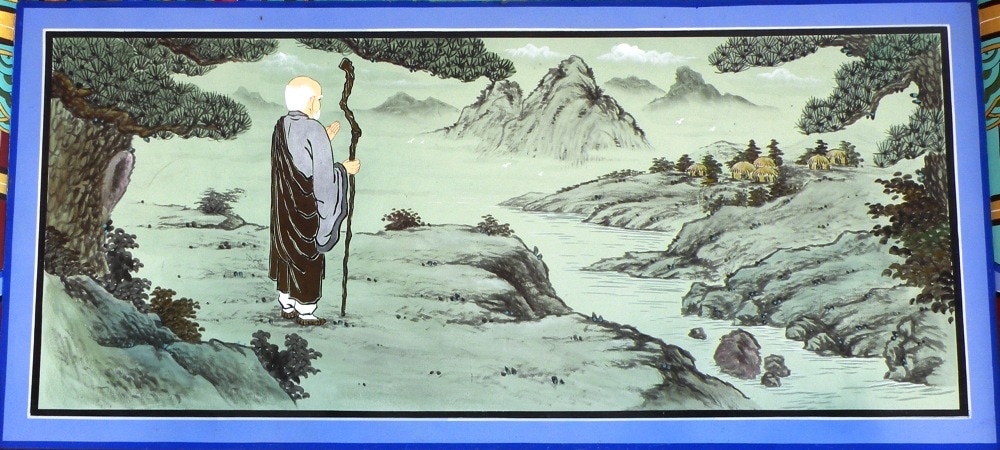
| #1 The Search for the Bull In the pasture of the world, I endlessly push aside the tall grasses in search of the bull. Following unnamed rivers, lost upon the interpenetrating paths of distant mountains; my strength failing and my vitality exhausted, I cannot find the bull. I only hear the locusts chirping through the forest at night. In the first picture, one realizes that one has lost one’s Ox (i.e., the True Self, which is also called“Original Face”in Seon, “True-Suchness” in the Discourse on the Awakening of Faith in the Mahayana, and “Emptiness” or “Dharma-Body” in the Thirty Verses on Consciousness-Only), and begins to search for it. In this phase, one does not know who she or he is. The image depicts one's aspiration and desire to achieve enlightenment of the True Self. Therefore, the goal of this path is to plant the seed of nirvana by practicing the Six Perfections and the Thirty-Seven Prerequisites for the Attainment of Enlightenment. |
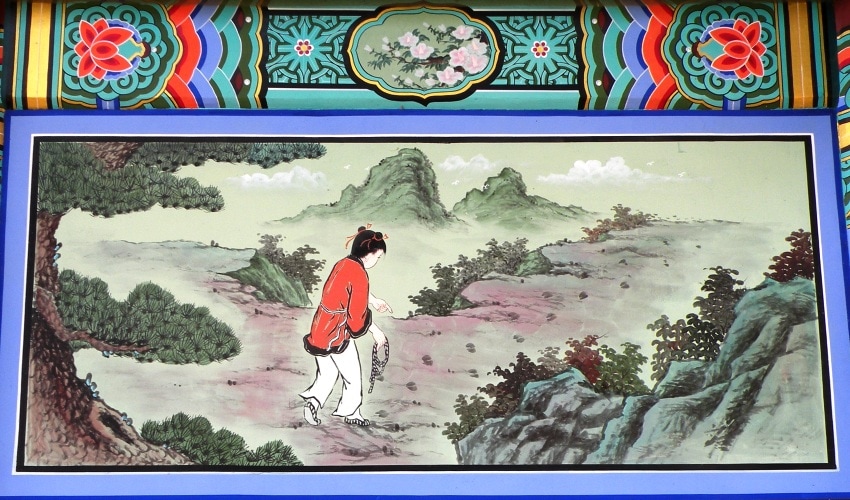
| #2 Discovering the Footprints Along the riverbank under the trees, I discover footprints. Even under the fragrant grass, I see his prints. Deep in remote mountains they are found. These traces can no more be hidden than one's nose, looking heavenward. Second, once practicing diligently, one discovers a footprint of the True Self. The footprint of the bull symbolizes that one is vaguely realizing the True Self. In this phase, one practices the Four All-Embracing Virtues and the Four Immeasurable Minds. The former are the four skillful means employed by Bodhisattvas to make all beings listen and receive the Dharma or Truth: generosity, kind words, beneficial actions to others, and cooperation with and adaptation of oneself to others. The latter are loving-kindness, compassion, sympathetic joy, and equanimity; dwelling in these four positives states, one radiates them out towards others. |
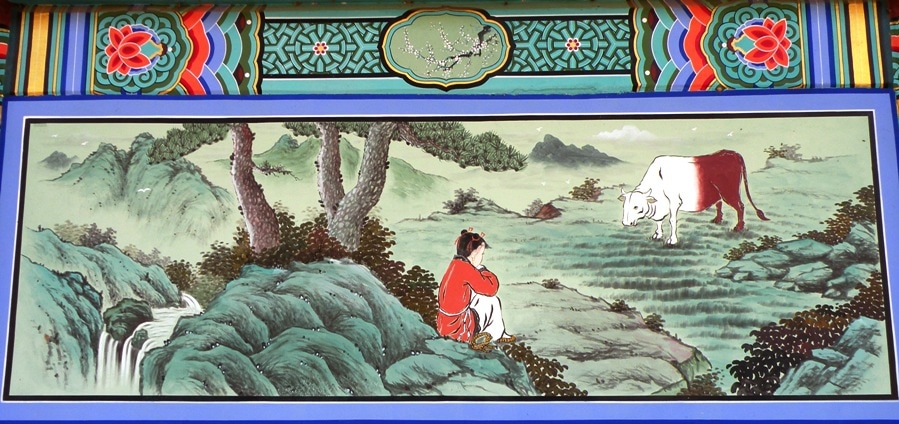
| #3 Perceiving the Bull Hear the song of the nightingale. The sun is warm, the wind is mild, willows are green along the road. Here no bull can hide. What artist can draw that massive head, those majestic horns? Third, one finds the bull that symbolizes the essential nature of True Self. However, at this phase, one does not completely see the True Self, but only a part of it; thus, the picture shows only the back half of the animal. One is gradually realizing the True Self. However, even though it is said that one is only beginning to realize the True Self, from the view of Mahayana practice system, the first three stages of the Ten Ox-Herding Pictures are considered to belong to the “Stage of Understanding.” In this phase, one practices the Four Reflections or Inquiries to eliminate the dichotomy of subject and object. |
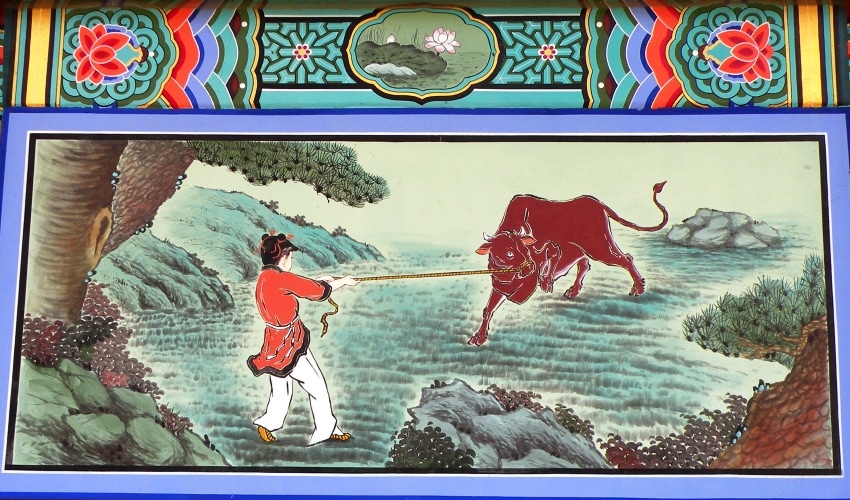
| #4 Catching the Bull I seize him with a terrific struggle. His great will and power are inexhaustible. He charges to the high plateau far above the cloud-mists, or in an impenetrable ravine he stands. Fourth, one attains right understanding of the essential nature of the True Self. However, at this phase, one is having difficulty grasping the True Self without losing it again because one has not completely eliminated the “Three Poisons”-- the three karmically unwholesome roots (greed, hatred, and delusion), which are causes of human suffering. In this phase, one practices the Four Reflections or Inquiries to directly and immediately experience the state of “no-subject and no-object.” |
| 5. Taming the Bull The whip and rope are necessary at first, else he might stray off down some dusty road. Then being well-trained, he becomes naturally gentle. Unfettered and half-purified, he obeys his master. Fifth, having eliminated the Three Poisons, one can easily grasp and keep the True Self. The whip and the rope imply that the Three Poisons as a habitual energy still remain, so one should observe and be aware of them. In this phase also, one practices the Four Reflections or Inquiries to directly experience “the object” and to become one with it. |
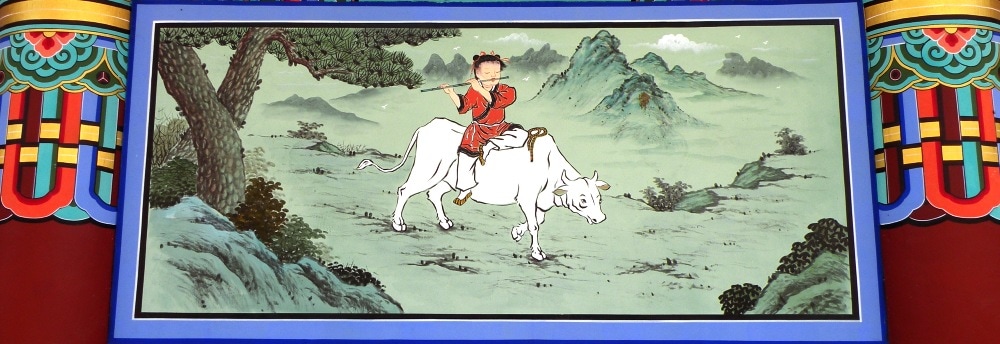
| 6. Riding the Bull Home Mounting the bull, slowly I return homeward. The voice of my flute intones through the evening. Clapping along with the pulsating harmony, I direct the endless rhythm. Whoever hears this melody will join me. Sixth, by taming habitual energies, one is returning home (arriving at the original pure essential nature, the True Self); one comes into union with the True Self. However, there is still a boundary between one and the True Self because both are not empty. That is, at this stage, one as the perceiver (subject) sees the True Self as the perceived (object). Therefore, it can`t be said that one truly resides in the True Self. In this phase, one still practices the Four Reflections or Inquiries and directly experiences“no-object”one sees things as they truly are. It is called the Land of Joy because one has direct experience of Truth. One achieves non-discriminating knowledge because there is no discrimination between the perceiver and the perceived. |
| 7. The Bull Transcended Astride the bull, I reach home. I am serene. The bull too can rest. The dawn has come. In blissful repose, within my thatched dwelling, I have abandoned the whip and ropes. Seventh, the True Self becomes empty; it has transcended. There is no object to be perceived. However, there still remains one who perceives that the True Self is empty; the perceiver as a subject is not empty yet. In this phase, one practices further to remove attachment to self. |
| 8. Both Bull and Self Transcended Whip, rope, person, and bull - all merge in No Thing. This heaven is so vast, no message can stain it. How may a snowflake exist in a raging fire? Here are the footprints of the Ancestors. Eighth, there is neither oneself as the perceiver (emptiness of self) nor the True Self as the perceived (emptiness of things), but there is only emptiness. One-mind and its object are both empty. At this phase, there is no boundary between the perceiver and the perceived. One achieves complete emptiness. which is transcendental knowledge. |
| 9. Reaching the Source Too many steps have been taken returning to the root and the source. Better to have been blind and deaf from the beginning! Dwelling in one's true abode, unconcerned with and without: The river flows tranquilly on and the flowers are red. After one attains the emptiness of Ox and self at the eighth stage, one returns to the things that one had left and sees them. All things appear as they really are; for one sees them based on emptiness of self. At this stage, what one achieves is a discriminative wisdom that is called Jin-gong-myoyu in Korean, “The Recovery of Existence from the True Nonexistence.” |
| #10 Returning to the World to Compassionately Assist Others Barefooted and barely-clothed, I mingle with the people of the world. My clothes are ragged and dust-laden, and I am ever blissful. I use no magic to extend my life; now, before me, the dead trees become alive. Finally, one returns to the beings one had left and sees them. All beings appear as they really are; for one sees them based on emptiness of self. One works for all beings, but one does not have either the idea or the consciousness that one helps others, because there is no boundary between oneself and others. At this final phase, one completes perfect enlightenment. When this occurs, the eight types of consciousness that organize one to cognize things - including oneself as a subject and an object - are transformed into the Four Wisdoms, which are Buddha's own knowledge: 1. The Knowledge of a Great Perfect Mirror -- it is unbiased perception of things as they are, like a mirror that reflects impartially without grasping or rejecting. Unawareness of all karmas accumulated through countless lives is transformed into awareness. 2. The Knowledge of Essential Equality -- it is a clear knowing that all things, including self and others, are absolutely equal. 3. The Knowledge of Wonderful Observation -- it is a knowing that differences or changes in all things depend on conditions. 4. The Knowledge of Accomplishment of Task -- it is the knowledge of achieving the task of benefiting all beings. |
| the classical Seon-allegory "Ten Ox-Herding Pictures" on the outer walls of the Main Hall of Jincheon Seongrim-sa -- with Commentary by Ven. Seogwang, Ph.D., Unmun-san Unmun-sa Temple |
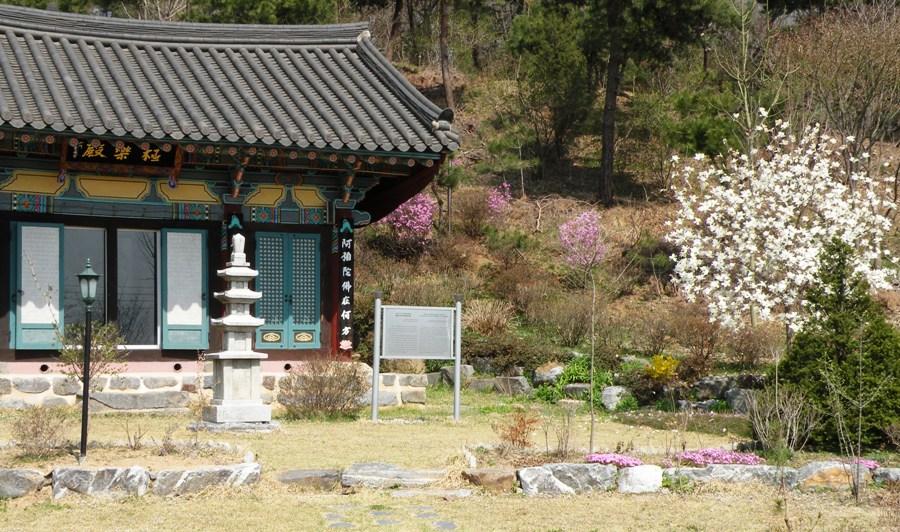
| The Amita-jeon Hall, which facilitates veneration of the badly-worn Goryeo-Dynasty Amita-bul Statue behind it Amithabha is Buddha of "the Western Paradise" or “the Pure Land”, manifesting Compassion |
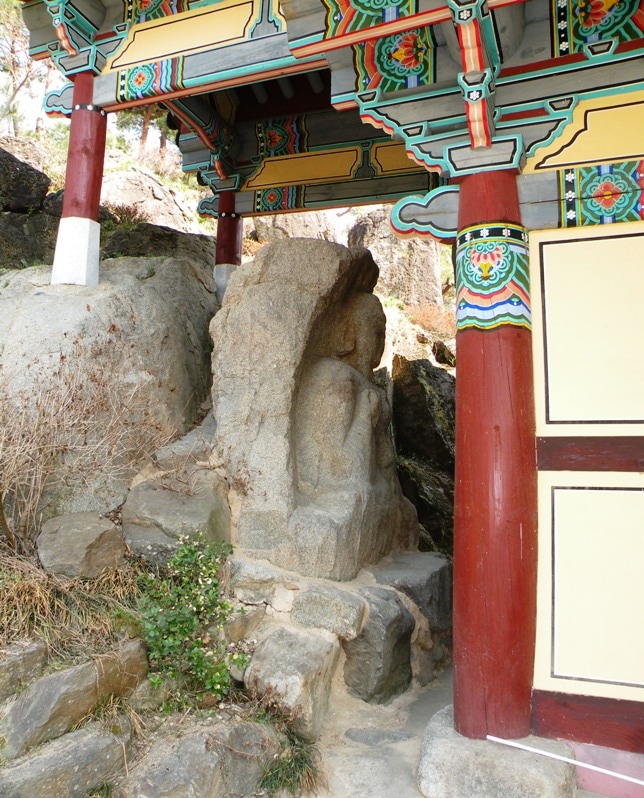
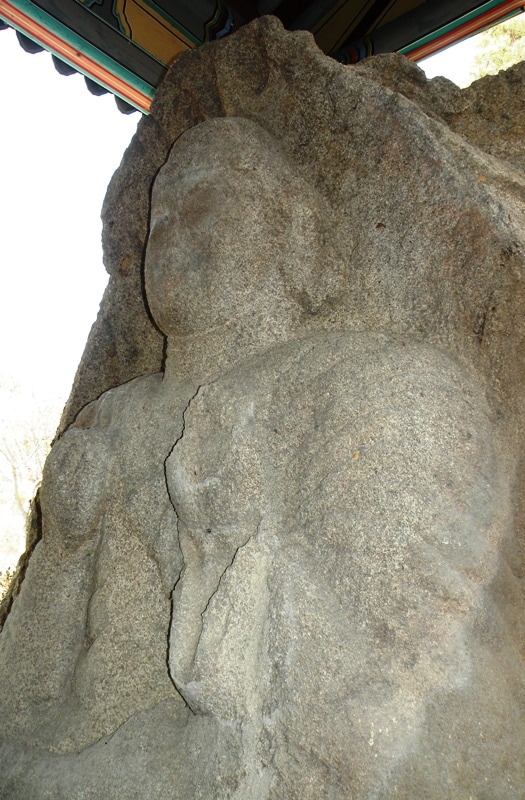
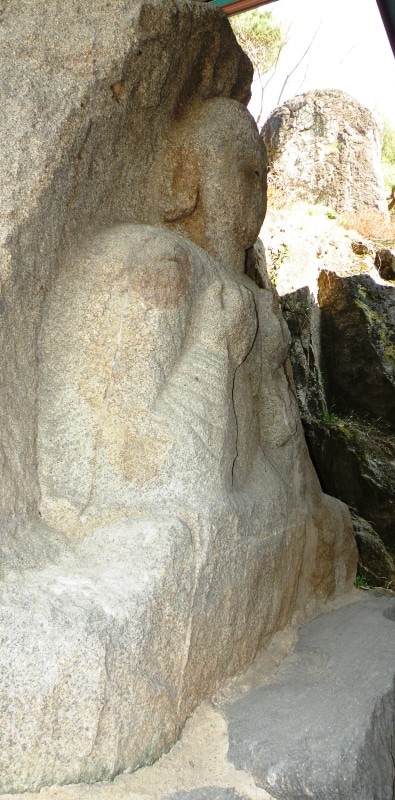
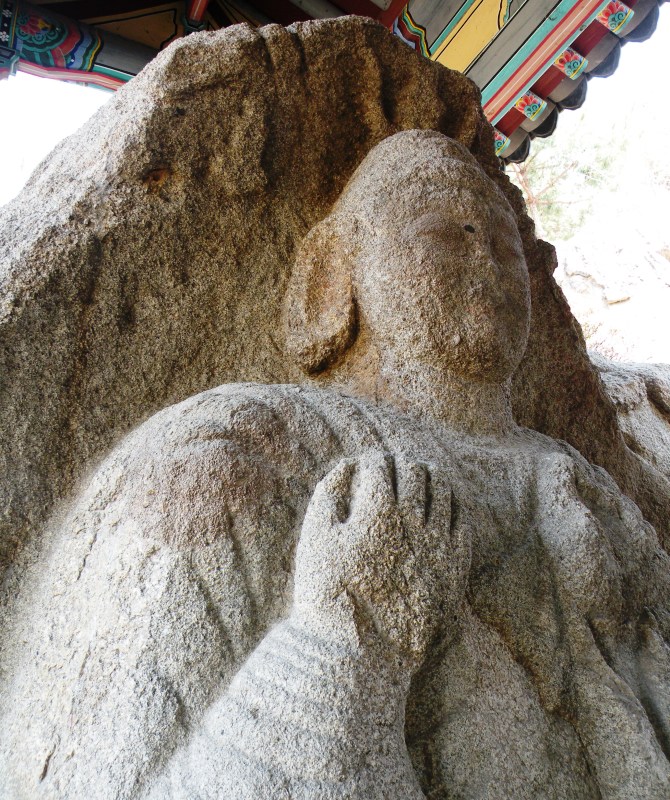
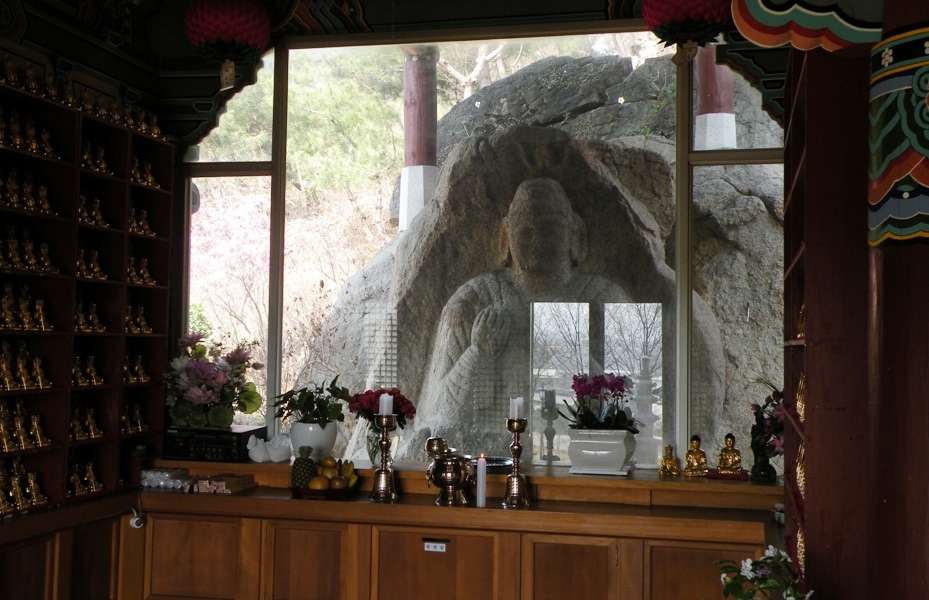
| This Hall was built so that the statue could be venerated through the window above the altar, in the historic Korean style started by Master Jajang-yulsa at the grand Yeongchuksan Tongdo-sa. |
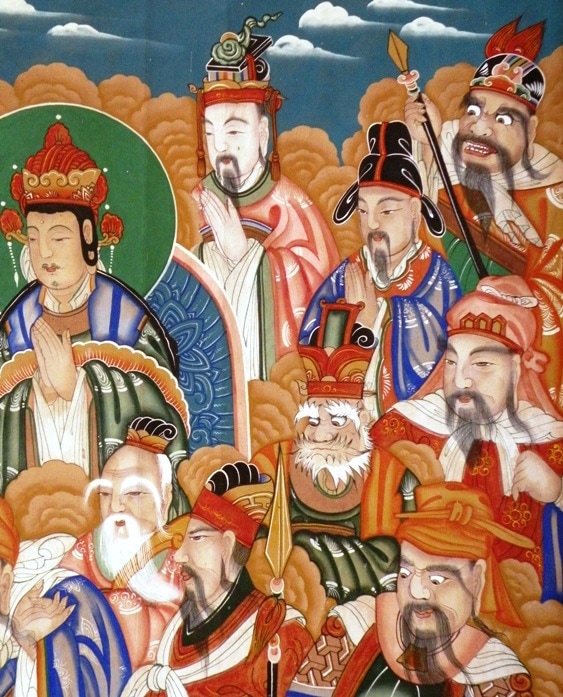
| San-shin (lower-left) and Yong-wang (lower-center) in the Shinjung-taenghwa [Assembly of the Guardian Spirits altar-painting] in that Amita-jeon Hall |
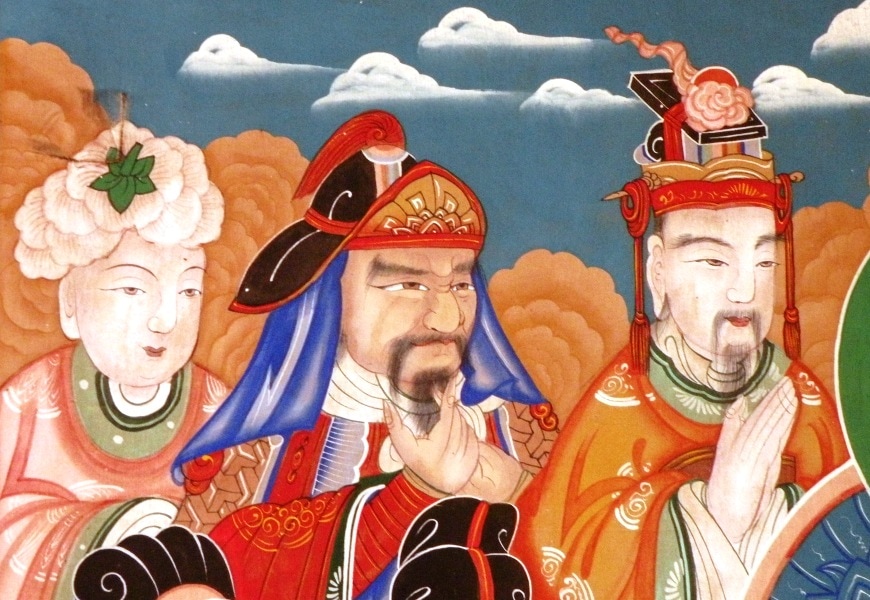
| other figures in that painting |
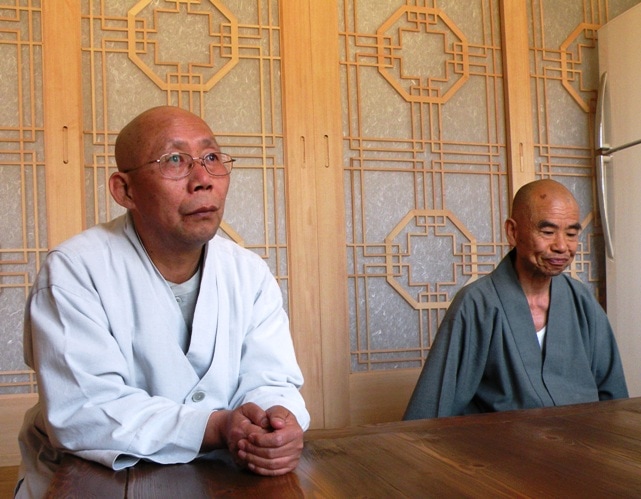
| dharma-masters of this temple |