| Unique Star-Spirit Paintings of Do-dong Daewon-sa on Ulleung-do Island my photos from my visit in September 1998 |
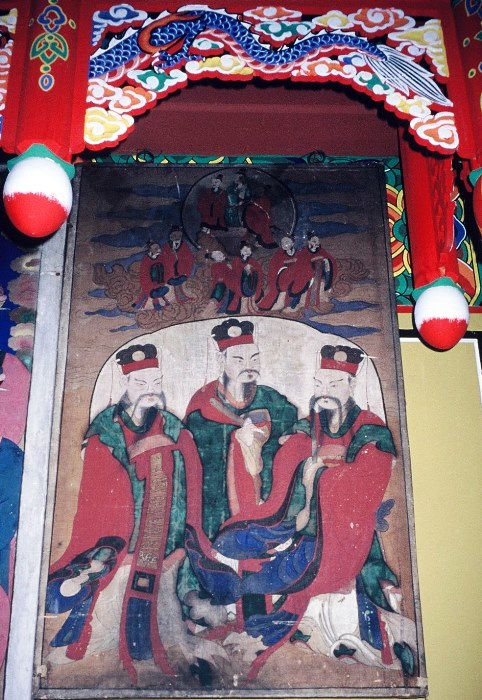
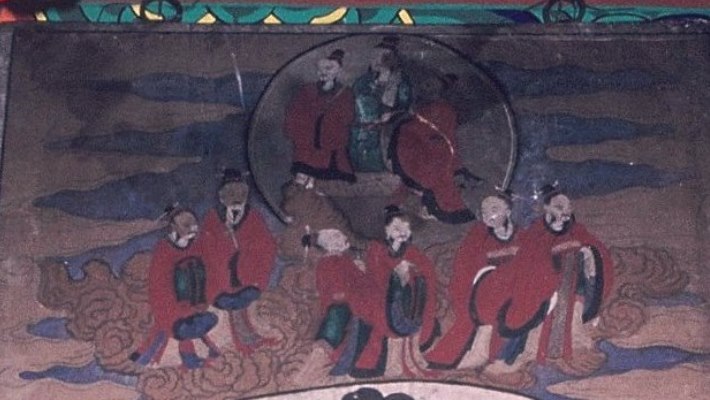
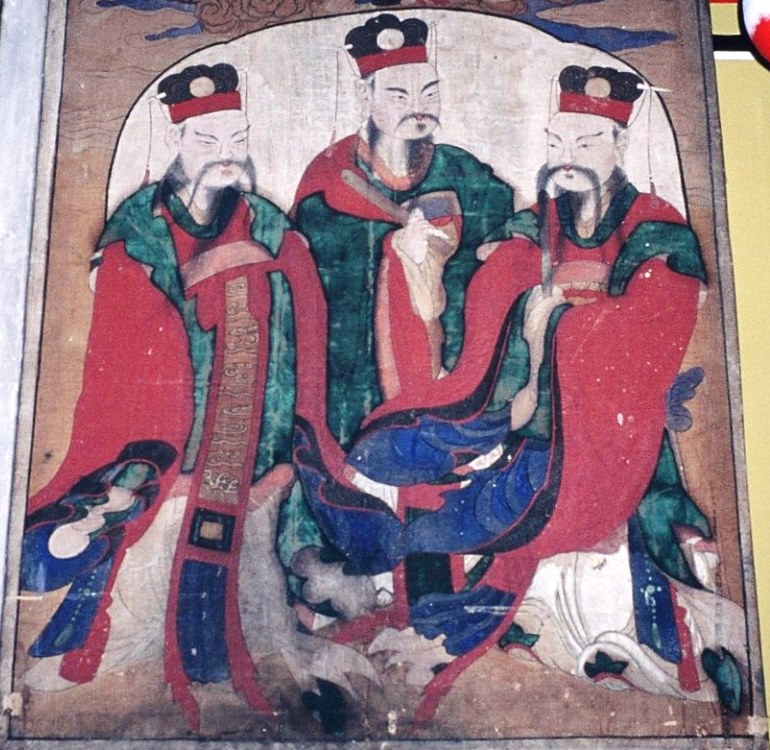
| Readers of my website and books are familiar with the very-common-in-Korea Chilseong [Seven Stars of the "Big Dipper"] icon-motif, with examples of their amazing variety on many of my other pages here. This temple boasts some very interesting variations on that theme, the ideological reasons for which I do not know (other than that all the primary odd numbers are sacred in Korean spirituality) -- a Three Stars painting, a Nine Stars painting, and a separate painting of the North Star |
This first one is a very rare Samseong [Three Stars, possibly of "Orion's Belt"] icon. This Shamanic
motif of Samshin "triplet": spirits is explained on my page about Jiri-san's Samshin-bong, and was a
favorite of my late mentor Zo Zayong. There are nine other figures above the main three, a regular
Samshin trio in a halo, and a triplet of paired spirits on clouds (intended as "divine twins", perhaps?).
The clothing and accessories of all these figures is that of Neo-Confucian Kings, and the white disks
in their headgear represent stars, as in most Chilseong icons (where the figures are usually "buddhas").
motif of Samshin "triplet": spirits is explained on my page about Jiri-san's Samshin-bong, and was a
favorite of my late mentor Zo Zayong. There are nine other figures above the main three, a regular
Samshin trio in a halo, and a triplet of paired spirits on clouds (intended as "divine twins", perhaps?).
The clothing and accessories of all these figures is that of Neo-Confucian Kings, and the white disks
in their headgear represent stars, as in most Chilseong icons (where the figures are usually "buddhas").
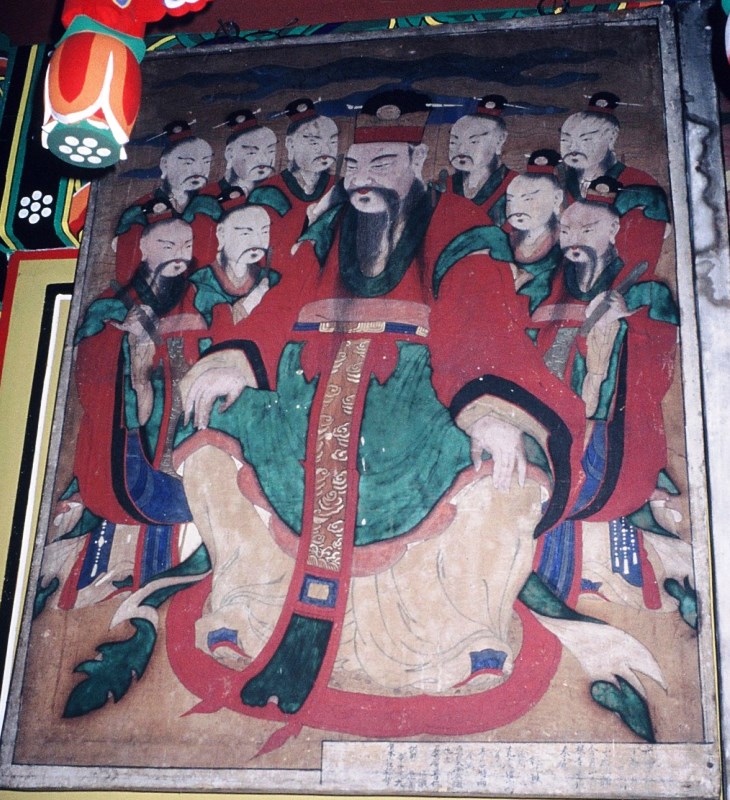
This second one is unique, to my knowledge. It depicts ten Neo-Confucian kingly figures
with white disks in their headgear representing stars; clouds are behind them. Nine (a holy number)
of them are smaller, standing in the background, and one is dominant in the fore, looking a bit
older and stouter, with heavier facial-hair. I suppose that he is the Chief of them and the others
are his officials -- it is similar to the "Ten Kings of Hell" paintings in Korean temple funeral-halls.
I cannot tell if this is a "Ten Stars" painting (motif unknown to me) or a Guseong-shindo
[Nine Stars Spirit-icon], with the front figure as their collective Lord. Which constellation
they represent and what their usage and significance might be, I cannot guess for now.
with white disks in their headgear representing stars; clouds are behind them. Nine (a holy number)
of them are smaller, standing in the background, and one is dominant in the fore, looking a bit
older and stouter, with heavier facial-hair. I suppose that he is the Chief of them and the others
are his officials -- it is similar to the "Ten Kings of Hell" paintings in Korean temple funeral-halls.
I cannot tell if this is a "Ten Stars" painting (motif unknown to me) or a Guseong-shindo
[Nine Stars Spirit-icon], with the front figure as their collective Lord. Which constellation
they represent and what their usage and significance might be, I cannot guess for now.
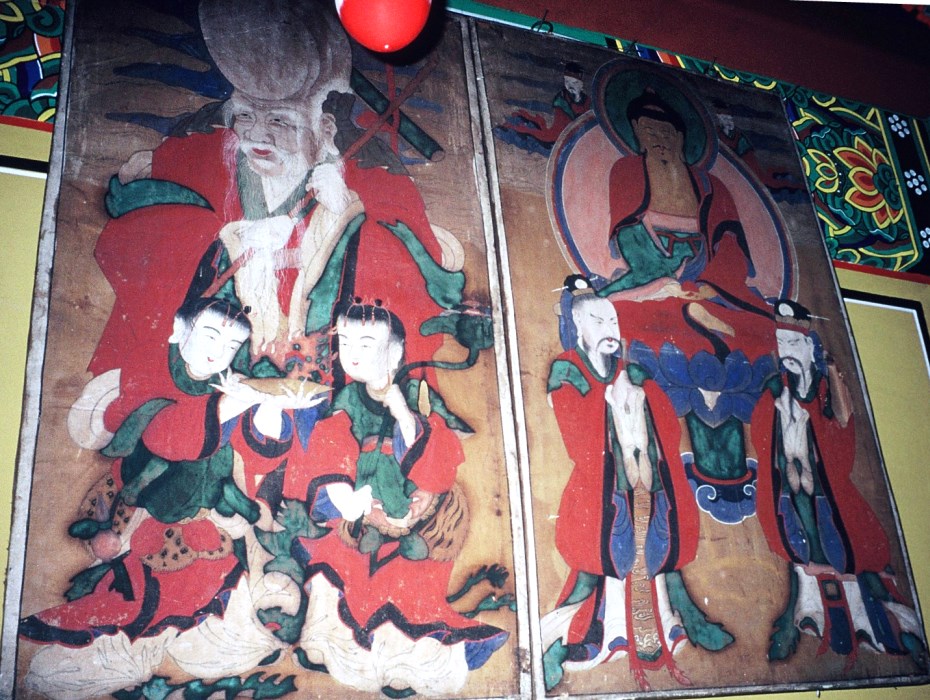
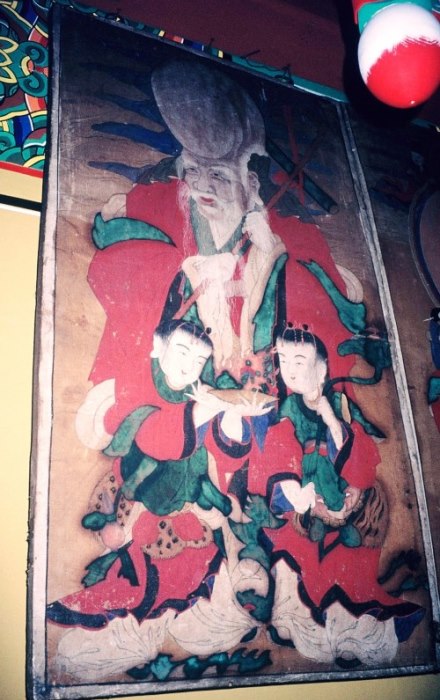
Finally, I found this wonderful antique icon-painting of the Bukseong-shin [North Star Spirit], the "God
of Longevity" that is universally popular in Chinese cultural areas. He is the most famous member of
the folk-Daoist Samseong 三星 [Three Stars, Sanxing in Chinese], known individually as 福祿壽
-- Bok-Nok-Su 복녹수 or Bokshin-Nokshin-Sushin in Korean when the title "Spirit" is added,
Fú-Lù-Shòu or Fúxing-Lùxing-Shòuxing in Chinese. Collectively they are known as the Good-
Fortune Gods of Three Stars; with 福 Bok/Fú representing happiness from a good family-life (with
many healthy children) and good-luck in-general; 祿 Nok/Lù representing wealth/prosperity such as an
official salary with high status, and 壽 Su/Shòu representing longevity including vigorous good health.
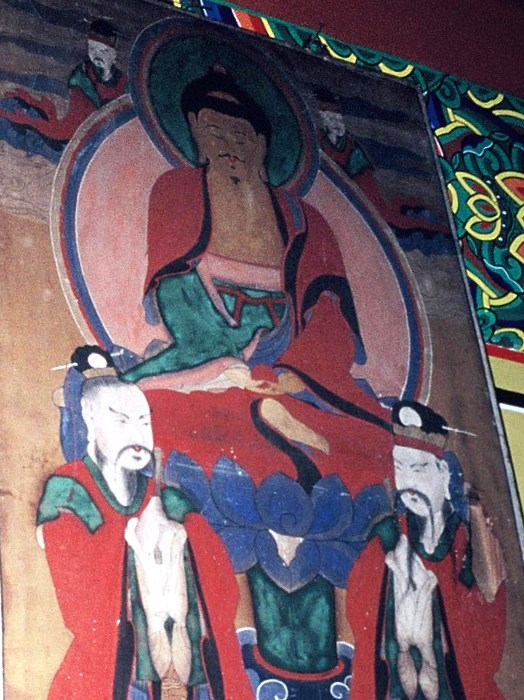
In this case, this very rare independent Bukseong-shin painting is paired with another, a Buddha-
like figure who is probably the Hindu god Indra, Jeseok-bul in Korean, usually the largest figure in
the center of Korean Chilseong Taenghwa, associated with the Yaksa-yeorae [Medicinal Buddha];
it is also quite rare to find an independent painting of him in Buddhist art. Both of these figures are
far more likely to be seen in independent paintings in the iconography of Korean Shamanism.
of Longevity" that is universally popular in Chinese cultural areas. He is the most famous member of
the folk-Daoist Samseong 三星 [Three Stars, Sanxing in Chinese], known individually as 福祿壽
-- Bok-Nok-Su 복녹수 or Bokshin-Nokshin-Sushin in Korean when the title "Spirit" is added,
Fú-Lù-Shòu or Fúxing-Lùxing-Shòuxing in Chinese. Collectively they are known as the Good-
Fortune Gods of Three Stars; with 福 Bok/Fú representing happiness from a good family-life (with
many healthy children) and good-luck in-general; 祿 Nok/Lù representing wealth/prosperity such as an
official salary with high status, and 壽 Su/Shòu representing longevity including vigorous good health.
In this case, this very rare independent Bukseong-shin painting is paired with another, a Buddha-
like figure who is probably the Hindu god Indra, Jeseok-bul in Korean, usually the largest figure in
the center of Korean Chilseong Taenghwa, associated with the Yaksa-yeorae [Medicinal Buddha];
it is also quite rare to find an independent painting of him in Buddhist art. Both of these figures are
far more likely to be seen in independent paintings in the iconography of Korean Shamanism.
Su is especially known and represented in Korea as the Bukseong-shin as-said; the North Star
Spirit is associated with long-healthy-life as the "God of Longevity" because the Pole Star is the
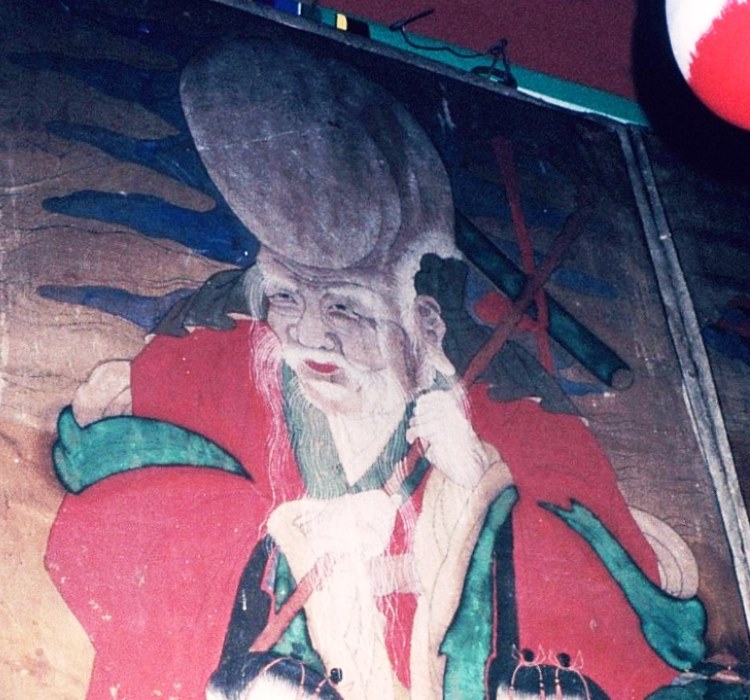
one that does not move, indicating stability of permanent position. This figure usually appears in
the top-right corner of Korean Chilseong Taenghwa, immediately recognisable by his grotesquely
extended head, and usually holding a gnarled staff and sometimes a holy-peach-of-immortality
(one of the Ship-jangsaeng); there is often a complimentary "South Star Spirit" in the opposite corner.
In China, this figure is known as the 南極老人星 "Star of the Old Man of the South Pole", and in the
standard Chinese Daoist-folklore the star of the North Pole determines the dates of human births
and the star of the South Pole determines the dates of deaths. I do not yet know how this became
reversed in Korea, with the North Star being venerated for the aspirational-value of Healthy Longevity.
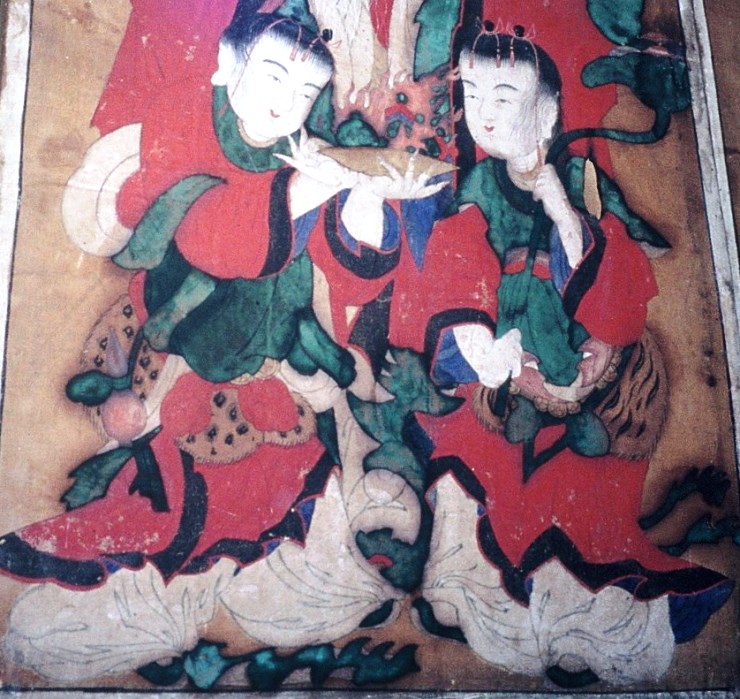
In this great, unique, antique icon, his straight staff has a scroll of holy scripture tied to it, and he
has two dongja boy-attendants (wearing leapord & tiger pelts!) offering natural items symbolizing
health, enlightenment and fecundity -- a lotus-leaf plant used as scepter, and a dish of what seem
to be pomegranates -- that seems to be burning in flames!!!
Spirit is associated with long-healthy-life as the "God of Longevity" because the Pole Star is the
one that does not move, indicating stability of permanent position. This figure usually appears in
the top-right corner of Korean Chilseong Taenghwa, immediately recognisable by his grotesquely
extended head, and usually holding a gnarled staff and sometimes a holy-peach-of-immortality
(one of the Ship-jangsaeng); there is often a complimentary "South Star Spirit" in the opposite corner.
In China, this figure is known as the 南極老人星 "Star of the Old Man of the South Pole", and in the
standard Chinese Daoist-folklore the star of the North Pole determines the dates of human births
and the star of the South Pole determines the dates of deaths. I do not yet know how this became
reversed in Korea, with the North Star being venerated for the aspirational-value of Healthy Longevity.
In this great, unique, antique icon, his straight staff has a scroll of holy scripture tied to it, and he
has two dongja boy-attendants (wearing leapord & tiger pelts!) offering natural items symbolizing
health, enlightenment and fecundity -- a lotus-leaf plant used as scepter, and a dish of what seem
to be pomegranates -- that seems to be burning in flames!!!