He opened his Emille Museum (named after the legendary Shilla-dynasty bronze bell, a
masterwork of Korean artisanship), in Seoul in 1968, but was oppressed by successive
military regimes. A breakthrough came in the late 1970's when he was allowed to hold a
major exhibition of folk-tiger paintings which then toured the USA and Europe. By then he
owned the world's largest collection of traditional Korean folk paintings [minhwa], created
by anonymous artists within the last three centuries. They included wonderfully imaginative
depictions of mythical animals such as dragons, Mountain-spirits and other Shamanic deities.
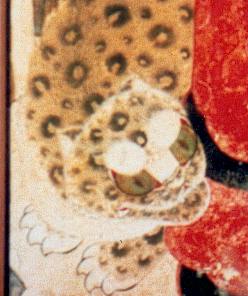
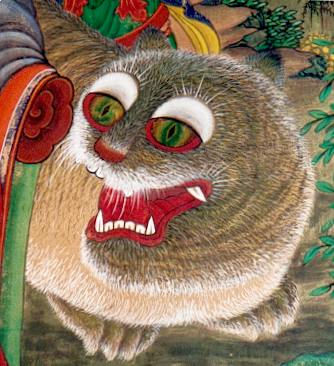
Closest to Horae's heart were the surrealistic folk-paintings of tigers, such a quintessentially
Korean art-form, both by themselves and playing staring roles in San-shin paintings and
statues. Crazy-but-friendly-looking tigers from his collection became the inspiration for the
"Hodori", the 1988 Seoul Olympics' mascot (designed by Kim Hyun, a close friend of his); Zo
Zayong's personal obsession ended up as the ubiquitous symbol of Korea's finest hour.
masterwork of Korean artisanship), in Seoul in 1968, but was oppressed by successive
military regimes. A breakthrough came in the late 1970's when he was allowed to hold a
major exhibition of folk-tiger paintings which then toured the USA and Europe. By then he
owned the world's largest collection of traditional Korean folk paintings [minhwa], created
by anonymous artists within the last three centuries. They included wonderfully imaginative
depictions of mythical animals such as dragons, Mountain-spirits and other Shamanic deities.
Closest to Horae's heart were the surrealistic folk-paintings of tigers, such a quintessentially
Korean art-form, both by themselves and playing staring roles in San-shin paintings and
statues. Crazy-but-friendly-looking tigers from his collection became the inspiration for the
"Hodori", the 1988 Seoul Olympics' mascot (designed by Kim Hyun, a close friend of his); Zo
Zayong's personal obsession ended up as the ubiquitous symbol of Korea's finest hour.
The Korea Times reported him saying in 1998: "Like the
dokkaebi, tigers were supposed to expel evil spirits. But look
at them! They're so retarded! They aren't scary at all. They
are more funny-looking, and you want to laugh at them.
That is the unique thing about Korean folk paintings and the
tigers in them. Though they are supposed to be about a
serious subject like the mountain god, the paintings are
lovable and you can laugh and feel affection towards them."
In 1983 Zo moved with his wife to the southern slope of high
craggy mountains in the center of South Korea -- partly to
escape official harassment and partly to live in harmony with
nature, closer to the villages. He became known as the
Tiger of the 'Remote-From-the-Mundane-World Mountains'
[Sogni-san, a National Park in North Chungcheong Province].
He claimed to have moved there because he "found the
Sam-shin living up on the Cheon-hwang-bong".
Using his studies of ancient times and architectural skills, he
built a proper Emille Museum building and a compound of
shrines, firepits and thatched huts that modeled those lived
in by Korean ancestors more two thousand years ago. He
held educational festivals in this compound, teaching bus-
loads of children, farmers and international groups about
the practices and spirit of Korean folk-traditions.
The events often climaxed with masked dancing around
a bonfire to samul-nori drumming, in the style of ancient
exorcisms of harmful spirits.
dokkaebi, tigers were supposed to expel evil spirits. But look
at them! They're so retarded! They aren't scary at all. They
are more funny-looking, and you want to laugh at them.
That is the unique thing about Korean folk paintings and the
tigers in them. Though they are supposed to be about a
serious subject like the mountain god, the paintings are
lovable and you can laugh and feel affection towards them."
In 1983 Zo moved with his wife to the southern slope of high
craggy mountains in the center of South Korea -- partly to
escape official harassment and partly to live in harmony with
nature, closer to the villages. He became known as the
Tiger of the 'Remote-From-the-Mundane-World Mountains'
[Sogni-san, a National Park in North Chungcheong Province].
He claimed to have moved there because he "found the
Sam-shin living up on the Cheon-hwang-bong".
Using his studies of ancient times and architectural skills, he
built a proper Emille Museum building and a compound of
shrines, firepits and thatched huts that modeled those lived
in by Korean ancestors more two thousand years ago. He
held educational festivals in this compound, teaching bus-
loads of children, farmers and international groups about
the practices and spirit of Korean folk-traditions.
The events often climaxed with masked dancing around
a bonfire to samul-nori drumming, in the style of ancient
exorcisms of harmful spirits.
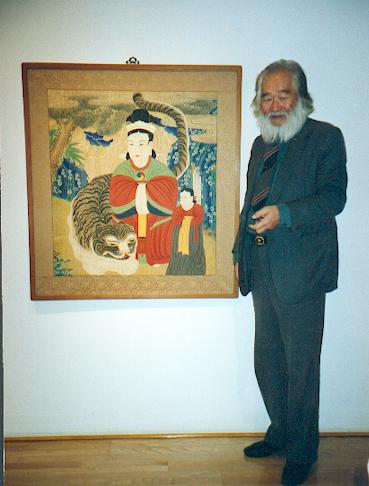
Dr. Zo at his Insa-dong exhibition in January 1998.
He is standing with one of his "new" San-shin
paintings, showing a female San-shin (a
mountain-goddess), which is a very rare motif.
He is standing with one of his "new" San-shin
paintings, showing a female San-shin (a
mountain-goddess), which is a very rare motif.
By 1990, following the Olympics, official attitudes had changed and his collection
became regarded as a national treasure, exemplifying a truly unique Korean spirit.
Horae started up what he called the "Old Village Movement", traveling the countryside
seeking surviving tutelary shrines, trying to inspire the remaining residents to maintain
them and revive old ritual-festivals at them. He tried to educate young Koreans about
their ancient traditions and inspire them to respect them. Sometimes after years of
gentle prodding and providing support he was successful; sometimes he wasn't and
that deeply disappointed him.
In about 1987 Horae founded the "Sam-shin Association", dedicated to furthering his
projects, with a hundred members (mostly younger Koreans). After decades of primary
devotion to tigers and the Mountain-spirit [San-shin], he turned his studies towards the
old Shamanic deity the Triple-spirits [Sam-shin]. In these triplet-gods-of-conception he
found a trinity-symbol that he could associate with other religious trinities across Korean
culture, from the Christian Father-Son-Spirit and the Buddhist Buddha-Dharma-Sangha
to the Neo-Confucian Heaven-Earth-Humanity [Cheon-Ji-In]. In their grandmother-
goddess-of-lifespan [Samshin-halmoni] he found a unifying principle that could be used
to represent the spirit of the entire Korean nation from King Dan-gun onwards.
became regarded as a national treasure, exemplifying a truly unique Korean spirit.
Horae started up what he called the "Old Village Movement", traveling the countryside
seeking surviving tutelary shrines, trying to inspire the remaining residents to maintain
them and revive old ritual-festivals at them. He tried to educate young Koreans about
their ancient traditions and inspire them to respect them. Sometimes after years of
gentle prodding and providing support he was successful; sometimes he wasn't and
that deeply disappointed him.
In about 1987 Horae founded the "Sam-shin Association", dedicated to furthering his
projects, with a hundred members (mostly younger Koreans). After decades of primary
devotion to tigers and the Mountain-spirit [San-shin], he turned his studies towards the
old Shamanic deity the Triple-spirits [Sam-shin]. In these triplet-gods-of-conception he
found a trinity-symbol that he could associate with other religious trinities across Korean
culture, from the Christian Father-Son-Spirit and the Buddhist Buddha-Dharma-Sangha
to the Neo-Confucian Heaven-Earth-Humanity [Cheon-Ji-In]. In their grandmother-
goddess-of-lifespan [Samshin-halmoni] he found a unifying principle that could be used
to represent the spirit of the entire Korean nation from King Dan-gun onwards.
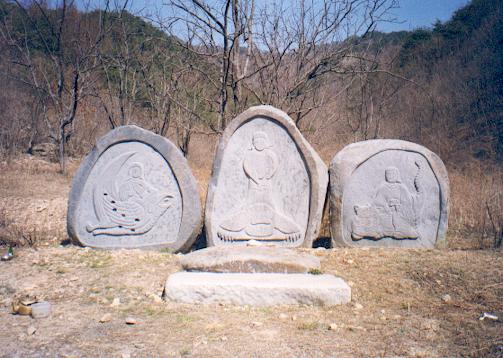
Towards the end of his life, his religious thought reached its full maturity; he carved,
painted and enshrined Korea's three main folk deities together as an expanded
Sam-shin. He placed the San-shin [Mountain-spirit] and the Chil-seong [Seven stars
of the Big Dipper / Ursa Major] flanking the central Sam-shin-halmoni as a grand
icon of the "Earth-Humanity-Heaven" trinity.
painted and enshrined Korea's three main folk deities together as an expanded
Sam-shin. He placed the San-shin [Mountain-spirit] and the Chil-seong [Seven stars
of the Big Dipper / Ursa Major] flanking the central Sam-shin-halmoni as a grand
icon of the "Earth-Humanity-Heaven" trinity.
Zo returned to a focus on the Mountain-spirit
theme with a successful exhibition in Insa-dong of
a half-dozen of his own new San-shin's (copying
from the old ones in his collection). It was held in
January of 1998, just after Korea entered the
"IMF-crisis-era" economic troubles and just two
years before his untimely death.
theme with a successful exhibition in Insa-dong of
a half-dozen of his own new San-shin's (copying
from the old ones in his collection). It was held in
January of 1998, just after Korea entered the
"IMF-crisis-era" economic troubles and just two
years before his untimely death.
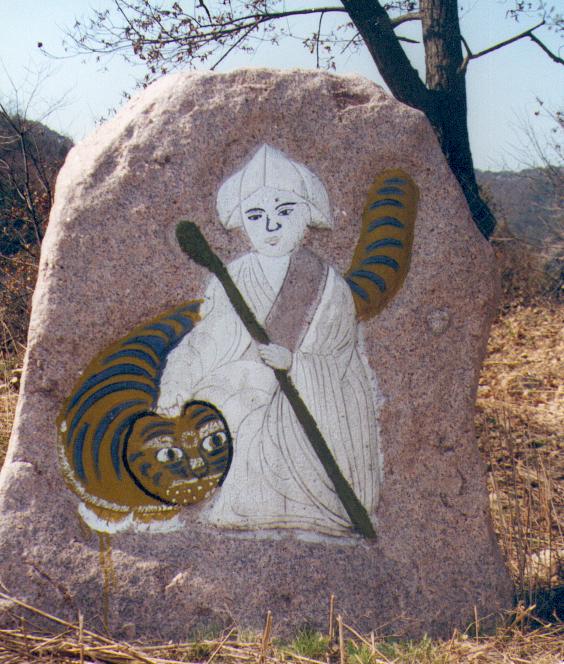
He was quoted: "One day, I had a dream and a
voice told me, 'Why use the strength of others? Try
to paint by yourself.' So I did the three paintings on
that wall the next day... They are our rendition of
the Mountain Spirit and Korean Tiger for the 21st
century. The mountain spirit isn't a dead belief
and these folk paintings aren't a dead tradition,
they are still the heart-beat of our culture."
voice told me, 'Why use the strength of others? Try
to paint by yourself.' So I did the three paintings on
that wall the next day... They are our rendition of
the Mountain Spirit and Korean Tiger for the 21st
century. The mountain spirit isn't a dead belief
and these folk paintings aren't a dead tradition,
they are still the heart-beat of our culture."
RIGHT: the Chil-seong - Sam-shin-
halmoni (on a turtle) - San-shin trinity,
designed by Zo, now in front of his
tomb in that valley.
BELOW: the San-shin from the first
trinity Zo painted himself and set up
behind his house below the Tiger-
head bawi.
halmoni (on a turtle) - San-shin trinity,
designed by Zo, now in front of his
tomb in that valley.
BELOW: the San-shin from the first
trinity Zo painted himself and set up
behind his house below the Tiger-
head bawi.