Horae was one of my greatest teachers during my long stay in Korea, and the inspiration for my
years of travel and research that led to Spirit of the Mountains, my book on San-shin. I never did
get the chance to present a copy of my book to him, and tell him how much his work and
example meant to me, before he left us. That disappointment will remain with me for a long time.
However, his strong spirit is infused throughout my work and that of thousands of others, and will
achieve immortality as we carry forward what he was trying to do with his life. I consider it a high
honor to be known as one of those influenced by him to participate in the preservation and
globalization of traditional Korean culture. Other international scholars such as Dr. John Caruso
Jr. (Fulbright Professor at Yonsei University) and David McCann posted tributes on the internet.
Dr. James Grayson (University of Sheffield, England), one of the world's top authorities on
Korean religion, noted: "I always found him to be a great and interesting man. He was really the
one who really revived Koreans' interest in their traditional material culture and art." Dr. Yong-ho
Choe (University of Hawaii) wrote:
years of travel and research that led to Spirit of the Mountains, my book on San-shin. I never did
get the chance to present a copy of my book to him, and tell him how much his work and
example meant to me, before he left us. That disappointment will remain with me for a long time.
However, his strong spirit is infused throughout my work and that of thousands of others, and will
achieve immortality as we carry forward what he was trying to do with his life. I consider it a high
honor to be known as one of those influenced by him to participate in the preservation and
globalization of traditional Korean culture. Other international scholars such as Dr. John Caruso
Jr. (Fulbright Professor at Yonsei University) and David McCann posted tributes on the internet.
Dr. James Grayson (University of Sheffield, England), one of the world's top authorities on
Korean religion, noted: "I always found him to be a great and interesting man. He was really the
one who really revived Koreans' interest in their traditional material culture and art." Dr. Yong-ho
Choe (University of Hawaii) wrote:
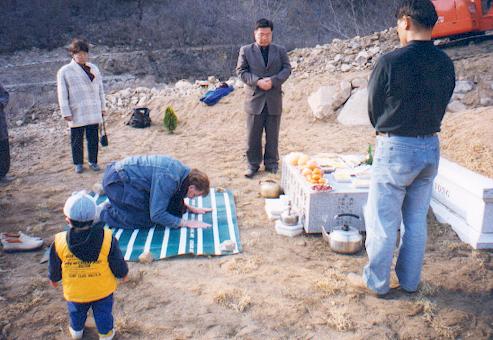
| bowing at Zo's tomb, April 2000 (photo by Eugene Campbell) |
"To die but not be forgotten is true longevity" (Lao tzu, Tao Te Ching #33,
Ma-wang-tui text translated by V. Mair 1990 and R. Henricks 1989).
On Wednesday April 5th 2000 (Arbor Day, Hanshik, 3rd new moon), three western
admirers of Dr. Zo Zayong gathered under clear blue heaven on the southern slope of
Sogni-san's Cheon-hwang-bong to grant him just a bit of that sort of "true longevity".
Horae's tomb is located at the edge of the forest in the upper part of the Dae-mok-gol
valley, off route 505 in Nae-sogni-myeon, Bo-eun-gun. Horae had prepared the site in
advance, just above one of his houses where he held educational festivals. It is at the
opening of a deep valley which is dominated by a huge granite outcropping called the
"Inja-bawi" [humane-person cliff], which strikingly resembles the head of a tiger. Horae
loved that bawi, and once intended to erect a gigantic shrine to King Dan-gun beneath
it; it seems appropriate that his body now rests there.
Ma-wang-tui text translated by V. Mair 1990 and R. Henricks 1989).
On Wednesday April 5th 2000 (Arbor Day, Hanshik, 3rd new moon), three western
admirers of Dr. Zo Zayong gathered under clear blue heaven on the southern slope of
Sogni-san's Cheon-hwang-bong to grant him just a bit of that sort of "true longevity".
Horae's tomb is located at the edge of the forest in the upper part of the Dae-mok-gol
valley, off route 505 in Nae-sogni-myeon, Bo-eun-gun. Horae had prepared the site in
advance, just above one of his houses where he held educational festivals. It is at the
opening of a deep valley which is dominated by a huge granite outcropping called the
"Inja-bawi" [humane-person cliff], which strikingly resembles the head of a tiger. Horae
loved that bawi, and once intended to erect a gigantic shrine to King Dan-gun beneath
it; it seems appropriate that his body now rests there.
NEXT PAGE --->
"I am saddened by the news of Zo Zayong's death. He was a teacher and
good friend to me. Only last September, my wife and I visited him and his
wife, when he greeted us with his typical gusty exuberance. From him, I
learned to appreciate all the items of daily use I grew up with in Korea's
countryside -- things which I had been told to be backward, primitive, or even
ugly. He opened my eyes to the beauty of the "real" Korea that had been
concealed under the glare of modernity. I shall cherish for long time his
lecture on Samshin at our last encounter. Although I mourn the passing of a
great iconoclast, I am grateful that he lived among us and did what he did."
good friend to me. Only last September, my wife and I visited him and his
wife, when he greeted us with his typical gusty exuberance. From him, I
learned to appreciate all the items of daily use I grew up with in Korea's
countryside -- things which I had been told to be backward, primitive, or even
ugly. He opened my eyes to the beauty of the "real" Korea that had been
concealed under the glare of modernity. I shall cherish for long time his
lecture on Samshin at our last encounter. Although I mourn the passing of a
great iconoclast, I am grateful that he lived among us and did what he did."