 |
 |
 |
| Antique San-shin Paintings from private collections of friends of mine |
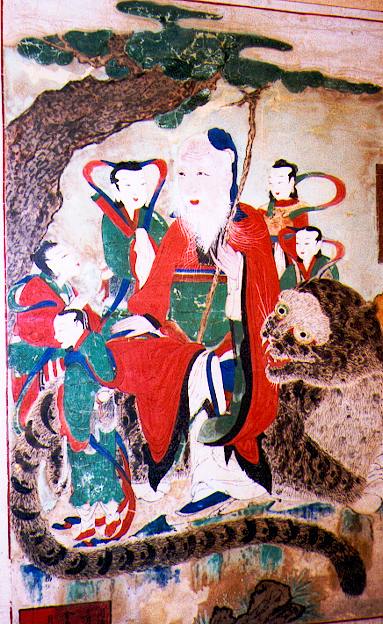
| RIGHT: from the 18th or 19th centuries. Daoist cloth-cap, holding a plain staff whose gnarls at the top resemble a dragon's head. Five boy-attendants [dong-ja], all with a "flying scarf" indicating angelic status, surround the San-shin, way more than usual. Four are merely posed in respect, however (2 have gourd-bottles tied onto their belts). The fifth holds a tray of persimmon fruit (symbol of fertility). The tiger is typical Korean-folk style, excellently done. |
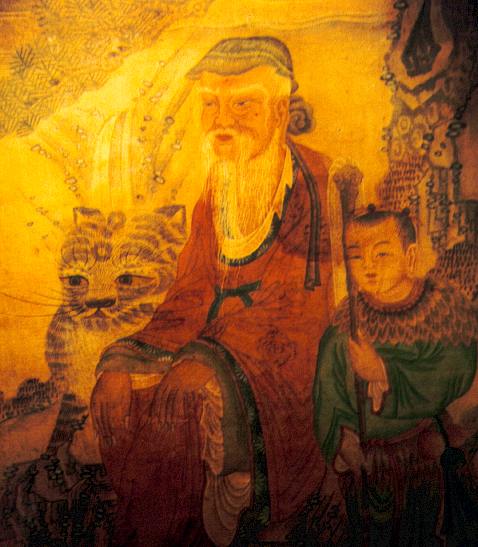
| LEFT: also from the 18th or 19th century, I would guess. Daoist cloth-cap, hands resting on his knees. The boy-attendant holds a Meditation-Master's fly-wisk. Note the very rare leaf-mantle on him, an echo of Korea's mythical Founding-King Dan-gun and China's progenitor-of-civilization Fu-xi (see pages 132-139 in my book). The San-shin and boy figures in this painting are fairly similar to those in the painting at the bottom of this page. |
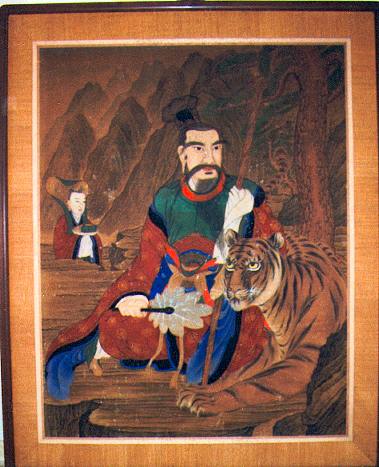
| RIGHT: Early 20th-century, by my best guess. Quite ordinary in every aspect, except for San-shin's dark-grey hair, crudely exaggerated mustache, and the small green fruit offered by the dong-ja. |
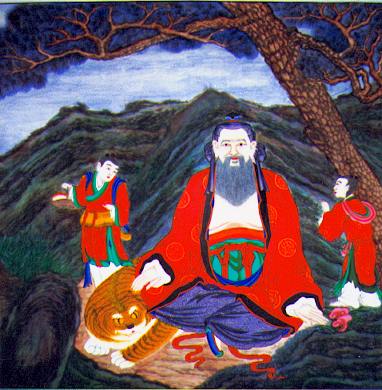
| RIGHT: painted a few decades ago, in a Buddhist artist's studio. Bullo-cho herbs growing next to San-shin's left hand, very simple background. Unusual for: 1. San-shin's square-angled grey beard, 2. his royal red robe open to reveal his chest in the style of a Sakyamuni Buddha, and 3. the way that his hands are extending out over his knees but not holding anything, almost like a yogic meditation posture. |
 |