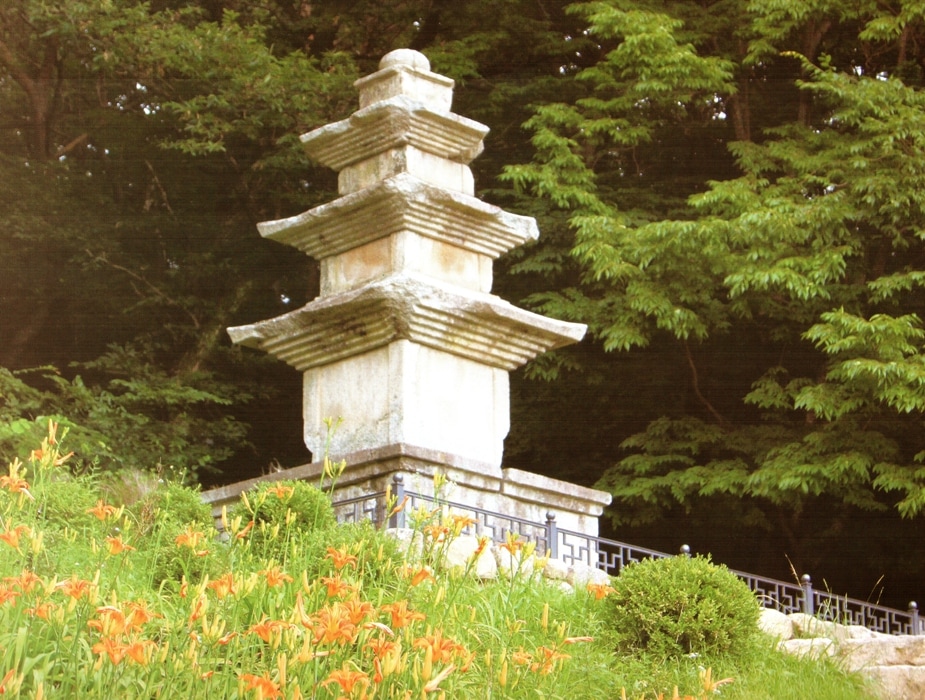
| Taebaek-san Buseok-sa's Uisang-tap Pagoda a powerful monument to a great doctrinal master |
| NEXT: the Josa-dang Shrine for Master Uisang Buseok-sa Intro Page Taebaek-san Index Page Sobaek-san Index Page San-shin Site Contents |
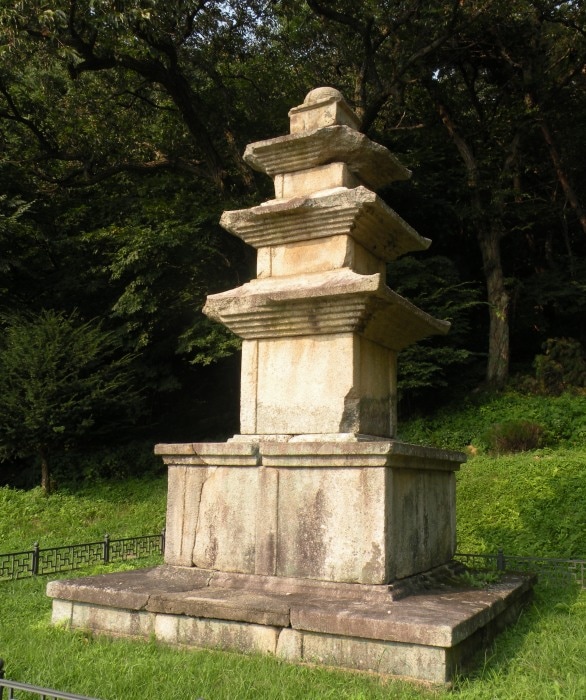
This a medium-sized 3-story stone pagoda from the Unified Shilla Dynasty period (roughly 8th~9th centuries),
designated as Treasure #249. The name "Uisang-tap" [Pagoda for Master Uisang] is not official, but is
my own invention, as it is just what makes sense to me, and a few other scholarly visitors to this temple.
The official name granted by the government cultural-heritage designators is merely a generic "Three-
storied Stone Pagoda of Buseok Temple" [부석사 삼층석탑], giving it no identity despite its unique
placement within the temple-complex. Instead of being centered in front of the Main Dharma Hall and
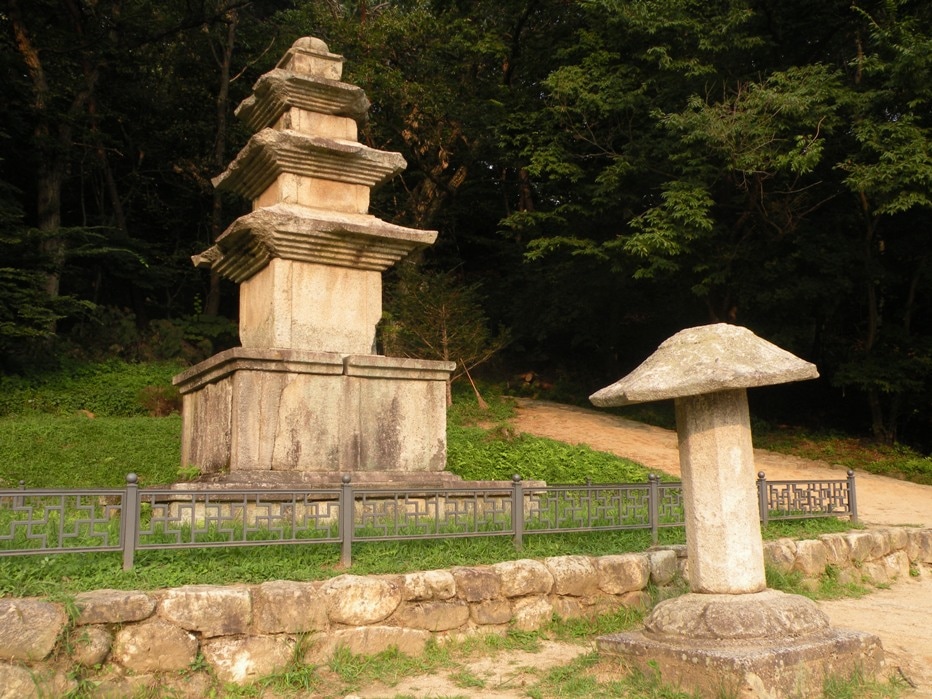
behind the Stone Lantern and Pavilion as usual, it is on a rise east of the hall -- and at the foot of the
trail leading up to the Josa-dang [Founder's Shrine]. It has a base, pedestal and cap of another, smaller
Stone Lantern in front of it -- suggesting that there should be another Buddha Hall behind it -- but the
hill-slope to its rear shows no trace that there ever was one. During a restoration in 1960, researchers
found an empty space in the 3rd story that should contain a sarira casket enshrining holy relics, but
there was none -- apparently it was stolen in the previous 1250 years. There is no pagoda or lantern
in front of the Josa-dang above; and there are already two similar but smaller pagodas down below.
Therefore, it seems most likely to me that this pagoda was built to honor Master Uisang, sited by his
disciples between the Main Hall built on the bones of his lover Seonmyo (in front of the small shrine for her)
and the shrine venerating him as Patriarch of school and temple, granting him status of a former "living
Buddha" -- and it once contained his post-cremation sarira remains and possibly copies of his writings.
Certainly, it has some close association with his legacy -- and thus I call it the "Uisang-tap" monument.
designated as Treasure #249. The name "Uisang-tap" [Pagoda for Master Uisang] is not official, but is
my own invention, as it is just what makes sense to me, and a few other scholarly visitors to this temple.
The official name granted by the government cultural-heritage designators is merely a generic "Three-
storied Stone Pagoda of Buseok Temple" [부석사 삼층석탑], giving it no identity despite its unique
placement within the temple-complex. Instead of being centered in front of the Main Dharma Hall and
behind the Stone Lantern and Pavilion as usual, it is on a rise east of the hall -- and at the foot of the
trail leading up to the Josa-dang [Founder's Shrine]. It has a base, pedestal and cap of another, smaller
Stone Lantern in front of it -- suggesting that there should be another Buddha Hall behind it -- but the
hill-slope to its rear shows no trace that there ever was one. During a restoration in 1960, researchers
found an empty space in the 3rd story that should contain a sarira casket enshrining holy relics, but
there was none -- apparently it was stolen in the previous 1250 years. There is no pagoda or lantern
in front of the Josa-dang above; and there are already two similar but smaller pagodas down below.
Therefore, it seems most likely to me that this pagoda was built to honor Master Uisang, sited by his
disciples between the Main Hall built on the bones of his lover Seonmyo (in front of the small shrine for her)
and the shrine venerating him as Patriarch of school and temple, granting him status of a former "living
Buddha" -- and it once contained his post-cremation sarira remains and possibly copies of his writings.
Certainly, it has some close association with his legacy -- and thus I call it the "Uisang-tap" monument.
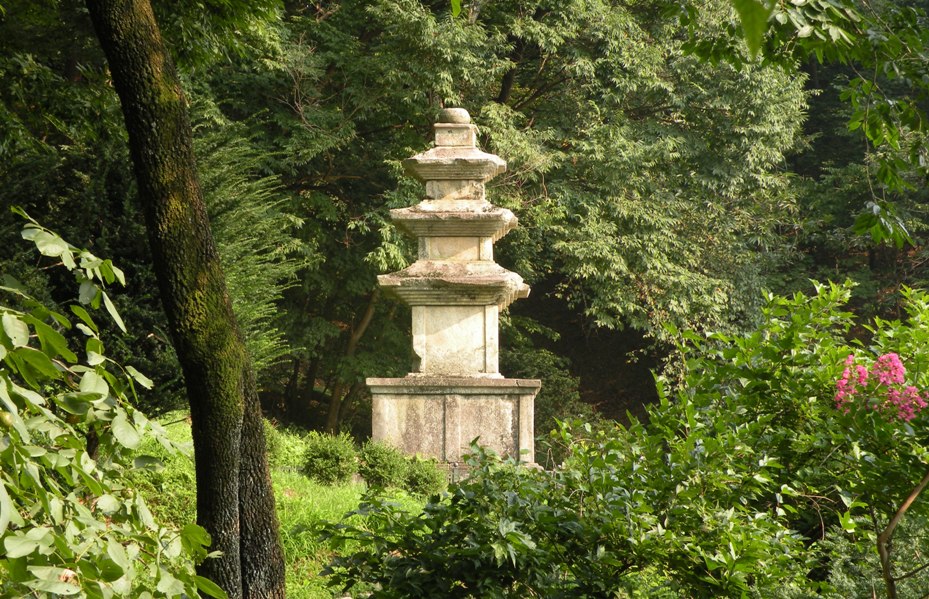
| surrounded by lush forest -- shot from the Seonmyo Shrine, in August 2013 |
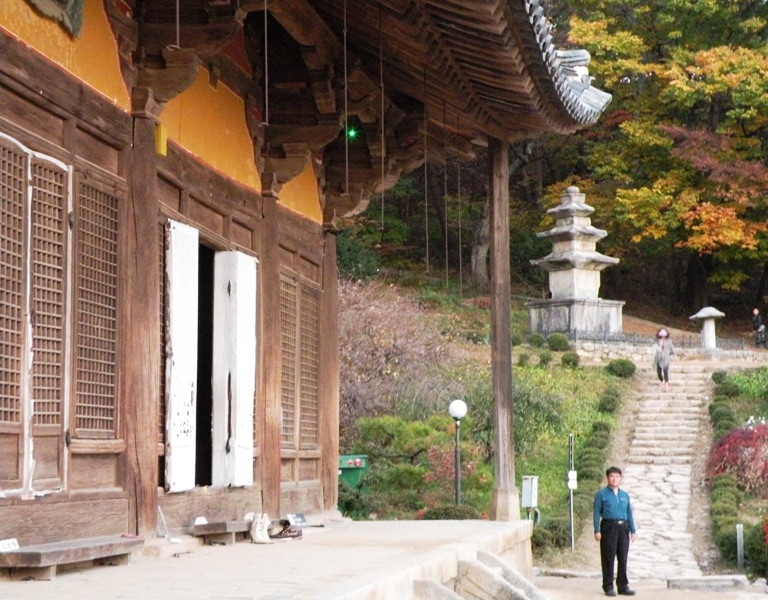
| sited up east of the Muryangsu-jeon Hall |
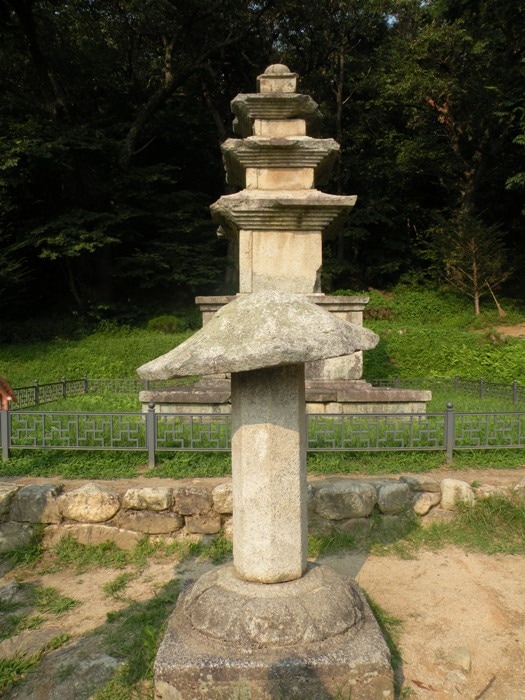
| fragments of a Lantern |
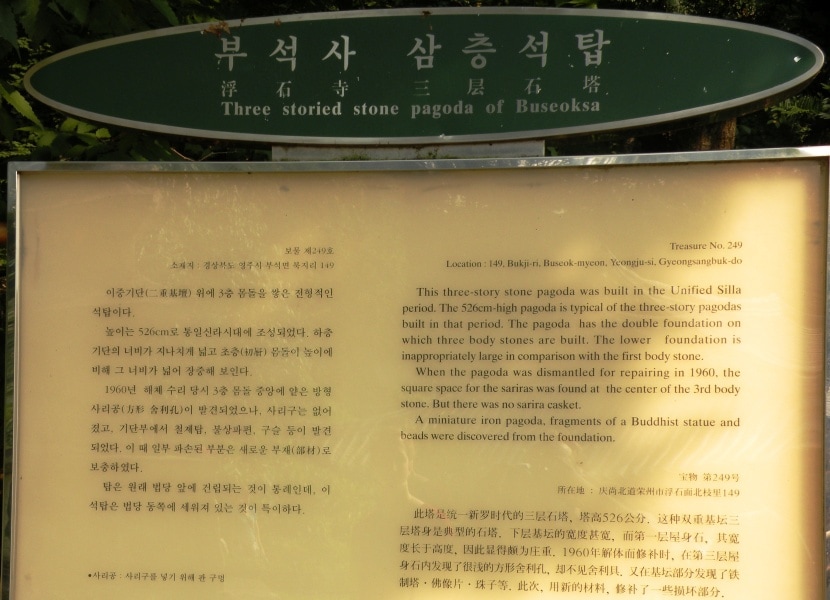
| the uninformative official sign |