| Taebaek-san 태백산 부석사 Buseok-sa the magnificent & profound Floating-Rock Temple One of Korea's Top-Six Temples and Top-21 Temples to visit a key sacred site along the Baekdu-daegan and one of Korea's UNESCO World Cultural Heritage Sites |
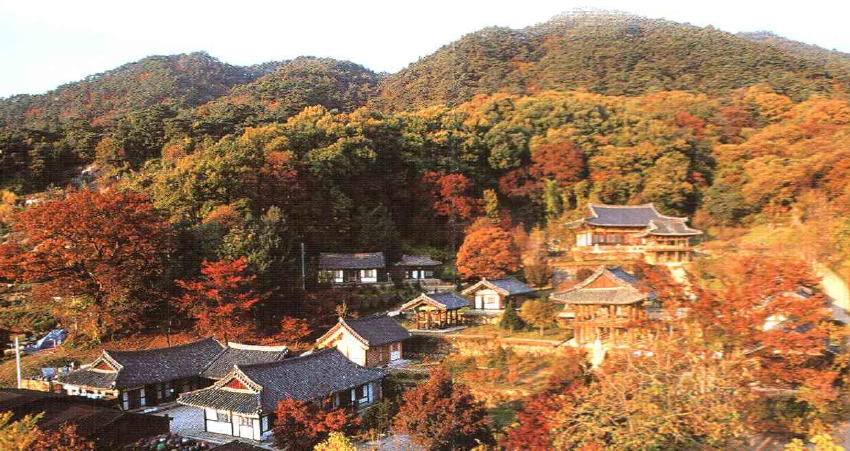
| overall view in October, from a Yeongju City tourist-brochure This is one of the most famous sites in Korea for having an ideal topograpical / geomantic configuration according to Pungsu-jiri theory. |
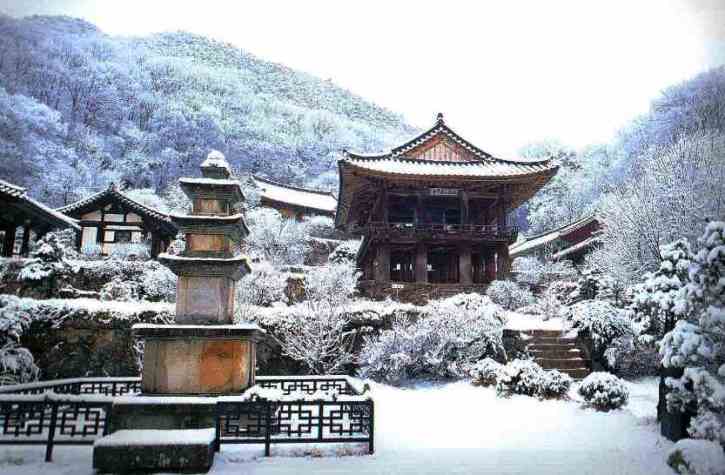
| Buseok-sa in mid-winter |
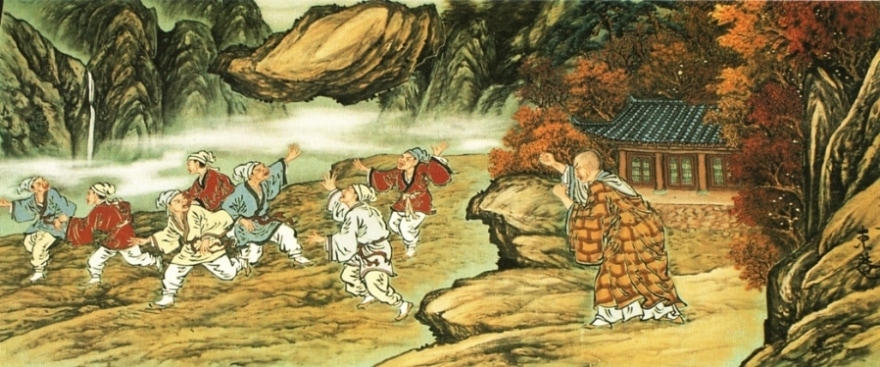
| The story from the Samguk-Yusa of Great Master Uisang-josa founding Buseok-sa, when Seonmyo (as an invisible dragon) suspends the "floating rock" to threaten protesting villagers. |
| A grand monastery founded by Mater Uisang-josa in 676 CE to propagate Hwaeom [Avatamsaka] Buddhism, under authority granted by Great King Munmu; it is one of the Hwaeom-Shipchal Temples. It was burned down by a rebel army in n 1358, but then rebuilt and expanded by Great Master Won-eung under patronage of Goryeo King Gongmin from 1372-77. It has also been called Seondal-sa [Meditation-Moon Temple] and Heunggyo-sa [Arising-School Temple]. |
This great and famous temple is located at the southeastern tip of Sobaek-san National Park, and so
is often thought to be part of the Sobaek-san mountain-cluster area; technically, it is at the southwest
foot of the local peak of that cluster, called Bonghwang-san [Phoenix Mountain] (822m, just 1500m
south of the Baekdu-daegan Ridgeline) which is 4km south of Seondal-san [Immortal-Moon Mountain]
(1236m, member of the Baekdu-daegan); and so from the 1950s through 1990s it was commonly called
either "Sobaek-san Buseok-sa", "Bonghwang-san Buseok-sa" or "Seondal-san Buseok-sa". The
temple's name was even noted as "Seondal-sa" at some point in the early Goryeo Dynasty. However,
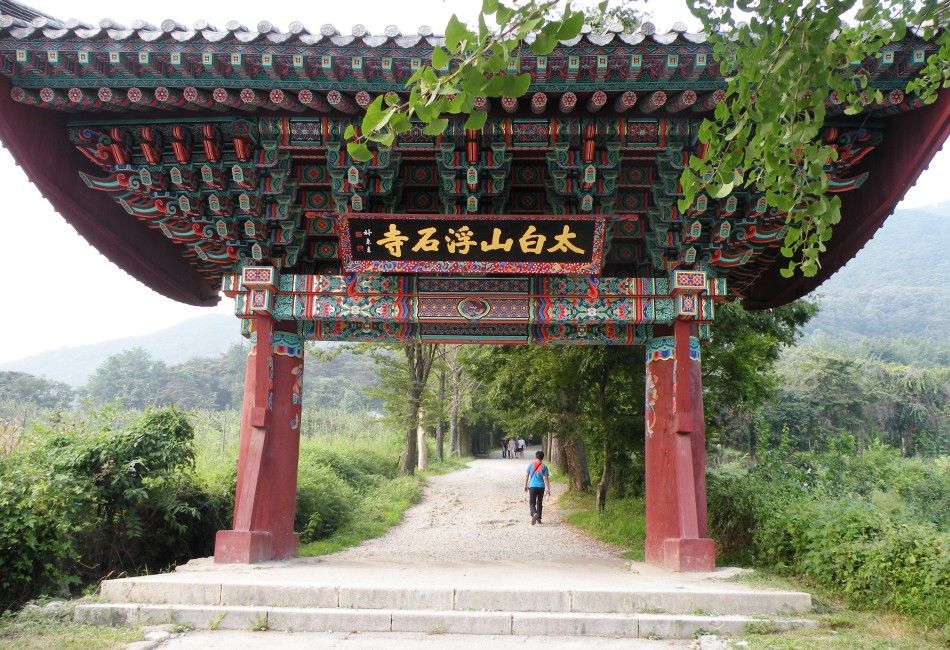
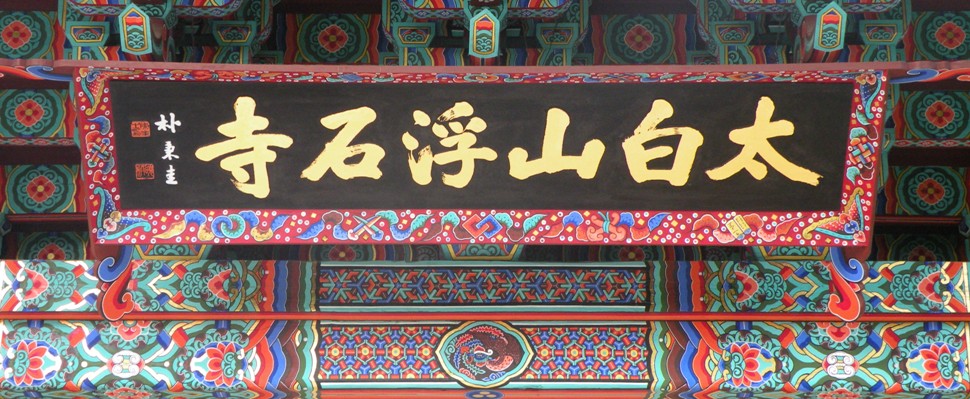
about the year 2000 they erected a new Ilchul-mun [One-Pillar Entrance-Gate], seen above, at their
main entranceway, and put on it a new pyeon-aek [扁額, formal signboard] that restored its traditional
name "Taebaek-san Buseok-sa" -- claiming the temple to be hosted by the Grand White Mountain itself.
Buseok-sa is about 23km from the summit of Taebaek-san in a straight line (ENE), and much farther by
any roads or the Baekdu-daegan Trail, but the national spiritual reputation of Taebaek-san is so high
that its name is invoked by temples this far away; see also the cases of Jeongam-sa on Hambaek-san
and small temples in the Deokgu Hot-Springs Valley near the east coast; claiming it as their host just
increases the sacred status of that temple (or other institution, village or business).
is often thought to be part of the Sobaek-san mountain-cluster area; technically, it is at the southwest
foot of the local peak of that cluster, called Bonghwang-san [Phoenix Mountain] (822m, just 1500m
south of the Baekdu-daegan Ridgeline) which is 4km south of Seondal-san [Immortal-Moon Mountain]
(1236m, member of the Baekdu-daegan); and so from the 1950s through 1990s it was commonly called
either "Sobaek-san Buseok-sa", "Bonghwang-san Buseok-sa" or "Seondal-san Buseok-sa". The
temple's name was even noted as "Seondal-sa" at some point in the early Goryeo Dynasty. However,
about the year 2000 they erected a new Ilchul-mun [One-Pillar Entrance-Gate], seen above, at their
main entranceway, and put on it a new pyeon-aek [扁額, formal signboard] that restored its traditional
name "Taebaek-san Buseok-sa" -- claiming the temple to be hosted by the Grand White Mountain itself.
Buseok-sa is about 23km from the summit of Taebaek-san in a straight line (ENE), and much farther by
any roads or the Baekdu-daegan Trail, but the national spiritual reputation of Taebaek-san is so high
that its name is invoked by temples this far away; see also the cases of Jeongam-sa on Hambaek-san
and small temples in the Deokgu Hot-Springs Valley near the east coast; claiming it as their host just
increases the sacred status of that temple (or other institution, village or business).
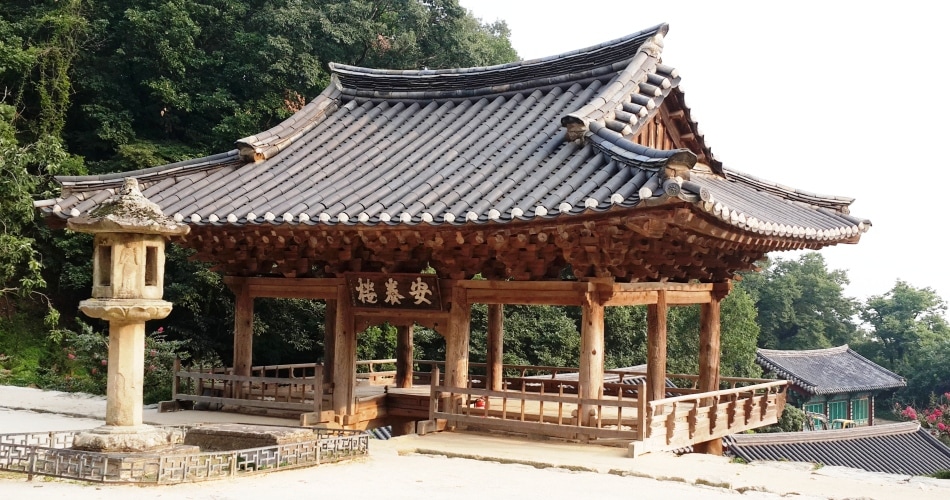
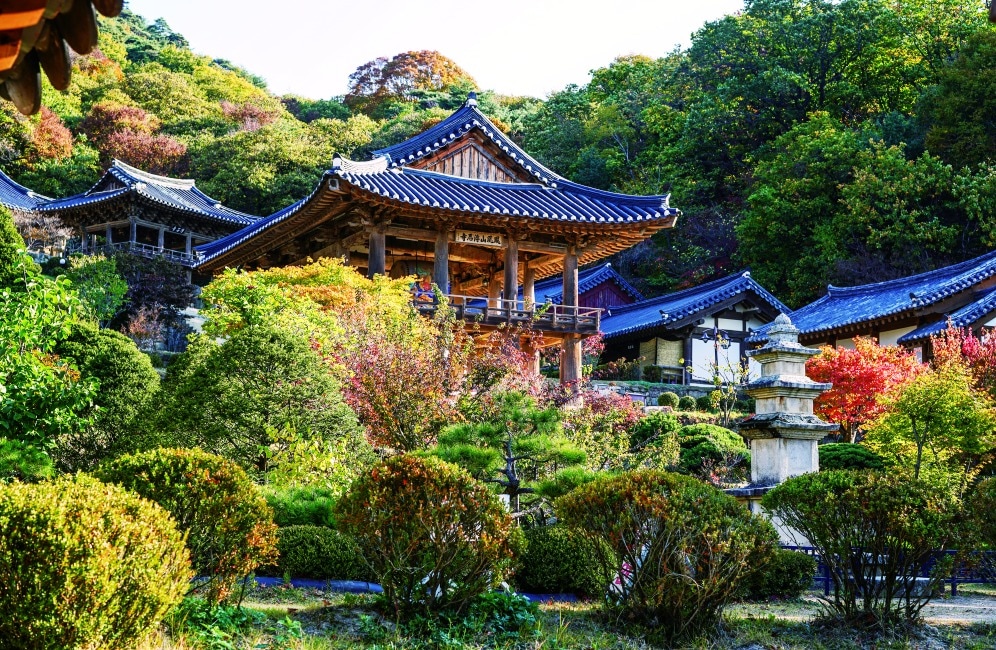
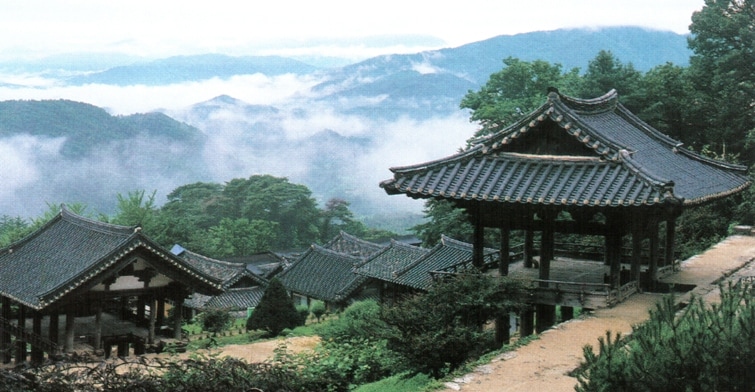
| the Anyang-ru Pavilion, famous in poetry for the view it offers, and the Stone Lantern |
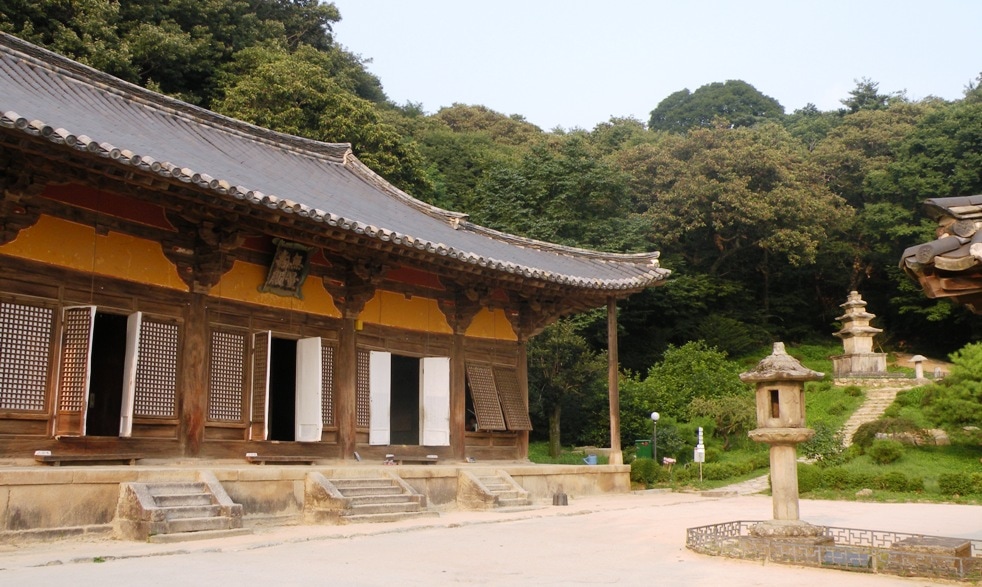
| the Muryangsu-jeon Main Hall, oldest surviving wooden building in Korea, Stone Lantern and Uisang Pagoda |
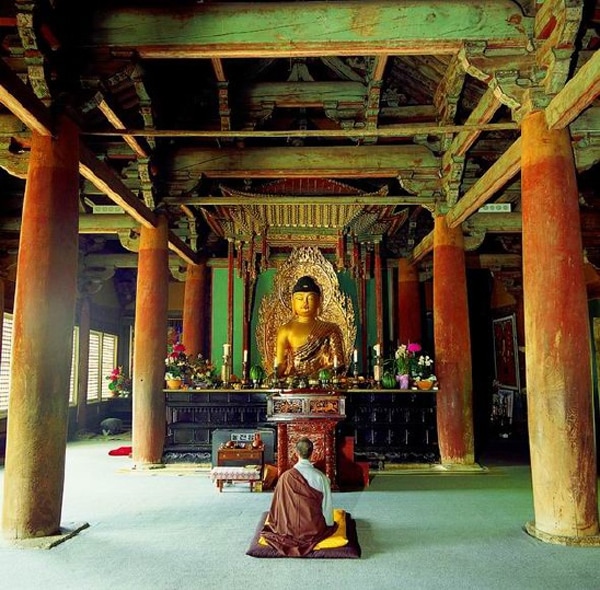
| interior of the Muryangsu-jeon, featuring the treasured gilt-clay Buddha statue |
| in October glory |
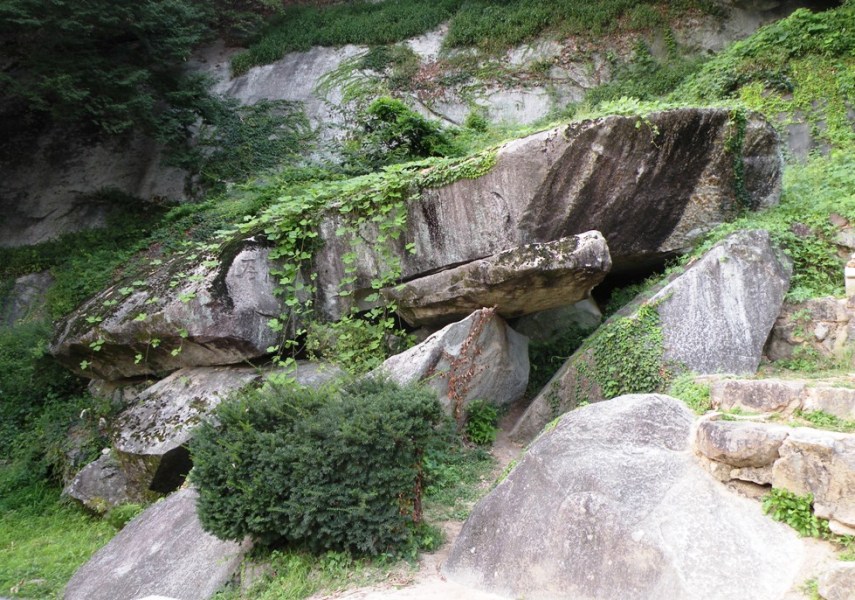
| The actual "buseok" [floating rock] today, resting to the left of the Muryangsu-jeon |
The legend of this temple's foundation and source of its unusual name can be found on my
Seonmyo and Buseok page.
Buseok-sa contains five of Korea's 316 official National Treasures, the second-most on one
traditional site, following only Gyeongju's Bulguk-sa Temple. The most famous is the Main
Hall built 1358 and named Muryangsu-jeon, the oldest intact wooden building in all Korea,
registered as National Treasure #18. The clay statue of Amita Buddha within it is NT #45,
and the seokdeung [石燈, stone lantern] standing in front of it is #17; the Josa-dang [祖師堂,
the Founder’s Hall enshrining Master Uisang] is #19 and the 6 Wall-Paintings originally in that
shrine are #46 -- see my individual pages on all these, linked below.
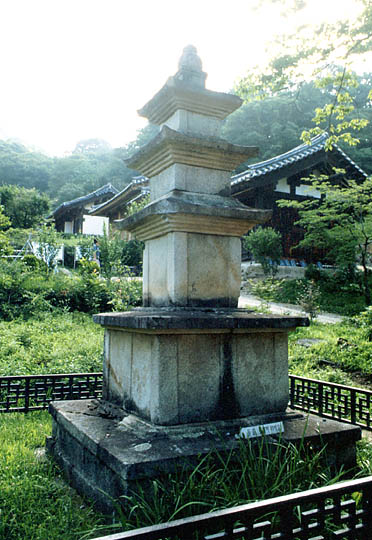
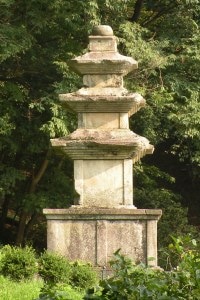
In addition, the 3-story seoktap [stone pagoda] associated with Uisang, the Ilju-mun [One-Pillar Gate]
and the three Seated Stone Buddha Statues are designated as Treasures, and the budo and biseok
monuments of Woneung Guksa (圓應國師) are designated as Local Tangible Cultural Properties.
Seonmyo and Buseok page.
Buseok-sa contains five of Korea's 316 official National Treasures, the second-most on one
traditional site, following only Gyeongju's Bulguk-sa Temple. The most famous is the Main
Hall built 1358 and named Muryangsu-jeon, the oldest intact wooden building in all Korea,
registered as National Treasure #18. The clay statue of Amita Buddha within it is NT #45,
and the seokdeung [石燈, stone lantern] standing in front of it is #17; the Josa-dang [祖師堂,
the Founder’s Hall enshrining Master Uisang] is #19 and the 6 Wall-Paintings originally in that
shrine are #46 -- see my individual pages on all these, linked below.
In addition, the 3-story seoktap [stone pagoda] associated with Uisang, the Ilju-mun [One-Pillar Gate]
and the three Seated Stone Buddha Statues are designated as Treasures, and the budo and biseok
monuments of Woneung Guksa (圓應國師) are designated as Local Tangible Cultural Properties.
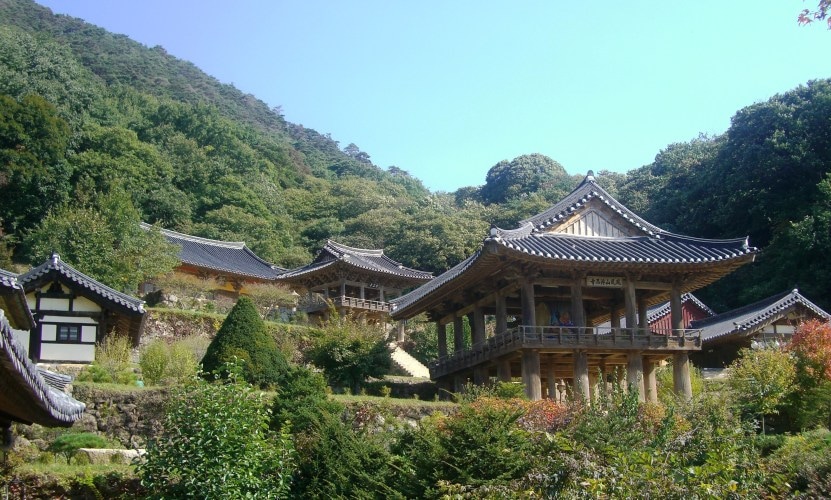
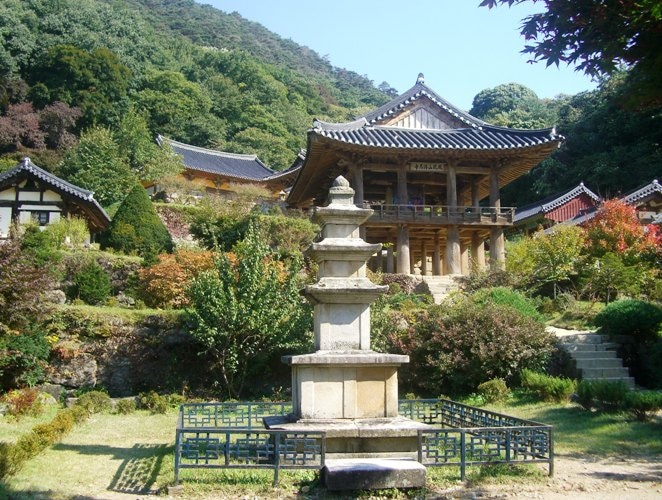
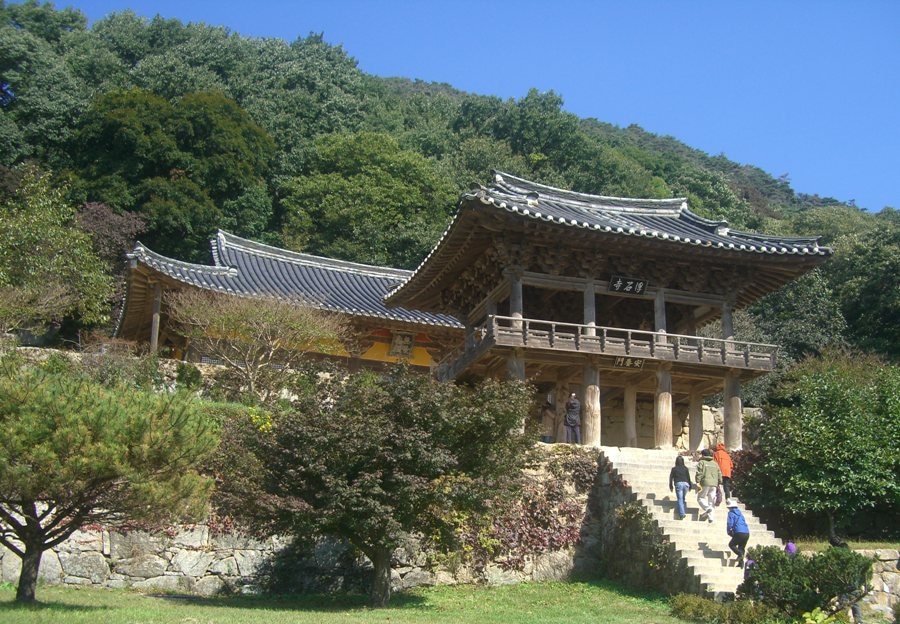
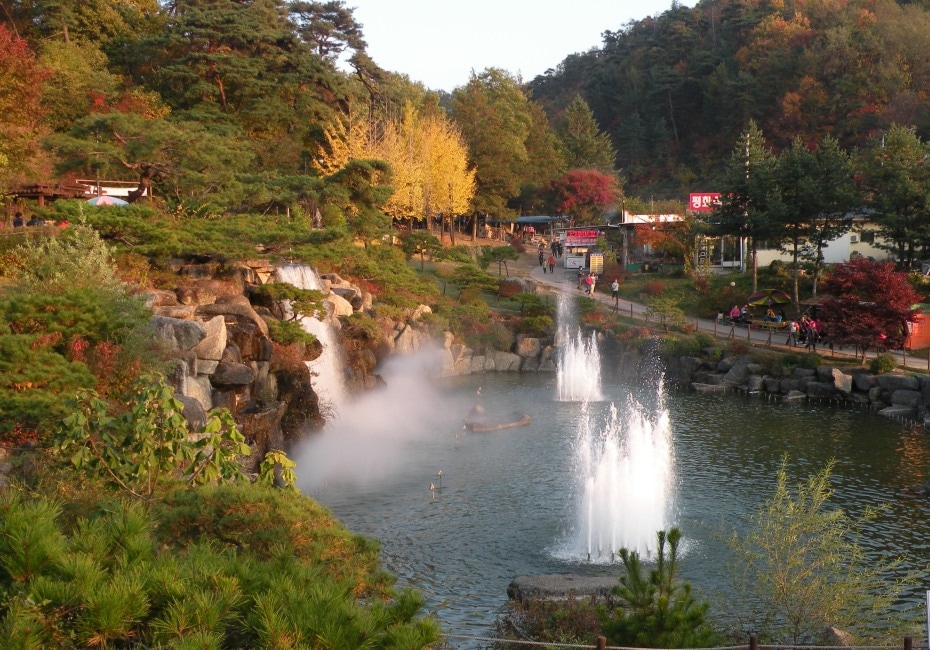
| beautiful pond at the entranceway, below that Ilchul-mun Gate and above the parking lot |
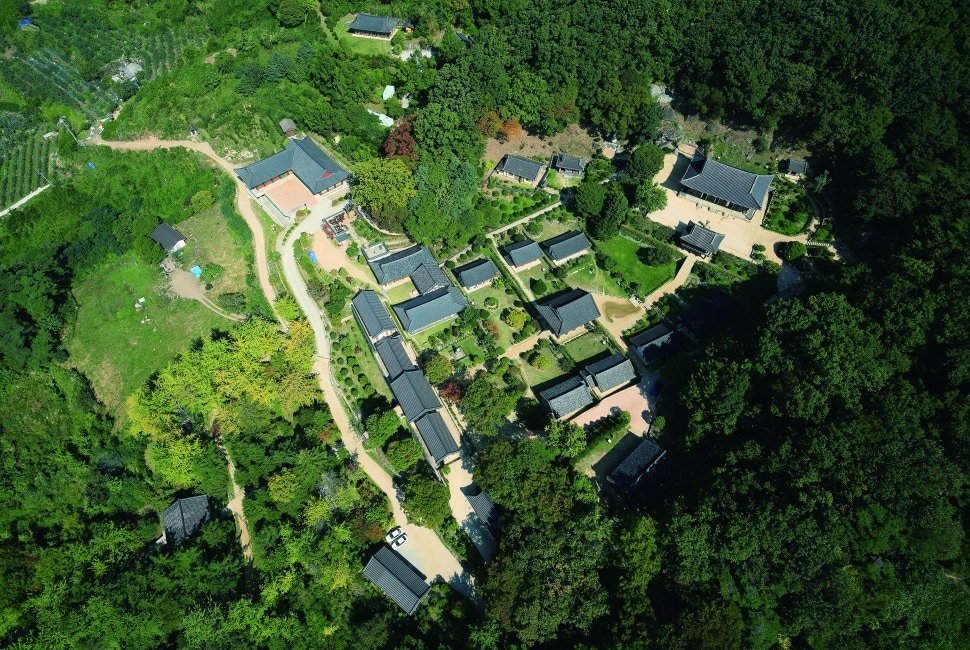
Buseok-sa has a very unusual architectural layout or arrangement, possibly unique in Korea in
several ways. It is sited on successive terraces of a steep and twisting slope, flowing according
to the original natural topography with little artificial modification, and so there are no straight axis
lines or rectangular parallelism as found in most large monasteries. As can be seen in these shots,
the main hall is on quite a different angle (facing SE) than the Sabeopmul-gak [Four Dharma
Instruments Pavilion] in front of it (facing south). This along with the great view and water-flow
conditions makes Buseok-sa a favorite site of Korea's Pungsu-jiri-seol enthusiasts.
several ways. It is sited on successive terraces of a steep and twisting slope, flowing according
to the original natural topography with little artificial modification, and so there are no straight axis
lines or rectangular parallelism as found in most large monasteries. As can be seen in these shots,
the main hall is on quite a different angle (facing SE) than the Sabeopmul-gak [Four Dharma
Instruments Pavilion] in front of it (facing south). This along with the great view and water-flow
conditions makes Buseok-sa a favorite site of Korea's Pungsu-jiri-seol enthusiasts.
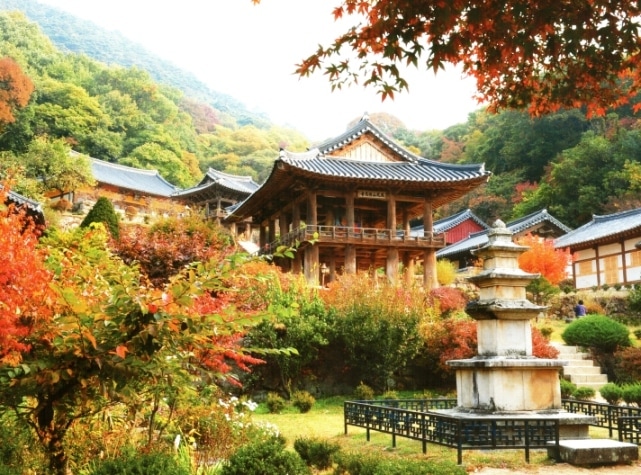
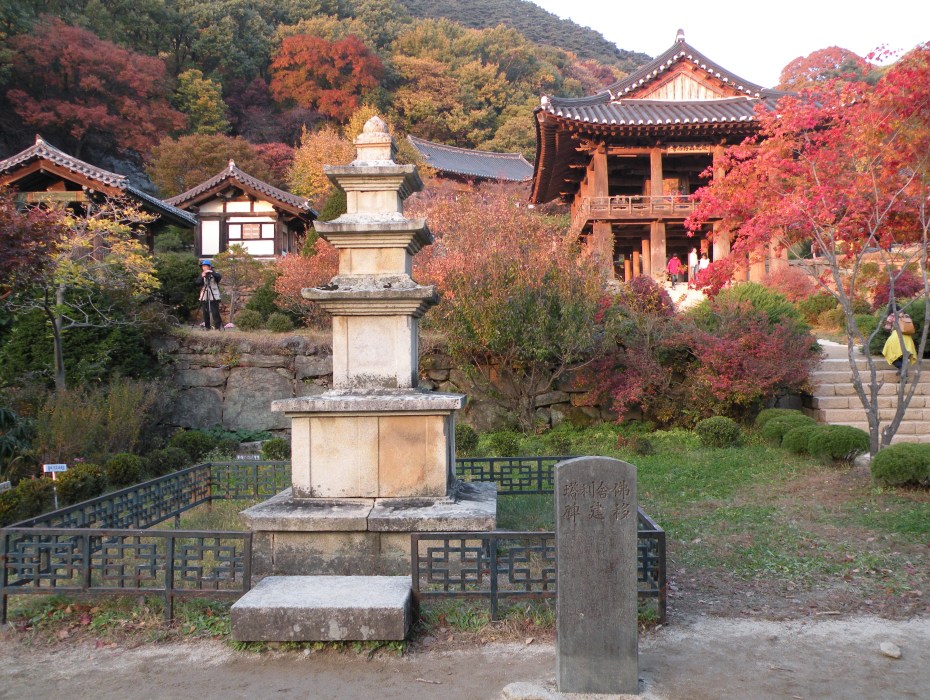
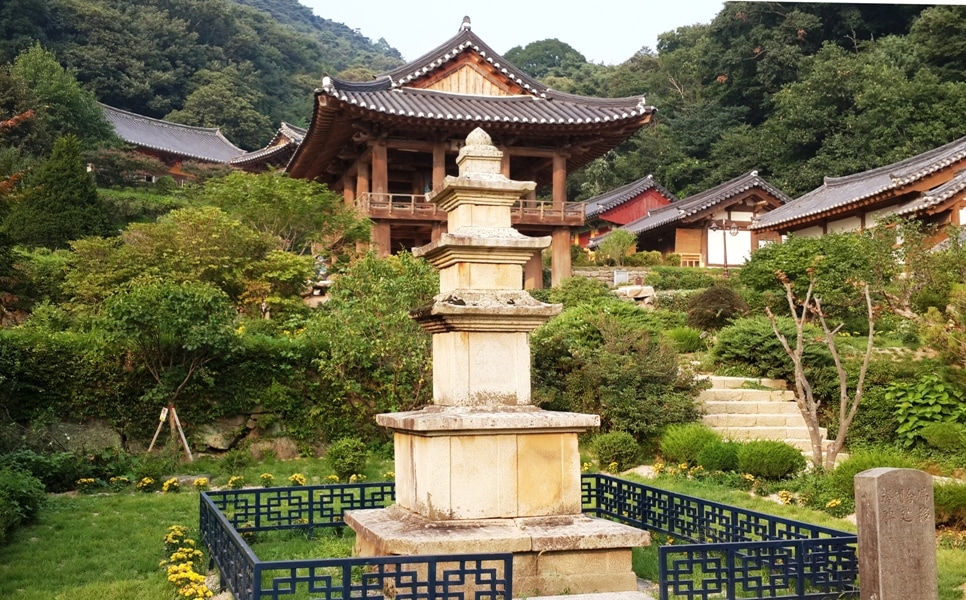
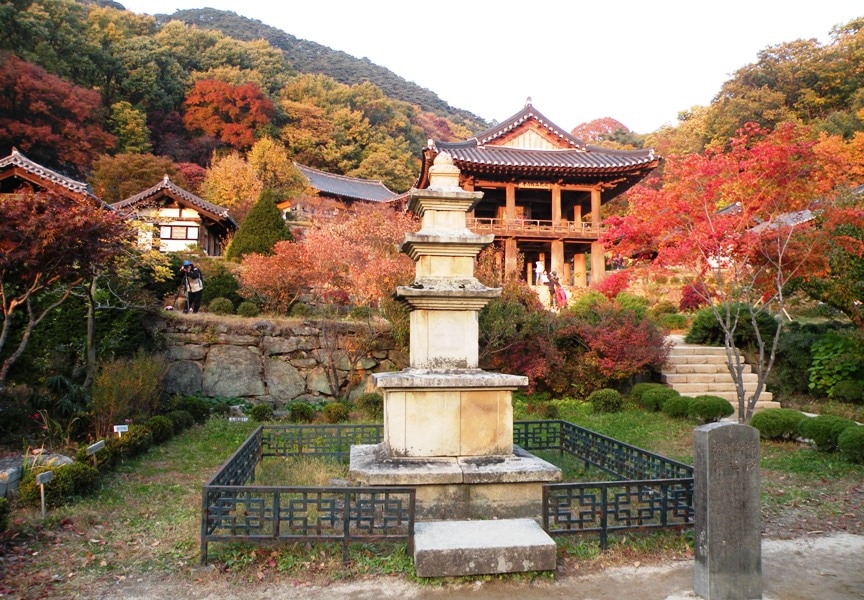
There is no pagoda in the main courtyard in front of
the Main Hall, as that space is too narrow (although
Instead, there are twin small Unified Shilla Dynasty
stone pagodas in the lowest courtyard; the eastern one
(right) has a limited view behind it, so is rarely shot by
visitors, but the western one has a great view of the
temple's principal buildings behind it and so is very
frequently photographed, as in the several examples here.
the Main Hall, as that space is too narrow (although
Instead, there are twin small Unified Shilla Dynasty
stone pagodas in the lowest courtyard; the eastern one
(right) has a limited view behind it, so is rarely shot by
visitors, but the western one has a great view of the
temple's principal buildings behind it and so is very
frequently photographed, as in the several examples here.